|
The National Highway Institute (NHI) is proud to announce the launch of a new five-course series: Constructing Quality PCC Pavement Preservation Treatments!
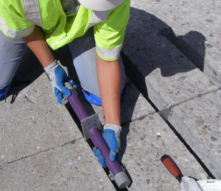
Pavement preservation is a proactive approach to protecting and maintaining existing pavements. This exciting, new web-based training (WBT) focuses on various preservation techniques for extending the life of portland cement concrete (PCC).
Whether you work for a transportation agency (Federal, State, or local) or a contractor, you'll learn successful practices and techniques for PCC preservation. The WBTs include short lessons that focus on "how-to" techniques and tips targeted at construction and maintenance workers, technicians, inspectors, and managers.
You'll find checklists, visual aids and graphics, and videos that help you apply what you learned right away.
Below is the curriculum that will enhance your knowledge of pavement preservation.
|
COURSE OVERVIEWS
Full-depth repairs are used to restore local areas of slab damage that extend beyond the upper one-third of slab depth or originate from the bottom.
This WBT offers a comprehensive guide to successfully complete a full-depth renovation project, from planning and preparation to testing and quality assurance.
Partial-depth repairs are defined as the removal and replacement of small areas of deteriorated (or spalled) concrete pavement.
This important preservation technique can slow or eliminate the spread of spalling distresses that tend to occur under repeated thermal stresses, freezing and thawing, and traffic loading. When properly constructed, partial-depth patches are cost effective and can last 10 -15 years.
Diamond grinding and grooving are surface restoration procedures used to correct concrete pavement surface weaknesses. They are often used with other pavement preservation techniques (i.e., dowel bar retrofit, partial-depth repairs, full-depth repairs) as part of a comprehensive program, to address a specific pavement shortcoming.
Learn when, why, and how to use each technique. Explore the special equipment needed on these projects and learn how to properly use and care for the grinding and grooving tools.
Learn the full scope of tasks and considerations in performing DBR and cross-stitching operations.
DBR is the installation of dowel bars at existing transverse joints or cracks in order to effectively transfer wheel loads across slabs and reduce deflections. Cross-stitching is a preservation method designed for longitudinal joints that are in good condition but must be strongly tied together.
Sawed joints are sealed to prevent the intrusion of water, deicing chemicals, and incompressible material.
Discover why joint sealing is an important part of concrete pavement preservation; the options and best opportunities that are available; what materials are involved; and the sequential tasks required to properly perform joint sealing.
Register today to learn how to successfully utilize PCC pavement preservation techniques!
 Did you know that this WBT series is also available in Spanish (FHWA-NHI-134207S)? Select this Link for more information.
Please Note: You must complete the entire series to earn a certificate and credit for taking the course. If you are only interested in receiving credit for one or two of these trainings, NHI suggests registering only for the one(s) you need. Refer to the individual course numbers listed.
|