Innovation of the Month:
Community
Connections
Community connections tools
and strategies help transportation agencies work with community stakeholders to
identify gaps in transportation infrastructure and services and develop
solutions.
Analytical tools to identify and
assess the impacts of transportation infrastructure on communities include the
following:
-
PlanWorks,
a web-based resource from FHWA, supports collaborative decision making in
transportation project planning.
-
Geographic information system
technology helps agencies evaluate transportation infrastructure assets,
demographics, and community impacts such as access to services.
-
Bicycle
and pedestrian assessments help communities understand
obstacles and safety issues in the road, bicycle, and pedestrian
infrastructure.
Public involvement strategies
enable agencies to communicate with stakeholders about transportation issues
and get input on design plans.
- Tactics
such as community meetings, websites, and social media help agencies inform and
engage stakeholders.
- Advisory
groups allow community and business leaders to participate in developing
solutions.
-
Visualization
techniques such as maps, videos, and 3D renderings help project
teams convey challenges and solutions more clearly.
Watch the Every Day Counts (EDC)
round four summit session on community connections
approaches.
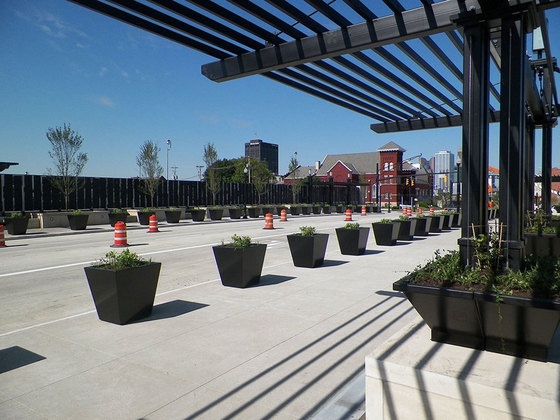 The Long Street Bridge project improved pedestrian passage over I-71 to downtown Columbus, Ohio. Photo courtesy Ohio DOT.
Colorado Interchange Project
Uses Design-Build
The Colorado Department of Transportation (CDOT) used
the design-build contracting
method to encourage flexibility on planning and construction scheduling and
accelerate delivery of the I-25/Cimarron Street interchange project in
Colorado Springs. The project, designed to enhance safety and operations,
included reconstruction of an interchange, new I-25 bridge structures, and
improved highway alignment. A new connector between 8th and Cimarron
Streets is expected to reduce traffic congestion at the intersection by 20
percent on weekdays and 40 percent on weekends. For information, contact David
Watt of CDOT.
EDC Innovations Featured in Central
Federal Lands Highway Division Projects
Central Federal Lands Highway Division (CFL) finished work on a 23.4-mile
pavement
preservation project in Rocky Mountain National Park in Colorado. The project involved applying a
microseal—a thin, durable coating that helps prevent future cracking—to the surface
of the main road and parking areas. The treatment is expected to extend the
life of the road, which provides access to numerous recreational areas throughout
the park. For information, contact James Kerrigan of CFL.
A transportation improvement project in the Bureau of Land Management’s (BLM) Red
Rock Canyon National Conservation Area in Clark County, NV, includes road
rehabilitation, two bridges, and parking area expansions. Using the concept of improving
collaboration and quality environmental documentation, BLM, CFL, and environmental consultants
collaborated on a streamlined review process in the design, National
Environmental Protection Act, and permitting portions of the project. The conservation
area’s core values, including protecting natural resources while providing an
excellent visitor experience, were preserved while maintaining an accelerated
project delivery schedule. The Safety Edge paving technique was used on 13 miles of roads
to bevel the pavement edge to reduce roadway departure
crashes. For information,
contact Matt
Ambroziak of CFL.
|