|
Innovation of the Month:
Data-Driven Safety Analysis
The
Every Day Counts innovation of the month for September is data-driven safety analysis, the
application of the latest generation of tools to analyze crash and roadway data
and better target highway safety investments.
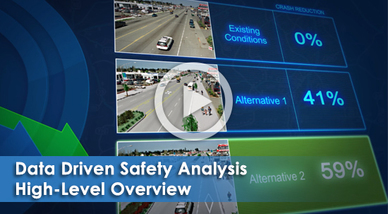 The Federal Highway Administration is promoting two
approaches to safety analysis: predictive to identify sites with the most
potential for safety improvement and systemic to scan an entire road network
for high-risk features associated with crashes. These strategies can be used
individually or in combination to integrate safety performance into all
transportation investment decisions.
Eight states have made DDSA a standard practice in their
project development processes, while 13 have institutionalized DDSA in their
safety management processes. Another 28 states and Washington, D.C., are
applying DDSA in project development and safety management.
Watch a video that explains DDSA
approaches and highlights state success stories.
Contact Jerry Roche of the FHWA
Office of Safety and John McFadden of the FHWA
Resource Center for information and technical assistance.
|
Learn About EDC-4 Innovations
Sign up for introductory webinars on the
11 innovations in the fourth round of EDC. First in
the series are Safe Transportation for Every Pedestrian (STEP) from 10:30 a.m.
to noon ET on September 7 and 3 to 4:30 p.m. ET on September 8 and Community
Connections from 1 to 2:30 p.m. ET on September 8.
Concrete Innovations Focus of Arkansas Conference
The Arkansas Concrete Pavement Conference featured
presentations by FHWA staff on concrete pavement innovations and two programs that
offer incentives for innovation deployment, Accelerated Innovation Deployment Demonstration
and State Transportation Innovation Council Incentive.
The more than 200 people who attended the August 16 conference in Little Rock
also had an opportunity to tour the FHWA Mobile Concrete Laboratory.
Traffic Flows on Colorado’s Third Diverging Diamond
Interchange
Colorado’s third diverging diamond interchange
is open to traffic. The new interchange, part of the I-25 and Fillmore Street
project in Colorado Springs, is designed to enhance safety and traffic flow and
increase traffic capacity. The project included installation of a pedestrian
walkway and bike paths. The Colorado Department of Transportation changed the original
single-point urban interchange design proposed for the project when it
recognized that a diverging diamond interchange could provide similar
operational benefits and be built for about $35 million less.
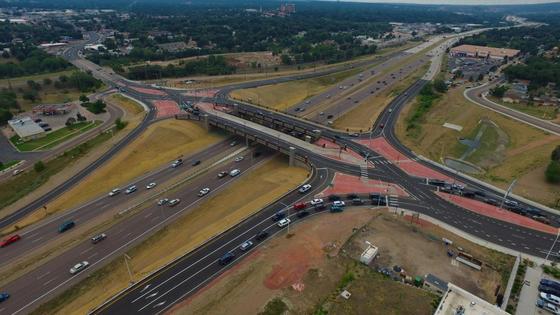 A new diverging diamond interchange in Colorado provides more efficient traffic flow.
Iowa First to Require Electronic Signatures on Contracts
The Iowa Department of Transportation is the first state highway
agency to require electronic signatures on all construction contracts. After
conducting a successful pilot project using digital signature technology, the
department began requiring electronic signatures on contracts in August.
Contractors also submit insurance, bond and other required documents
electronically. Adopting digital signatures on contracts is a major step in the
Iowa DOT’s effort to implement e-Construction for project administration.
Montana Project Uses e-Construction to Enhance Efficiency
FHWA Administrator Gregory Nadeau viewed the use
of e-Construction technology on
the Federal Lands Highway Pleasant Valley Road relocation
project near Kalispell, Montana. Nadeau used a tablet to review project plans
and observed a motor grader with dual global navigation satellite system
antennas at the job site. Global navigation satellite system technology allows
grading operations to be completed quickly and accurately.
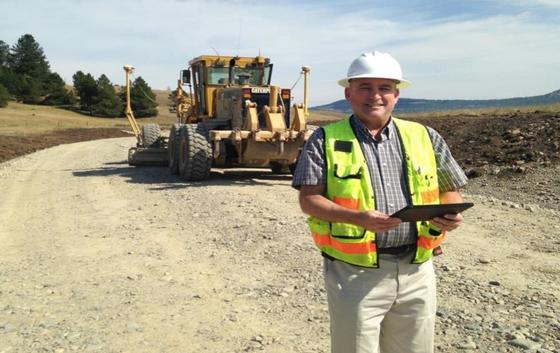 FHWA Administrator Gregory Nadeau views e-Construction in action on a Montana project.
Tennessee Holds Road Diet Peer Exchange
Transportation professionals from Alabama,
Arkansas, Indiana, Iowa, Mississippi, Missouri, Tennessee and Wisconsin met in
Nashville, Tennessee, on August 24 to 25 for a road diet peer exchange. The
event provided participants with an opportunity to discuss best practices and
exchange ideas on implementing road diets to improve safety
and relieve congestion on mixed-use streets. FHWA hosted the peer exchange.
|