|
Innovation of the Month:
3D Engineered Models: Schedule, Cost and
Post-Construction
Success with using 3D
engineered models to enhance design and construction processes is
encouraging the transportation community to apply these models to other phases
of the project delivery cycle.
Expanding 3D data use offers several benefits:
- Improved
project management—Incorporating schedule, or 4D, information into 3D models
helps stakeholders visualize construction over the life of a project and
identify potential conflicts.
- More
accurate cash-flow estimates—Adding cost, or 5D, information to models enables
stakeholders to evaluate costs and model cash flow for each construction phase.
- A
living record throughout the project life cycle—Using 3D models in
post-construction and program-level applications enables agencies to create
asset inventories and as-built records for maintenance, management and
planning. An example is an inventory of subsurface features, such as utilities.
See the 3D Engineered Models website for
information on workshops, case studies, technical briefs and specifications.
Contact Chris
Schneider of the Federal Highway Administration’s Office of Infrastructure or David
Unkefer of FHWA’s Resource Center for information or technical assistance.
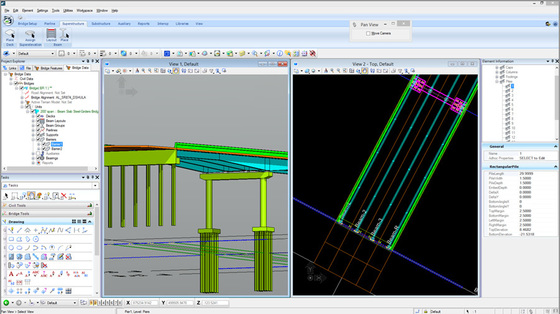 Image Credit: Bentley Systems Inc.
Alaska Ready for Construction Manager/General
Contractor Project
A construction
manager/general contractor workshop April 27 and 28 in Fairbanks helped
the Alaska Department of Transportation and Public Facilities prepare for its next
project using the delivery method. The project will replace a bridge
on the Parks Highway through Denali National Park and provide safe paths for pedestrians and
bicyclists. The workshop enabled participants to learn about the benefits of
early contractor involvement in projects.
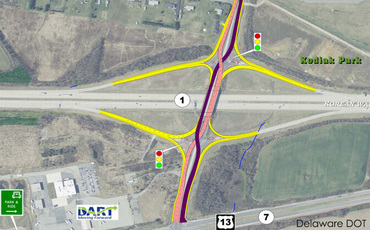
Delaware Breaks Ground on First Diverging
Diamond Interchange
Maine Offers Local Project Administration
Training
About 50 municipal
officials and private sector transportation professionals participated in the
Maine Department of Transportation’s local project administration certification
course on April 28. Course participation is required for those involved in administering
federally funded local transportation projects in the state.
Participants learned about the project development process from start to
finish, including consultant selection, project design, environmental and
right-of-way processes, utility coordination and construction.
Michigan Hosts Interactive Highway Safety Design
Model Workshop
The Michigan
Department of Transportation and Local Technical Assistance Program Center
hosted a workshop on the Interactive
Highway Safety Design Model, a suite of software analysis tools that
support data-driven
safety analysis. Michigan DOT, local agency and FHWA staff attended the workshop April
28 and 29 in Lansing. The Michigan DOT held the workshop to spur the use of predictive
safety modeling in the state.
New Hampshire Updates Programmatic Agreement
The New Hampshire
Department of Transportation and FHWA signed an updated programmatic
agreement for categorical exclusion approvals on May 5. The New Hampshire DOT has
had an agreement in place for 16 years that allows it to determine whether
projects qualify for categorical exclusions, actions that don’t involve
significant environmental impacts. The updated agreement satisfies requirements
of the Moving Ahead for Progress in the 21st Century Act, which
expands and standardizes allowable categorical exclusions.
Rhode
Island Accelerates Bridge Project to Reduce Traffic Impact
The Rhode Island
Department of Transportation is using accelerated bridge construction techniques to
replace the East
Shore Expressway and McCormick Quarry bridges in East Providence.
The agency will cut construction time and traffic delays on the project by
building geosynthetic reinforced soil abutments and
installing new superstructures with self-propelled modular transporters. The bridges—a vital
link in Rhode Island's highway system—are expected to be completed a year
earlier than possible using conventional construction methods.
Peer
Exchanges to Feature Safety Analysis
More than 150
participants from 27 state transportation departments are expected to attend
three peer exchanges on data-driven
safety analysis. The peer exchanges are set for May 24 to 26 in New Orleans, Louisiana;
June 21 and 22 in Sterling, Virginia; and July 13 and 14 in Kansas City, Missouri.
The agenda will cover applying crash prediction methods in the American
Association of State Highway and Transportation Officials Highway Safety Manual and incorporating
quantitative safety performance into project development processes and
procedures.
|