|
Last month we celebrated the 95th anniversary of the Women’s Bureau. In 1920, the law creating the Bureau gave it the duty to “formulate standards and policies which shall promote the welfare of wage-earning women, improve their working conditions, increase their efficiency, and advance their opportunities for profitable employment.” Click here to read the blog by Women’s Bureau Social Science Advisor Jane Walstedt.
 We are thrilled to be making available $1.25 million in
grant funds to support research and analysis on the development and
implementation of paid leave programs at the non-Federal level.
Up to 10 grants of up to $250,000 each will be awarded.
Eligible applicants include government entities from states, U.S. territories
and possessions, counties and cities with at least 100,000 residents, and
federally recognized Indian/Native American tribes with a population of at
least 50,000. Click here to view Frequently Asked Questions about the grants. This funding opportunity builds upon a 2014
grant program that awarded a total of $500,000 to support paid leave
feasibility studies in three states and the District of Columbia.
Last month also marked the
one-year anniversary of the White House Summit on Working Families, which was a
catalyst for a national conversation on paid leave and related issues including
our Lead on Leave tour and paid leave grants program.
|
 Asian American/Pacific
Islander (AAPI) workers have had more favorable economic outcomes than workers
in any other racial group. There were about 7.8 million Asian American (AA)
women and 442,000 Native Hawaiian and other Pacific Islander (PI) women 16 years
of age and over in the U.S. in 2013. Of those, 4.6 million AA women and 283,000
PI women were in the civilian labor force.
The aggregate statistics, while positive, tell an incomplete story
of the economic status within the AAPI community. There is a great deal of
variation and disparity between AA women and PI women, as well as among women
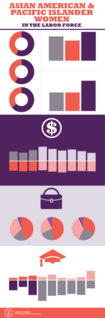
in different Asian communities. The data in our latest infographic highlight these differences, and
compares them to white non-Hispanic women as a reference group in the areas of
labor force participation, poverty rate, unemployment rate, earnings/wage gap,
occupations and educational attainment. In some cases – to get a more complete
picture – we further divided Asian Americans in to the following detailed
groups: Asian Indian, Chinese, Filipina, Japanese, Korean, and Vietnamese
(other groups have small estimates and are not included). This analysis unveils
a stark contrast between groups within the AAPI community.
|
On the Road to Achieving Equal Pay
Women’s Bureau Deputy Director Pronita Gupta participated on a panel for the YWCA’s “Closing the Gender Pay Gap” workshop on June 5. Following an address delivered by Lisa Maatz, AAUW’s Vice President for Government Relations, Gupta spoke about the importance of women’s economic security and the work the Women’s Bureau is doing to address pay secrecy and occupational segregation as well as create pathways to higher paying jobs.
 Expanding Access to non-traditional occupations
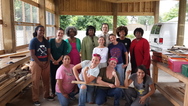
The Women’s Bureau participated in events aimed at expanding access to women in non-traditional occupations.
-
The Women’s Bureau and Middlesex Community College co-hosted a “Women in the Workforce” roundtable discussion in Lowell, Massachusetts on June 8th. Securing equal pay, increasing entry into higher paying non-traditional occupations, and expanding employment opportunities for women veterans led the list.
-
The Women’s Bureau, the Office of Federal Contract Compliance Programs, and the Equal Employment Opportunity Commission participated in a roundtable discussion with the Moore Community House, Women in Construction (WIC) program June 12 in Biloxi, Mississippi.
- Women’s Bureau Director Latifa Lyles facilitated a workshop at the National Fund for Workforce Solutions annual meeting in Baltimore, MD on June 19th. The workshop, entitled “Preparing Women for Careers: Leveraging Federal Highway Funds” brought together U.S. Department of Transportation Deputy Assistant Secretary Bryna Helfer and Institute for Women’s Policy Research Study Director Ariane Hegewish.
Additional
resources:
2014 Non-Traditional Occupation Data
ApprenticeshipUSA
|
|
|
U.S. Department of Labor | Frances Perkins Building, 200 Constitution Ave., NW, Washington, DC 20210
www.dol.gov | Telephone: 1-800-827-5335 | TTY | Contact Us
|