In the News:
NLCD 2023 Project Kick-Off
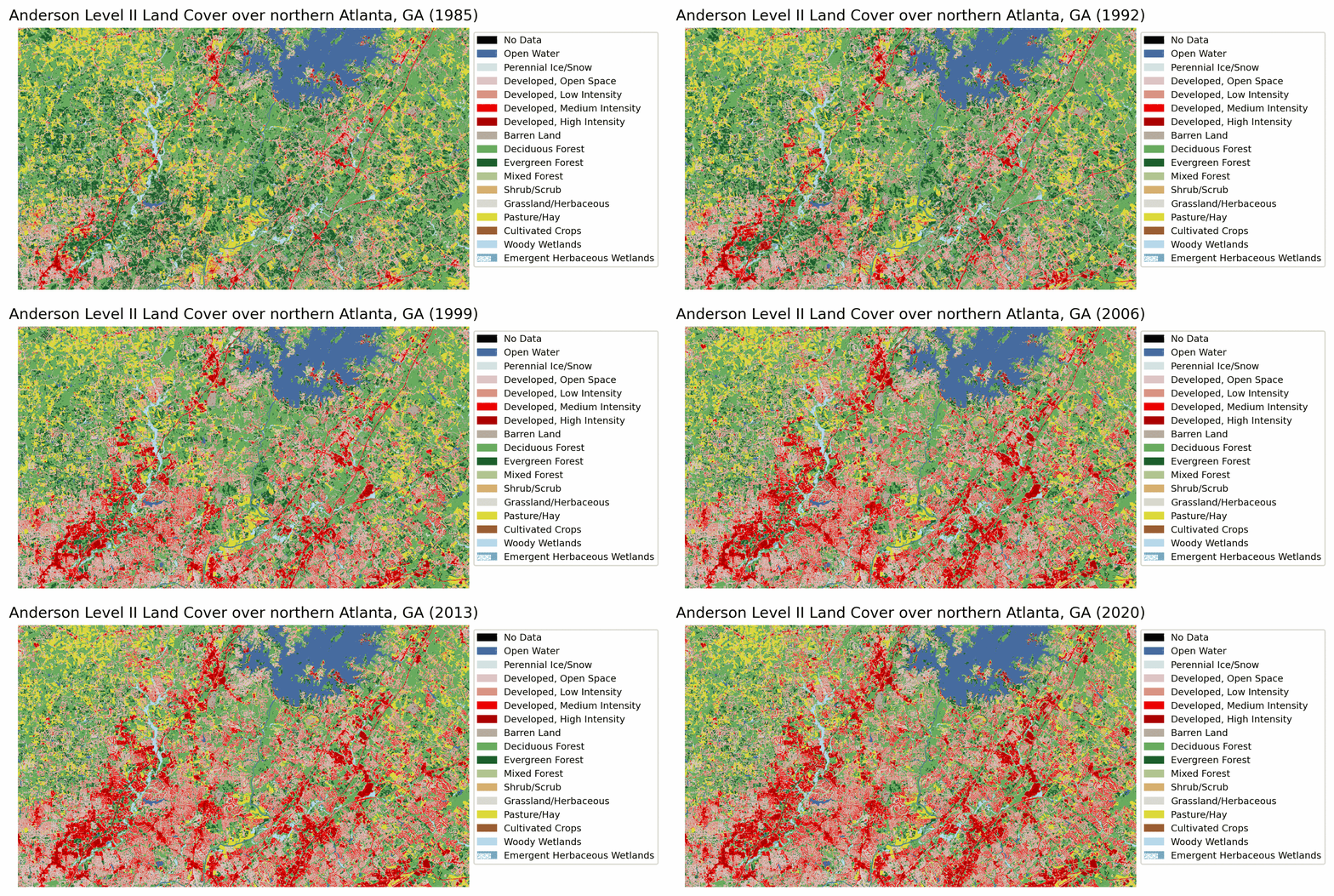
November 2023 – Two of USGS’s premier land cover programs—National Land Cover Database (NLCD) and Land Cover Monitoring Assessment and Projection (LCMAP)—have joined forces to advance the science of land cover. Building on a 30-year legacy of land cover mapping, research is well underway to produce the next generation of USGS national land cover products.
Next generation land cover will be developed through the use of high- performance computing (HPC) and cloud processing environments, and leverage advancements in artificial intelligence and machine learning (AI/ML) techniques. These advancements will provide the USGS with leading-edge capabilities for land cover monitoring, assessment, and projection. Users can expect Anderson Level II type land cover classes like those used in the current NLCD products across the conterminous United States at 30-meter spatial resolution and, like LCMAP, the program will make use of the lengthy Landsat archive to provide products on an annual time step for the years 1985-2023. Look for this data release in the fall of 2024.
Read More
NLCD 2021 Release Reminder
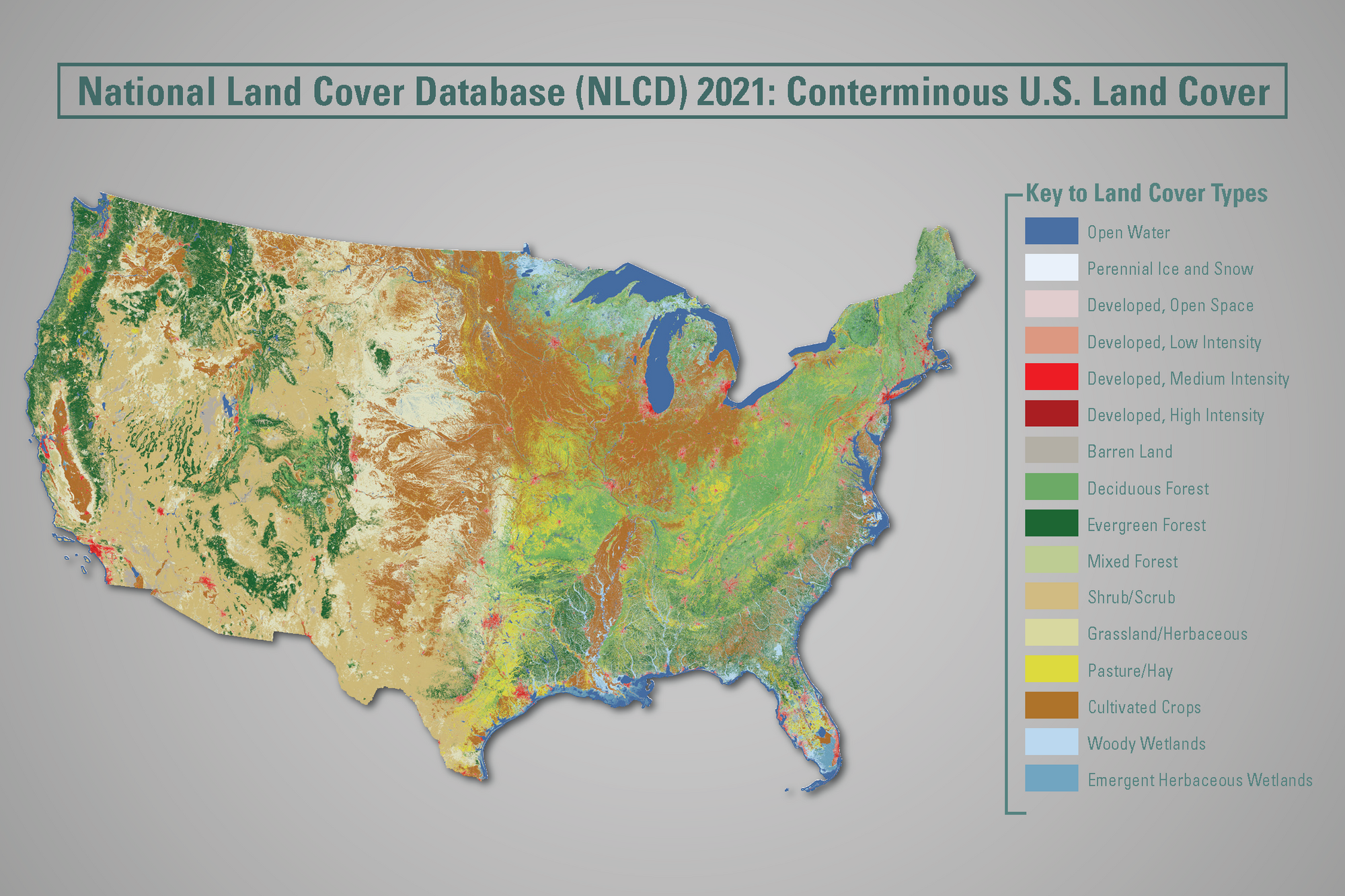
July 2023 — The U.S. Geological Survey (USGS), in association with the Multi-Resolution Land Characteristics (MRLC) Consortium, was pleased to announce the completion and release of the latest epoch of the National Land Cover Database (NLCD) for the conterminous U.S.—NLCD 2021 this past summer.
With the latest release, NLCD now includes map products characterizing land cover and land cover change across nine epochs from 2001 to 2021 (2001, 2004, 2006, 2008, 2011, 2013, 2016, 2019, and 2021). The 2021 suite of NLCD products follow the same protocols and procedures of the previously released NLCD epochs (2001-2019), are directly comparable to the 2019 release across the full time series and are suitable for multi-temporal analysis. Science products and the change index, however, will need to be reacquired for the additional 2021 change information.
In addition, CONUS NLCD 2021 Tree Canopy Cover (TCC) data was released and are available at the same interval as the NLCD land cover data starting in 2011 (2011, 2013, 2016, 2019, 2021). These tree canopy products have values representing the percentage of canopy cover for each 30-meter pixel in the conterminous U.S.
NLCD 2021 will mark the last installment in traditional NLCD land cover mapping methodologies. Land cover data users can look forward to the next generation of USGS land cover, NLCD 2023, in Fall 2024.
Read More
EVA Tool Update
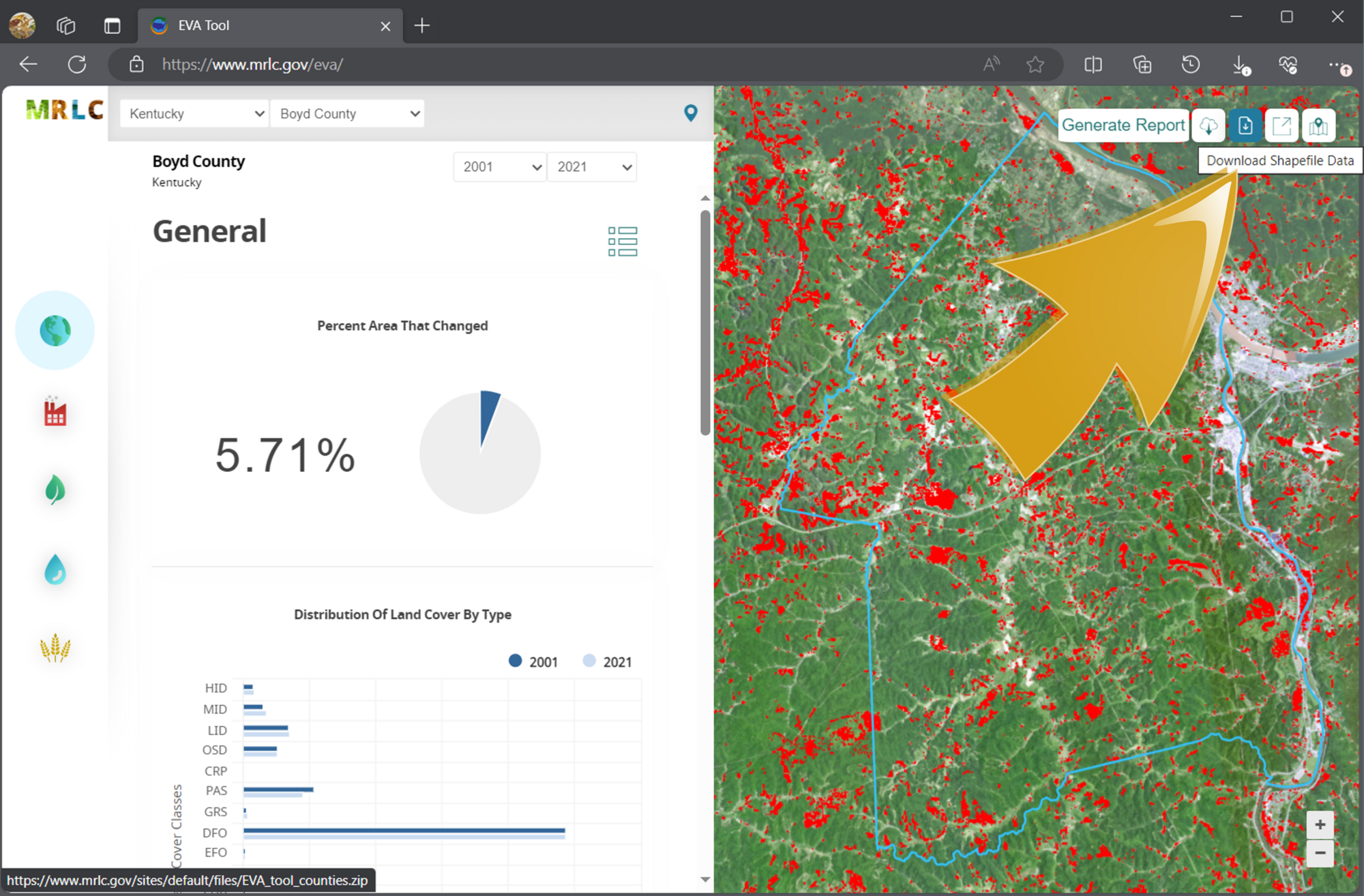
December 2023 — Did you see it yet? The EVA Tool has a brand-new button to provide users quick access and download of the U.S. counties shapefile that drives the EVA zonal statistical calculations of land cover. EVA has also been updated with latest NLCD 2021 statistics. And as always, with EVA you can conveniently view land cover statistics by county, generate land cover summary reports, and link directly to NLCD data. www.mrlc.gov/eva
LCMAP Collection 1.3 Reference and Validation is Released
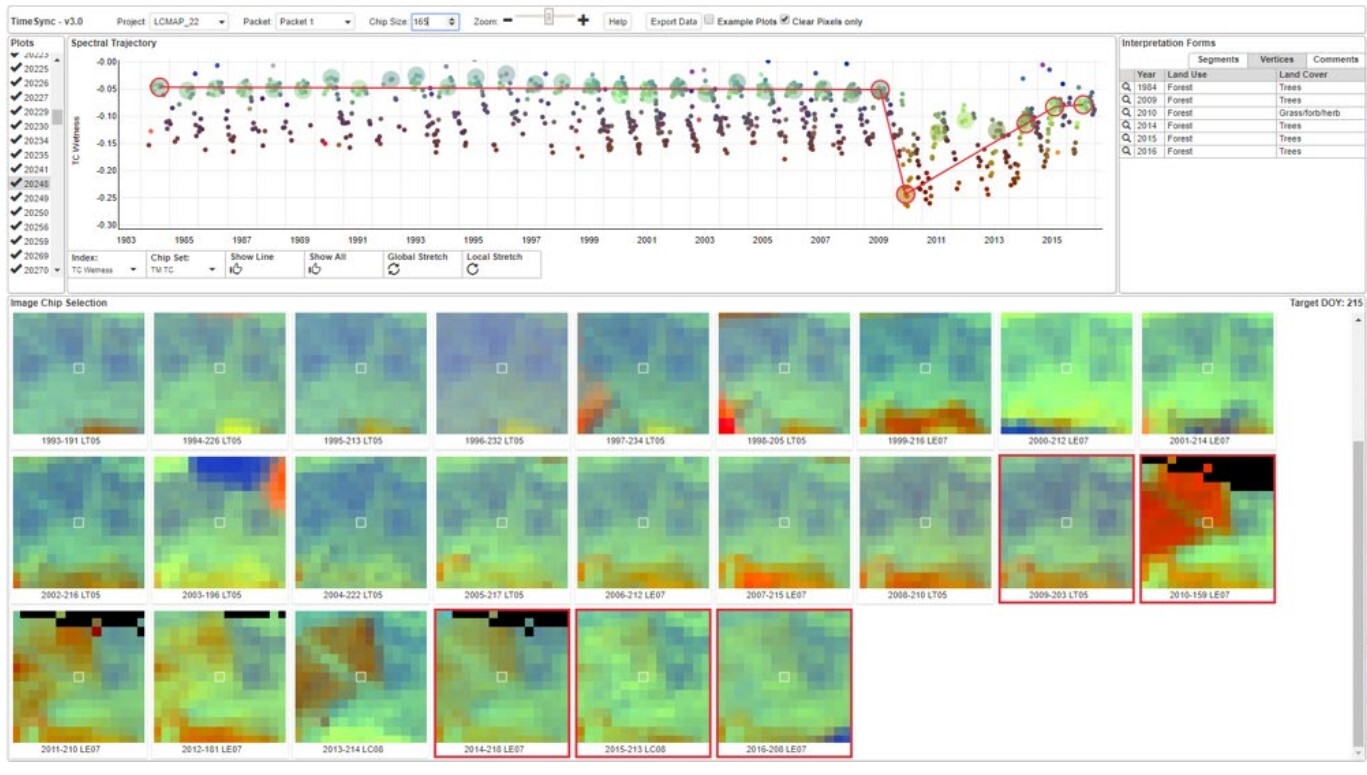
November 2023 — Reference Data and Validation Data and Tables for LCMAP Collection 1.3 are out! An updated dataset of 27,000 pixel locations across the United States has been meticulously collected by expert image interpreters and is now available on ScienceBase. The unique Reference Dataset offered by LCMAP now boasts land cover characterization from 1984 – 2021, providing over 30 years of annual interpretations at 27,000 pixel locations. This dataset is used to validate the accuracy of land cover and land cover change. Validation analysis compared the reference dataset labels with annual LCMAP land cover map attributes using cross tabulation. Results are reported as confusion matrices and summary tables. Validation Data and Tables can also be found on ScienceBase. Overall CONUS land cover agreement for LCMAP Collection 1.3 is 82.5%. 
AGU 2023
December 2023 — The American Geophysical Union (AGU) committed to the theme, “Wide. Open. Science.” by providing a forum for Earth and Space science collaboration, discussion and display at their annual meeting. USGS Land Cover was well represented, covering the following topics:
SSEBop Evapotranspiration Estimates using Synthetic Landsat Data derived from the Continuous Change Detection and Classification Algorithm Mikael Hiestand, Heather Tollerud, Chris Funk and Gabriel Senay https://agu.confex.com/agu/fm23/meetingapp.cgi/Paper/1349264
Assessment of Tree Cover Loss Associated with Model Breaks in LCMAP Data Products Francis Dwomoh and Roger Auch https://agu.confex.com/agu/fm23/meetingapp.cgi/Paper/1337646
Applying Machine Learning Based Training Data Method at Anderson Level II Legend Congcong Li and Suming Jin https://agu.confex.com/agu/fm23/meetingapp.cgi/Paper/1393953
Annual Land Cover Change and Validation across the Conterminous United States George Xian, Jesslyn Brown and Danika Wellington https://agu.confex.com/agu/fm23/meetingapp.cgi/Paper/1350605
Remote Sensing as the Basis for Interdisciplinary Modeling of Historical and Forecast Land Use Terry Sohl, Benjamin M. Sleeter, Jordan Dornbierer, Steve Wika, Greg Rouze and Bruce Worstell https://agu.confex.com/agu/fm23/meetingapp.cgi/Paper/1274509
New Publication:
Fifth National Climate Assessment Report
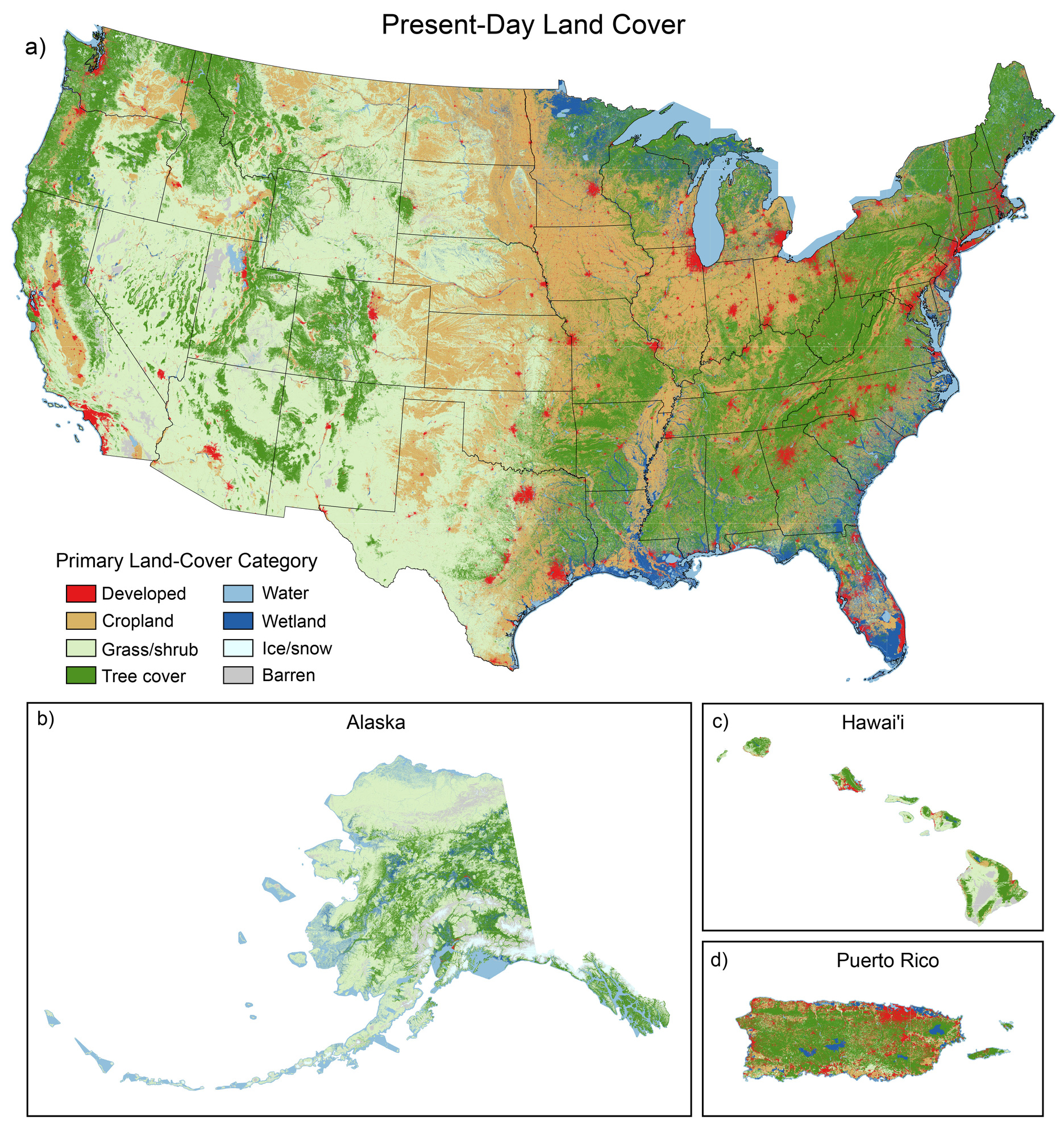
December 2023 — LCMAP and NLCD map products are used to illustrate and describe patterns of land cover and land cover conversion in Chapter 6: Land Cover and Land-Use Change in the Fifth National Climate Assessment, a report delivered to Congress and the President by the U.S. Global Change Research Program (USGCRP). This report provides the scientific foundation to support informed decision-making through documentation of observed and projected risks, vulnerabilities, and impacts associated with climate change across the U.S.
Read More
Upcoming Activities:
RCMAP 1985-2023 Time-series
December 2023 — Rangeland ecosystems in the western United States are vulnerable to climate change, fire, and anthropogenic disturbances, yet available geospatial data for assessing trends in vegetation condition or fire risk, for example, may not be sufficient to inform management practices. To address this need, scientists from the USGS and BLM developed the Rangeland Condition Monitoring Assessment and Projection (RCMAP) project. RCMAP provides robust, long-term, and floristically detailed maps of vegetation cover across western North America using Landsat imagery and machine learning from 1985-2023 at yearly time-steps. Data critical to advancing science in the BLM and assessing Landscape Health standards.
The RCMAP product suite consists of ten fractional components: annual herbaceous, bare ground, herbaceous, litter, non-sagebrush shrub, perennial herbaceous, sagebrush, shrub, tree, and shrub height in addition to the temporal trends of each component. Several enhancements were made to the RCMAP process relative to prior generations. First, we revised the high-resolution training using an improved neural net classifier and modelling approach. We further improved our training database by incorporating Landscape Data Commons and additional BLM field data. Together, these changes resulted in a 45% increase to the training data footprint. Next, we improved our Landsat compositing approach to better capture the range of conditions from across each year and through time. These composites are based on Collection 2 Landsat data with enhanced geolocation accuracy and dynamic range. Composites with improved dynamic range and representation of peak greenness (which tends to be short duration in rangelands) lead to better discrimination among components, for example between shrubs and herbaceous cover. Finally, we include the Canadian portion of the sagebrush biome, and a new component, shrub height. Product validation against independent field data reveals a 5-10% increase in accuracy over the previous generation of products.
Land managers and scientists can use annual fractional cover maps to monitor changes to vegetation composition, evaluate past management practices, target future improvements, determine locations of critical wildlife habitat, assess effects of climate change and interannual variation, and appraise landscape health and fragmentation.
Data will be available for download and visualization at www.mrlc.gov in January 2024. 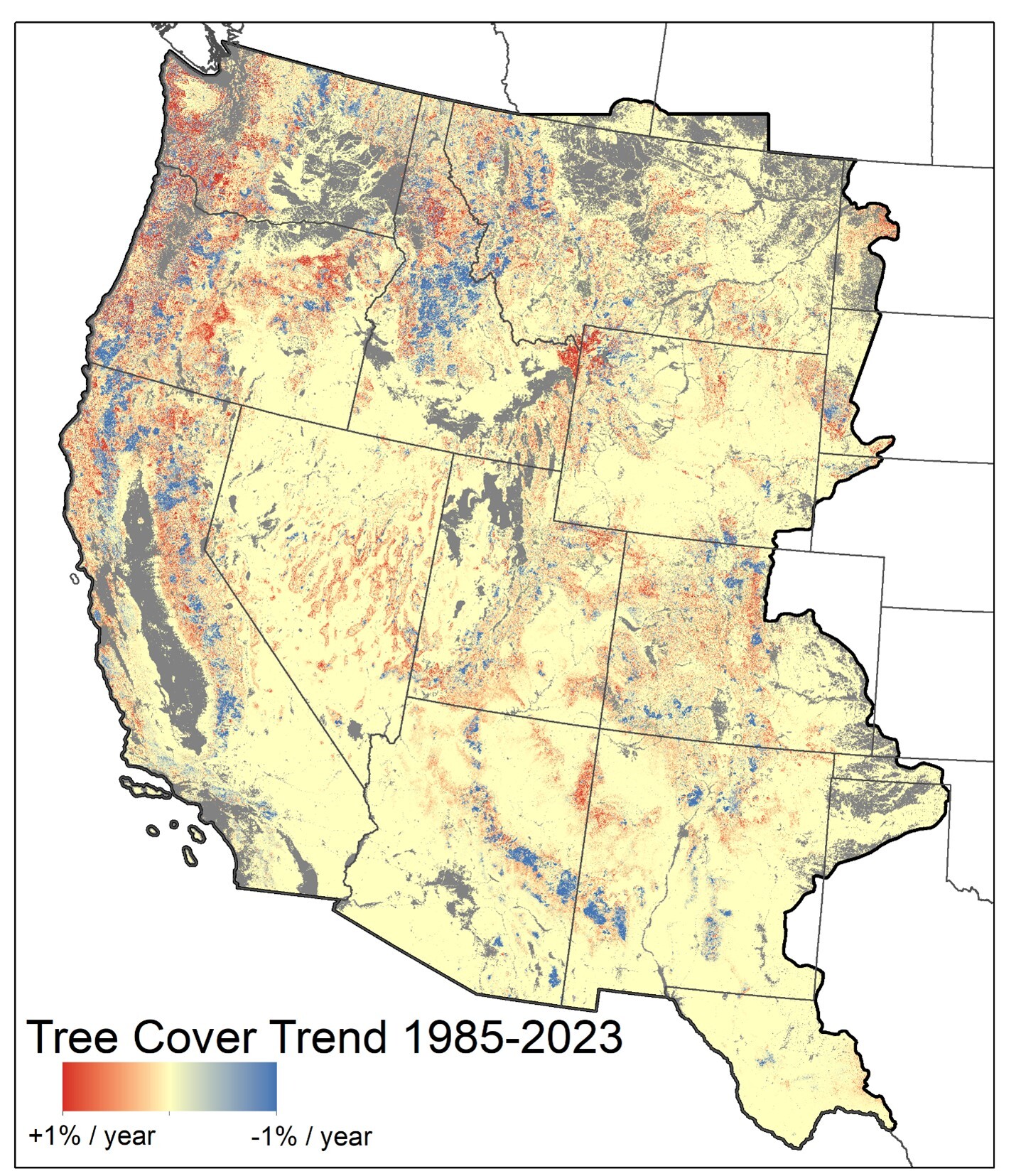
NLCD Accuracy Assessment is on its way!
December 2023 —NLCD products are widely used in climate modeling, hydrology, land management and ecosystem planning, plus a myriad of other areas including as the basis for other land cover mapping activities. As such a cornerstone dataset, it is essential to provide reliable metrics that support informed use of the data by quantifying the accuracy of the data products. With each new NLCD product suite delivered, a team of NLCD scientists performs statistically rigorous accuracy assessments that compare land cover maps with reference data labels collected from high-resolution imagery. Look for the NLCD 2021 accuracy assessment to be available later in 2024. In the meantime, check out other accuracy assessment publications by visiting www.mrlc.gov/publications then typing, “accuracy” in the search box.
Be sure to follow USGS Land Cover on Twitter, Facebook, and Instagram for more information on upcoming data, tools, services, and publications. Know someone who might be interested in the USGS’s next generation of land cover products? Forward this email and let them know they can subscribe through this link.
Thanks for being a subscriber!
|