In the News:
NLCD 2021 Tree Canopy Cover Product Release
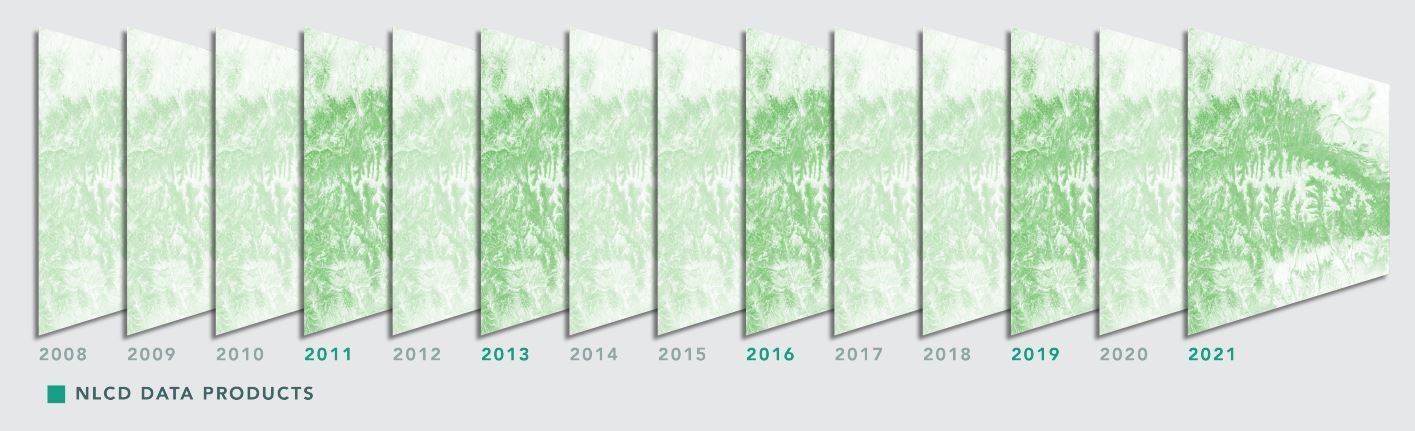
June 2023 – The United States Department of Agriculture (USDA) Forest Service, in collaboration with the Multi-Resolution Landscape Consortium (MRLC), is pleased to announce the release of the CONUS NLCD 2021 Tree Canopy Cover data plus a derivative Science TCC dataset. With this release, the NLCD TCC data is available at the same interval as the NLCD land cover data starting from 2011 (2011, 2013, 2016, 2019, 2021). The data is produced within a time-series framework, so change is now inherent in the annual time steps.
NLCD TCC and Science TCC data sets for coastal Alaska, Hawaii, Puerto Rico and American Virgin Islands will be available in the summer of 2023.
Read More
The USGS is Excited to Announce the Development of the Next Generation of Land Cover and Change Products.
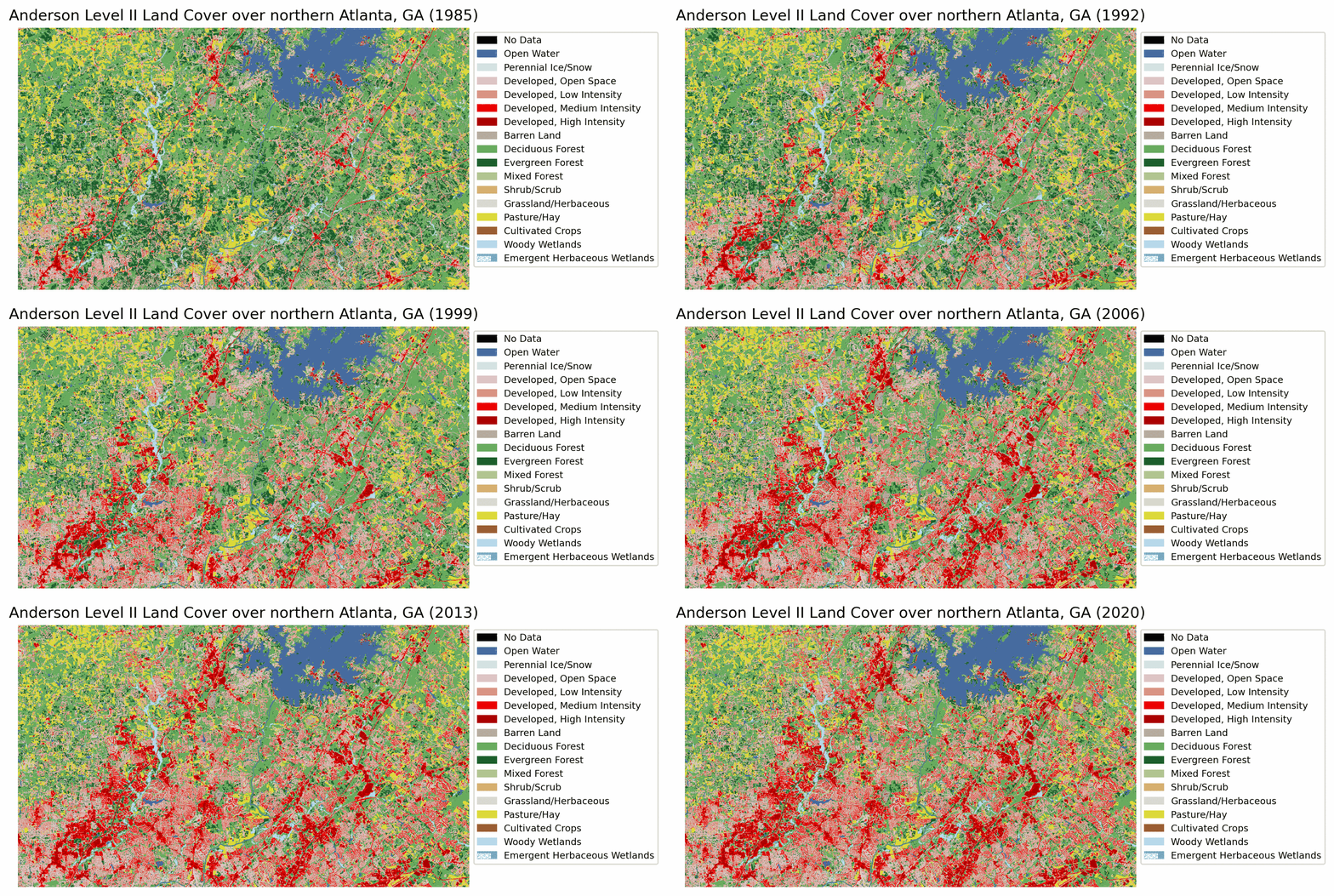
April 2023 — Research is well underway to produce the next generation of USGS land cover products with moderate thematic detail at low latency and annual frequency. These products will provide USGS with leading-edge capabilities for land cover monitoring, assessments, and projections.
In the coming months, the USGS in collaboration with the MRLC, will publish a 2021 Conterminous United States (CONUS) land cover suite (NLCD 2021). Later in 2023, we will release the CONUS Reference Data product updated through 2021, followed by a validation assessment of the Collection 1.3 LCMAP CONUS Science Products. After Collection 1.3, no further production of LCMAP Science Products will occur as the teams focus on publishing the next generation of annual NLCD-like landcover products.
Read More
CEC Releases New Digital Land Cover/Land Use Map of North America, Most Accurate Available at This Scale
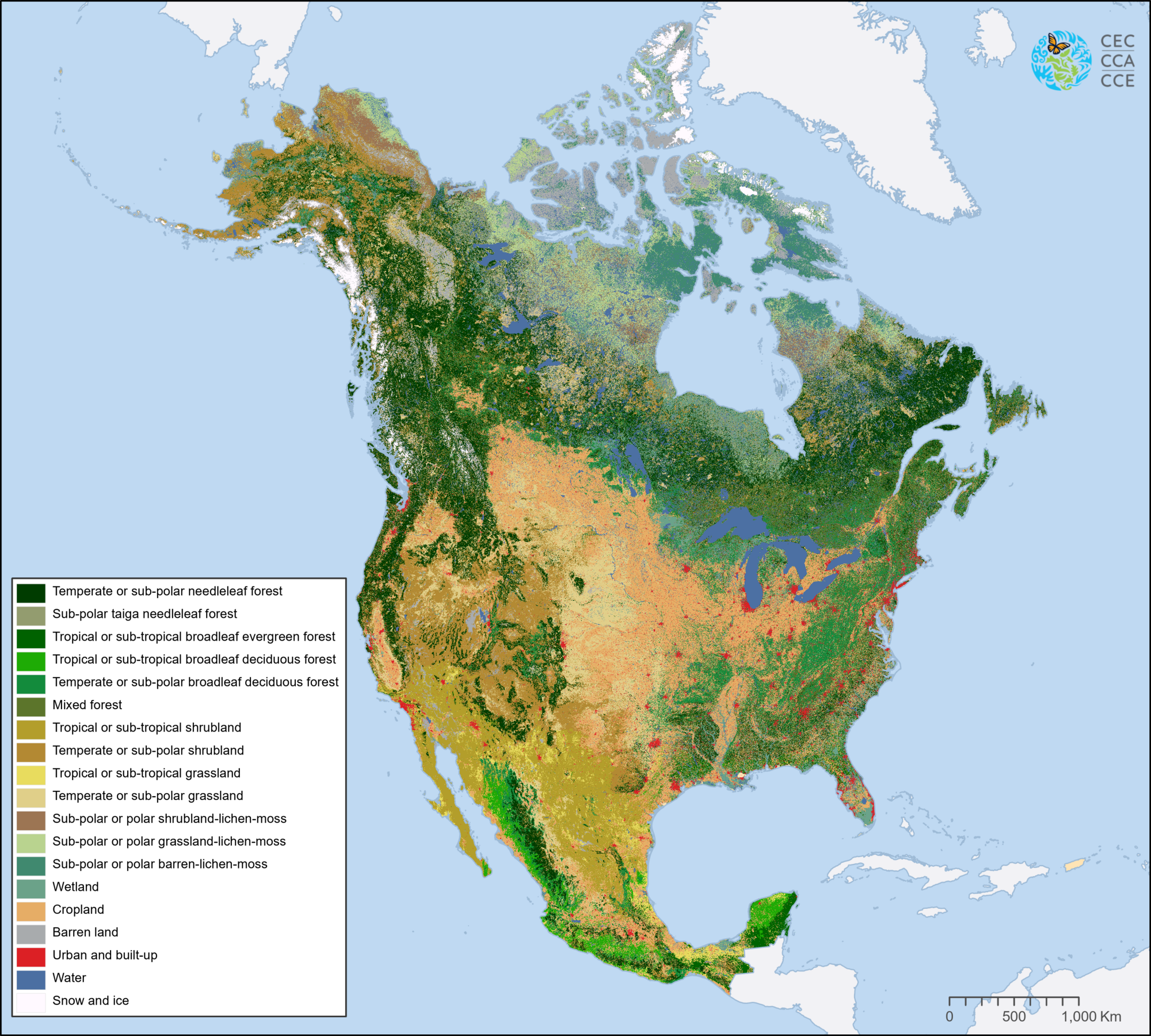
March 2023 — The Commission for Environmental Cooperation (CEC) is pleased to release the latest trinational digital land cover map of North America, under the North American Land Change Monitoring System (NALCMS), a collaboration with the Governments of Canada, Mexico and the United States and their respective mapping agencies. This land cover map is the most accurate map available at this scale and is publicly available through the North American Environmental Atlas. NLCD provided the U.S. portion of this map!
Read More
Tools Help Scientists Wrangle LCMAP Data and More.
January 2023 — The USGS Earth Resources Observation and Science (EROS) Center archive contains 50 years—and counting—of Earth observations in Landsat data. It’s no surprise, then, that one key activity among EROS scientists became characterizing land cover over the United States. They are also taking steps to make the data more accessible than ever for researchers.
Read More
A New E-Learning Resource is Available:
LCMAP and NLCD Science Product Analysis Workflow.
Workflows act as practical guides to the details and complexity of LCMAP and NLCD science products. They provide direction on how to approach land cover analyses by setting up use case examples and demonstrating how to tackle them in automated, Python-based Jupyter Notebooks. Each workflow is transportable, meaning you can apply them to your own Area of Interest (AOI) for your desired time period.
The fourth science product analysis workflow, “Comparing NLCD and LCMAP Primary Land Cover with Morphological Open Analysis,” is available! This latest workflow uses an image morphology technique known as a “morphological open” to remove narrow linear features in the “Developed” class from both products to analyze other occurrences of disagreement. Using an example in the Delaware River Basin, it demonstrates how to directly access the products, crosswalk the land cover classifications, calculate confusion matrices, and more.
Check out our Workflow Webpage or visit the Gitlab Repository to get started.
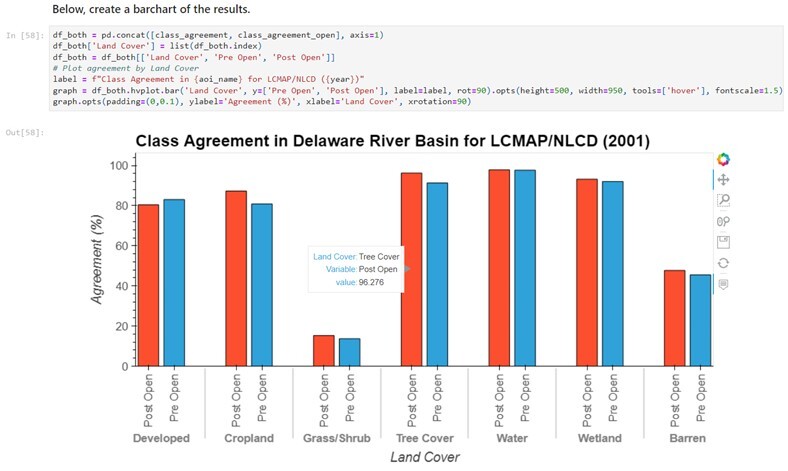
Figure 1. Example workflow results showing class agreement for each LCMAP primary landcover class both before (blue bars) and after (red bars) the morphological open technique was applied.
New Publication:
Leaf On. Leaf Off. A New Strategy for Creating Clean and Comprehensive Landsat Composite Images.
USGS and partners have developed a new and straightforward strategy to composite Landsat images to produce imagery free of cloud and cloud shadows and ready for large operational applications. This median value compositing method produced the best results for seasonal composites (leaf-on, leaf-off, primary reference, and complementary reference) for a target year among 10 different compositing algorithms. And because even the best composite images can still have clouds, cloud shadows, and missing-value pixels, a method was developed to detect and replace these pixels. NLCD 2019 (released in July 2021) successfully implemented this strategy for the entire conterminous United States.
Jin S, Dewitz J, Danielson P, Granneman B, Costello C, Smith K, Zhu Z. National Land Cover Database 2019: A New Strategy for Creating Clean Leaf-On and Leaf-Off Landsat Composite Images. J. Remote Sens.2023;3:Article 0022. https://spj.science.org/doi/10.34133/remotesensing.0022
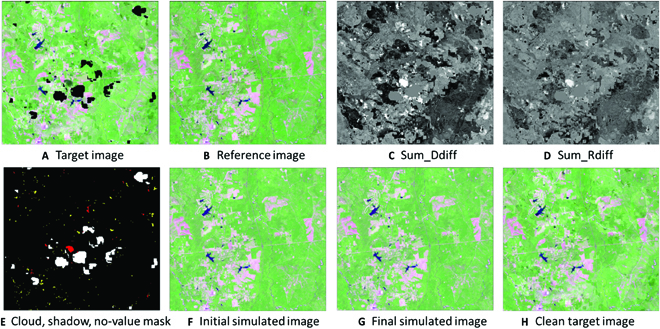
Figure 2. Imagery inputs and outputs (A to H) related to target image cloud and shadow detection and filling. All the Landsat images are displayed as RGB- SWIR2, NIR, and red. In (E), red indicates shadow, yellow indicates cloud, and white indicates no value mask.
Upcoming Activities:
NLCD 2021 Release Update
In July, NLCD will release a 2021 product that will include new science products, impervious surface, and land cover. Unlike past NLCD releases, the 2021 release will only add an additional year of data for 2021 and will not update data for the previous years. With this change, users will not need to re-acquire data from previous years for change analysis as required in the past.
Be sure to follow USGS Land Cover on Twitter, Facebook, and Instagram for more information on upcoming data, tools, services, and publications. Know someone who might be interested in the USGS’s next generation of land cover products? Forward this email and let them know they can subscribe through this link.
Thanks for being a subscriber!
|