Wind Energy Events
Renewable Energy Senior Manager Juan Torres participated on a panel at the recent DOE Office of Energy Efficiency and Renewable Energy (EERE) Lab Impact Summit to showcase Sandia Laboratories' partnership with Vestas at the Scaled Wind Farm Technology (SWiFT) facility in Lubbock, TX. SWiFT performs accredited research testing for both collaborative and highly proprietary projects with industrial, governmental, and academic partners. Two of the site's three Vestas V27 turbines are funded by EERE; the third was installed by Vestas R&D of Houston, TX. Vestas invested in the site to develop a technology accelerator to rapidly and cost-effectively facilitate marketplace innovation.
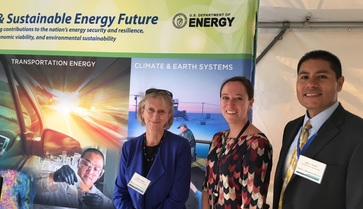 Renewable Systems & Energy Infrastructure Director Carol Adkins (left), Business Development Specialist Amanda Spinney (center), and Senior Manager Juan Torres (right) represent Sandia National Laboratories at the May 2016 EERE Lab Impact Summit.
Wind Energy NEWS
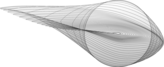 In the first phase of the DOE-funded additive manufactured blade mold demonstration project, Sandia National Laboratories has designed the wind blade that will be built with the new molds (drawing design shown here). One of the 3D-printed molds will be showcased at the American Wind Energy Association (AWEA) 2016 Windpower Conference and Exhibition, May 23-26 in New Orleans, LA. Using Sandia’s blade design, Oak Ridge National Laboratory is creating the molds by additive manufacturing.
|
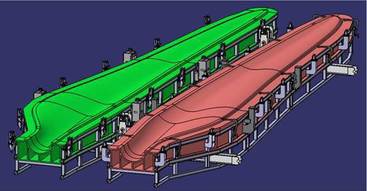 Drawing shows blade-mold fabrication assembly with sections joined together and attached to a support scaffold. Courtesy DOE WWPTO/AMO.
The 3-D printed molds will be transferred to
TPI Composites, Inc., where they will be finished and used to make four blades
based on Sandia’s design. Ultimately, the resulting 13-meter blade will be
flown on Sandia’s highly modified Vestas V27 turbines at Sandia’s subscale
Scaled Wind Farm Technology (SWiFT) facility in Lubbock, Texas. The first blade
of its kind, the National Rotor Testbed (NRT) is a scaled-down version of
the nation’s most common 1.5MW blade. This unique small-scale design will enable DOE and Sandia to analyze turbine-to-turbine
interactions cost effectively. EERE’s Wind Program and Advanced
Manufacturing Office (AMO) are collaborating on the funding and creation of the
blade molds; after the molds and resulting blades are complete, they will be
used to research wind facility efficiency at the SWiFT Facility. Project
success will enable significant cost savings for blade production as well as
agility to test and evaluate emerging designs that can improved efficiency and
reduce manufacturing costs. Contact: Josh Paquette
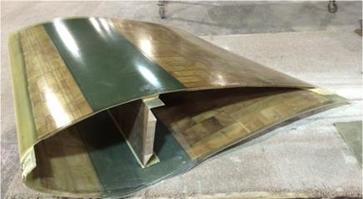 This demo blade section is ready to be trimmed to produce a clean edge of the laminate. [Photo courtesy of DOE WWPTO/AMO.]
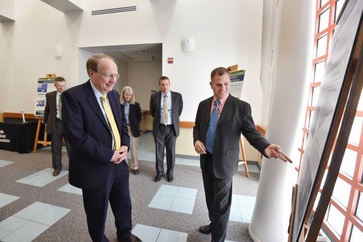 Wind Energy Technologies Department manager Dave Minster (right) describes Sandia’s wake imaging system, its reduced-scale wind turbines, the national rotor testbed, and 3-D printed blade molds.
A team from Sandia’s
Wind Energy Technologies department recently briefed Lieutenant General
Frank Klotz, the DOE Under Secretary for Nuclear Security and Administrator for
the NNSA (National Nuclear Security Administration). The briefing covered Sandia’s offshore wind
research and development, the leveraging of Sandia’s nuclear weapons
capabilities to address wind energy challenges, and a summary of present wind
energy R&D activities. Additional details regarding the NNSA Administrator’s visit
can be found in this Sandia
Lab News article. Of particular
interest to the NNSA chief was Sandia’s
recently announced work on a new 50 MW extreme-scale turbine concept,
funded by ARPA-E, the Advanced Research Projects Agency—Energy. Contact: D. Todd Griffith
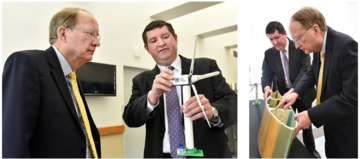 Using a small model, Todd Griffith explains the new 50MW concept to Gen. Frank Klotz (left); Klotz examines the features of a typical wind turbine blade structure in a cutaway model (right).
First Power for SWiFT Turbine Achieved during Recommissioning
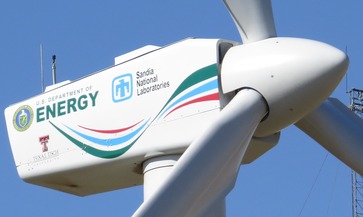 WTGa1 returns to power production at SWiFT
The SWiFT Facility reached an exciting milestone with the
return to power production of the WTGa1 turbine (aka DOE/SNL #1) as part of a
final series of commissioning tests. WTGa1 will complete all commissioning
before the end of May 2016 after satisfactorily operating in high wind
conditions. Turbines WTGa2 and WTGb1 will complete commissioning over the
summer months.
Completion of the WTGa1 milestone clears the way for the return
to normal experimental work at the facility, including the following:
- operation of the Wake Steering Experiment in
partnership with NREL (as discussed in detail, below)
-
detailed wake characterization in partnership
with Texas Tech University and Pentalum
- the flight of the National Rotor Testbed (NRT)
designed by Sandia National Labs
-
numerous industrial projects currently in
negotiation
All data and information from the SWiFT
experimental work will be made public so that industrial and academic partners
can calibrate their simulation tools. Contact: Jon White
Virtual LIDAR model helps researchers plan for the Wake Steering Experiment
at SWiFT
A team of researchers at Sandia National Laboratories (SNL)
and the National Renewable Energy Laboratory (NREL) are planning a critical
experiment at Sandia’s Scaled
Wind Farm Technology (SWiFT) Facility to investigate the use of wind
turbine yaw control to direct wakes, a promising approach to increase power
production in wind plants. During the multi-month field campaign, researchers
will collect data to improve both high-fidelity wind plant simulation software
and demonstrate novel control concepts. Industry could then develop advanced
controllers for deployment in commercial wind farms to increase power
production.
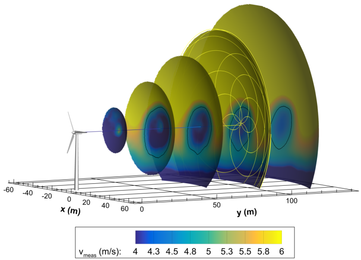 A screen capture from an animation depicting the SpinnerLidar scanning pattern at the SWiFT site overlaid on velocity profiles extracted from virtual lidar simulations
The animation depicted in the above screen capture was created from the virtual LIDAR (i.e., light detection and ranging) model and computational fluid dynamics (CFD) simulation to depict the LIDAR scanning pattern that will be used for the Wake
Steering Experiment. The video depicts one of the SWiFT turbines operating
in real time and scale while the DTU SpinnerLidar scans a rosette pattern at
five distances downstream (1 – 5 rotor diameters). The contour surfaces at each
scanning distance represent the average line-of-sight velocity interpolated
from the SpinnerLidar virtual model interrogation of the CFD simulation,
estimating the resolution of experimental data that can be expected. The black
irregular shape at each distance represents the output of an image-processing
method used to determine the center of the wake produced by the turbine. This
wake location in time and space will be a key data set to assess and improve
the wake steering control model, one of the primary objectives of the
experiment. All data from the upcoming experiment will be made public through
the DOE Atmosphere to electron (A2e) Data Archive Portal for other researchers
to analyze for their own models and tools. See more on the Wake Steering Experiment here. Contact: Brian Naughton
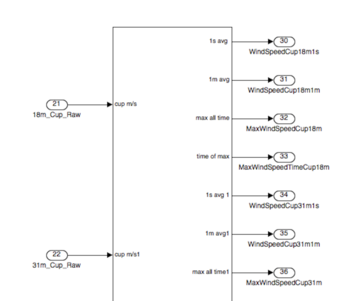 Simulink model converting analog signal to meters/second units for archiving
Sandia National Laboratories researchers have recently
completed a new software package to control data acquisition of the two
meteorological towers at the Scaled
Wind Farm Technology (SWiFT) facility. With this deployment, the real-time
operating system can now display live weather conditions for the operator. Future SWiFT experiments will rely on this
weather data to precisely control the turbine, avoiding the issues typically
associated with nacelle measurements which are corrupted by the presence of the
turbine. The software
package converts the voltage readings from the analog sensors (wind vane, cup
anemometers, humidity, and barometric pressure) to engineering units. These
values are then tabulated into the same log file as the digital sensors (sonic
anemometers) in 10-minute increments. Contact: Chris Kelly
Sandia vertical axis wind turbines (VAWTs) demonstrate
offshore advantages
Sandia National Laboratories has a long history of VAWT
research that is the foundation for today’s innovations. Wind researcher
Todd Griffith recently discussed vertical axis wind turbines (VAWTs) with Windpower
Engineering magazine, noting that there are still many advantages to VAWTs
over the conventional three-blade designs, especially when considering offshore
duty. Contact: Todd Griffith
Carter, C.,
Karlson, B., Martin, S., Westergaard, C., Continuous Reliability
Enhancement for Wind (CREW) Program Update, SAND2016-3844, April 2016.
Westergaard, C.,
Martin, S., Karlson, B., Carter, C., White, J., Wind Data, "Progress on SCADA Data Based
Wake Analysis," Presentation, Windpower Monthly, Houston, Texas.
(March 14, 2016). SAND 2016-2019.
Martin, S.,
Martin, S., Karlson, B., White, J., AWEA WINDPOWER 2015 Conference, "New
Wake Effects Identified Using SCADA Data Analysis and Visualization," Poster, American Wind Energy association, Orlando,
Florida. (May 19, 2015). SAND2015-2202D.
Westergaard, C.,
3rd Wind Energy Systems Engineering Workshop, "Towards
a more robust understanding of the uncertainty of wind farm reliability," Presentation, National Renewable Energy
Laboratory, Boulder, Colorado. (January 14, 2015). SAND2015-0052C.
Westergaard, C., White, J., Martin, S.,
IEA Wind TEM#78 on Field Test Instrumentation and Measurement Best Practices,
"Visualizing Wind Farm
Wake Losses using SCADA Data," Presentation, International Energy
Agency (IEA, wind), Lubbock, Texas. (October 7, 2014). SAND 2014-18489.
Water Power Events
During the last week of April, Sandia National Laboratories
participated in the National Hydropower
Association Waterpower Week in Washington, D.C., hosted by the Department
of Energy (DOE). Five Sandia water power engineers presented
posters at METS, the Marine Energy Technology Symposium, and generated interest from both academia
and industry in Sandia’s research and development efforts. Sandia Labs researchers presented a wide
range of work, including instrumentation of tidal turbines, advanced wave energy
control design and survival analysis of wave energy converters. Links to the
Sandia’s presentations are included in the Water Publications section, below.
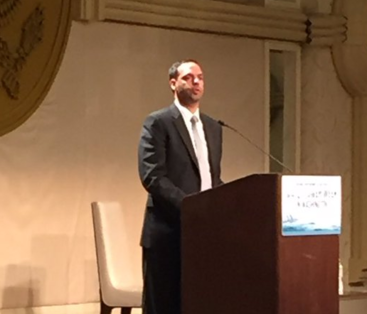 DOE Wind & Waterpower Technologies Office Director, Jose Zayas, addresses crowd at Waterpower Week [photo courtesy of the National Hydro Association]
 Workshop participants learn about Structured Innovation project
The U.S. Department of Energy and Wave Energy Scotland (WES)
jointly co-sponsored a one-day workshop on wave energy converter (WEC)
technology requirement specification and performance metrics following the
International Conference on Ocean Energy in Edinburgh, UK. Over 60 international participants
representing the wider wave energy community–industry, research, funding and
policy, and technology—contributed their input into WEC system requirements and
the formulation of performance metrics. Specifically, the workshop addressed
developments in the Structured Innovation project at the Sandia
National Laboratories and National Renewable Energy Laboratory (NREL) and advanced
the definition of performance metrics to be used in the stage gate funding
approach by WES.
Targeted at technology developers, supporting OEMs,
certifying bodies as well as the private investment and financing community and
public funding bodies, the workshop focused on using a structured engineering
approach, through systems engineering, to define and determine system
requirements and metrics for the following mission: The
wave energy plant will convert ocean wave energy to electricity and deliver it
to the continental grid market in a competitive and acceptable manner across
the lifecycle.
The Structured Innovation project sponsored by the U.S.
Department of Energy will use the results of this workshop to ensure that
comprehensive and design-agnostic system requirements are developed through the
systems engineering framework. The
results of the workshop have been made available to workshop participants. Contact: Diana
Bull
Water Power News
 Sandia National Laboratories successfully completed testing of its advanced wave energy converter (WEC) system for its customer, the U.S. Department of Energy (DOE) Wind and Water Power Technology Office. In partnership with the U.S. Navy, Sandia conducted the tests at the maneuvering and sea-keeping (MASK) basin at the Naval Surface Warfare Center’s Carderock Division (NSWCCD) in Bethesda, MD. As shown, left, the WEC device that was tested (1/17 scale) is among the largest scale models ever tested in a wave tank. The test program focused on model validation and system identification, producing high-quality data for control design of WECs. While the Carderock facility typically tests the effects of wave motion on Navy vessels, WEC tests provided an opportunity for Sandia, DOE, and the U.S. Department of Defense to collaborate on advanced wave energy testing. POCs: Ryan Coe and Giorgio Bacelli
|
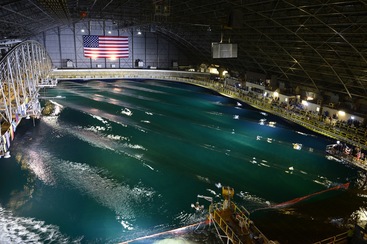 Test site: U.S. Navy MASK wave basin at the Carderock facility, Bethesda, MD [photo courtesy of U.S. Navy]
WEC-Sim Code Release
WEC-Sim v2.0 was
released early this year. New features include algorithms for simulating higher-order
nonlinear wave-body interaction, body-to-body interaction, a Morison element
model, and post-processing scripts for better visualization. The capability to
couple WEC-Sim to MoorDyn, an open-source lumped-mass-based mooring model, was
also added in v2.0, which allows the simulation of realistic mooring
configurations.
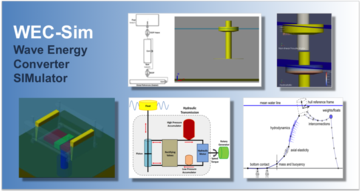 Example applications of using WEC-Sim to model various wave energy converters, coupled with PTO-SIm and MoorDyn
WEC-Sim Training Class
Kelley
Ruehl and Carlos Michelen from Sandia Labs, with Yi-Hsiang Yu and Jennifer van
Rij from NREL, offered a free two-day training class, open to the public, on
the use of WEC-Sim. The training course, hosted by Oregon State University and
broadcast internationally via webinar, drew academic researchers and industry
developers from the United States, the United Kingdom, Ireland, South Africa,
and Italy. Topics included WEC-Sim theory, installation and workflow, code
structure, application cases, advanced features, and collaborative open source
code development. Furthermore, the training focused on building a collaborative
code development environment for WEC-Sim, which is essential for the
open-source numerical model development to be successful and sustainable. Several
attendees shared how they have used WEC-Sim for modeling their devices and how
it has helped them move their technology forward. The instructors collected
participant suggestions and feedback which will be very helpful for the WEC-Sim
development team to improve the numerical model further. Contact:
Kelley Ruehl
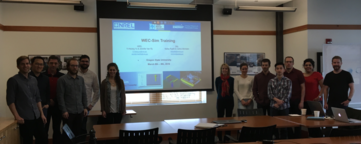 WEC-Sim training attendees
R.G. Coe, C. Michelen, A. Eckert-Gallup, Y. Yu and J. van
Rij, “WDRT: A toolbox for
design-response analysis of wave energy converters,” Proceedings of
the 4thMarine Energy Technology Symposium (METS), Washington,
DC, 2016. SAND2016-2983C
C. Michelen, R.G. Coe, Y. Yu and Q. Wang, “Tool for distributed pressure
time-histories of marine structures: verification and case study with a WEC,” Proceedings
of the 4th Marine Energy Technology Symposium (METS),
Washington, DC, 2016. SAND2016-2890C
L. Manuel, J. Canning, R.G. Coe, and C. Michelen, “On the short-term uncertainty
in performance of a point absorber wave energy converter,” Proceedings
of the 4thMarine Energy Technology Symposium (METS), Washington,
DC, 2016. SAND2016-2982C
G. Bacelli, R.G. Coe, D. Wilson, O. Abdelkhalik, U.A.
Korde, R.D. Robinett and D.L. Bull, “A comparison of WEC control
strategies for a linear WEC model,” Proceedings of the 4th Marine
Energy Technology Symposium (METS), Washington, DC, 2016. SAND2016-3408C
D. Wilson, G. Bacelli, R.G. Coe, R.D. Robinett, G. Thomas,
D. Linehan, D. Newborn and M. Quintero, “WEC and support bridge control
structural dynamic interaction analysis,” Proceedings of the 4th Marine
Energy Technology Symposium (METS), Washington, DC, 2016. SAND2016-3409C
G. Bacelli, V.S. Neary and A.W. Murphy,
“Compressible degree of freedom (CDOF): A potentially disruptive strategy
for boosting wave energy converter (WEC) performance,” Proceedings of the 4th Marine Energy
Technology Symposium (METS), Washington, DC, 2016. SAND2016-3118 A
Gunawan, B., Bachant, P., Neary, V.S., and Wosnik,
M. (2016) Fiber Optic Instrumentation for Measuring Rotor Strain. Proceedings
of the 4rd Marine Energy Technology Symposium METS2016 April 25-27, 2016,
Washington, D.C. SAND2016-3227C
|