Events
The next Wakebench Annual meeting (IEA Wind Task 31) will be hosted
by the Sandia Wind Energy Technologies department in Albuquerque, NM, March
16-17, 2016. The meeting will include a review of existing V&V
activities in Europe and the U.S., a discussion about how to unify these
activities into a common strategy, and a discussion of benchmarking
opportunities for meso-micro, wakes, and uncertainty quantification. Contact: David
Maniaci
Wind Energy
A new day: SWiFT reaches rotor mounting milestone
A new day at SWiFT with rotor mounting milestone
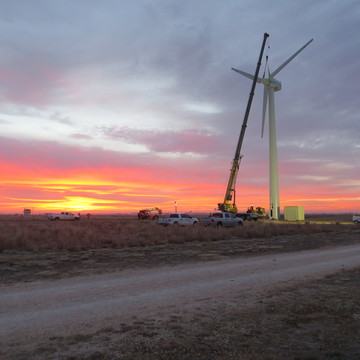
Sandia National Laboratories has reached a major milestone by successfully re-mounting a rotor on one of its SWiFT wind turbines, a heavily modified Vestas V27, at the SWiFT facility on January 20, 2016. Wind engineers at SWiFT have been preparing for this event since 2014 when one of the turbines over sped and failed. Since that time, Sandia’s Wind Energy Technologies department has been evaluating and improving hardware, software, safety systems, procedures, training, and security at the SWiFT site. Notable site improvements include:
- A
new generator brake system to maintain stopping capability with failure
tolerance
- A
new hardware-in-the-loop testbed which will provide exact replica testing of turbine
controller prior to deployment on the turbine
- Significantly
strengthened hardware safety system with multiple layers
- Reviewed and approved by Sandia, Vestas, Texas Tech, DOE, NREL, DNV-GL and Westergaard
Solutions
- Significant increase in the SWiFT team's capability and knowledge will benefit all
future research projects and partners
- Rigorous
readiness review and change management system which will expedite future
testing efforts
With the successful rotor re-mount to baseline the facility, SWiFT is moving forward in preparation for its DOE readiness review to be conducted over the next month. A successful readiness review is the final step in returning SWiFT to full operational capability and the initiation of a wide range of wind plant research.
The
Scaled Wind Farm Technology (SWiFT) Facility is the principal wind plant
research facility for investigating wind turbine wakes as part of the DOE
Atmosphere to Electrons (A2E) initiative. In 2016, the SWiFT Facility will be
the focus of a joint experiment conducted by Sandia National Laboratories and
National Renewable Energy Laboratory staff studying the use of wind plant
controls to mitigate the impact of wakes on plant performance. Additionally,
the SWiFT Facility is preparing to fly the first blade set from DOE and
Sandia’s National Rotor Testbed (NRT) program which aims to demonstrate the
ability to functionally scale utility rotor characteristics to the more
cost-effective research scale of the SWiFT turbines. The NRT rotor will
recreate the wake of a utility-scale turbine while future NRT rotor designs
could demonstrate wake mitigation, damage mitigating active load control, and
other innovative design concepts.
To
support A2E’s industrial partnership objectives, SWiFT will partner with Windar
Photonics and Westergaard Solutions to investigate simultaneous feed-forward /
feed-backward wake control. Additionally, Pentalum, Texas Tech University and
Sandia have also partnered on a Binational Industrial R&D (BIRD) Foundation
grant to further develop a new approach to LIDAR technology with the hopes of
leveraging the technology to develop wind plant controllers.
POC: Jon White
Sandia presents several wind energy papers at AIAA SciTech conference
Three members of Sandia National Laboratories’ Wind Energy
Technologies department presented technical papers at the AIAA SciTech 2016
conference in San Diego, CA. Over 3500 participants attended the 5-day
conference—which co-locates 12 technical conferences, including the 34th
ASME Wind Energy Symposium—allowing for many cross-disciplinary exchanges. Sandia’s
research overlaps significantly with the research community’s interest in several
areas related to wind turbine wakes and wind farm analysis including, but not
limited to, computational fluid dynamics (CFD) analyses and methods, mid-fidelity
vortex methods, atmospheric coupling to large wind farm simulations, and
vertical axis wind turbines (VAWTs).
Chris Kelley presented Scaled Aerodynamic Wind
Turbine Design for Wake Similarity on the aerodynamic design of the
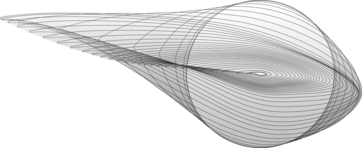
National Rotor Testbed blades to fly at SWiFT, as shown in Figure 1. These
blades were designed with a newly developed inverse design methodology whereby
the created wake is the scaled wake of a utility, commercial-sized wind
turbine. POC: Chris Kelley.
Figure 1. End view of NRT blade showing airfoil station cross-sections
Tommy
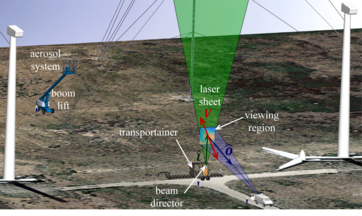
Herges updated participants on the Sandia Wake Imaging
System (SWIS) velocity measurement tool, describing the setup and results
from the demonstration field test campaign at the SWiFT facility in July 2015, as
shown in the schematic below (Figure 2). SWIS will improve the spatial and
temporal resolution capabilities of velocity measurements within wind farms. Velocity
images of the inflow wind velocity were safely and successfully acquired during
the demonstration field test that compared well with measurement predictions.
The software tool developed to model the physics of SWIS will be used to plan
future experiments. Based on feedback from high-fidelity modelers, the SWIS
team will refine the system to provide data for future verification and
validation efforts of CFD codes. POC: Tommy Herges
Figure 2. Schematic of the SWIS setup during the demonstration field test at the SWiFT facility
David Maniaci, in collaboration with Sven Schmitz of
Pennsylvania State University, presented a paper on an improved tip-loss model
for highly-loaded wind turbines: Analytical Method to
Determine a Tip Loss Factor for Highly-Loaded Wind Turbine Rotors. POC: David Maniaci
At the ASME Wind Energy Technical Committee meeting, Committee
members elected Todd
Griffith as the new Chair of the ASME Wind Energy Technical Committee.
Professor Lance Manuel and his University of Texas students presented
a paper, co-authored by members of the Sandia Wind and Water Power departments,
on developing a standard model for a floating offshore 13.2
MW horizontal-axis wind turbine (HAWT) using the Sandia 100m blade.
Sandia partner Montana State
University researchers presented two papers on fiber reinforced polymer composite
materials and mechanics: Fracture and
Fatigue of Thick Adhesive Joints in Wind Turbine Blade Structures (AIAA
2016-0755) and Influence of Fabric Architecture on
Damage Progression Evidenced by Acoustic Emission Measurements (AIAA
2016-0756). Abstracts and links to the full papers from the 34th
Wind Energy Symposium are available at the AIAA website. POC: Brandon Ennis
IEA meetings focused on wind turbine aerodynamics
Sandia was represented at the IEA Wind Task
29 and Task 11 meetings by David Maniaci who presented on tip-loss modeling of
highly-loaded rotors. IEA Wind Task 29, also known as MEXNEXT, is focused
on the analysis of wind tunnel measurements, specifically from the Mexico rotor
experiments. The IEA Wind Task 11, Base Technology Information Exchange, was focused
on aerodynamics, and included several presentations on work related to the
European Energy Research Alliance’s (EERA) AVATAR project
on large rotors. Similarities between the research goals of EERA and of
DOE’s A2e initiative were discussed, as well as the potential for IEA Wind Task
29 as a conduit for future collaboration. POC: David
Maniaci
Kelley, C.L., Ennis, B.L.,
“SWiFT Site Atmospheric Characterization,” Tech. Rep. SAND2016-0216, Sandia
National Laboratories, 2016.
Christopher L. Kelley, David C. Maniaci, and Brian R. Resor. "Scaled Aerodynamic Wind Turbine Design for Wake Similarity," 34th Wind Energy Symposium, AIAA SciTech, (AIAA 2016-1521).
Sven Schmitz and David C. Maniaci. "Analytical Method to Determine a Tip Loss Factor for Highly-Loaded Wind Turbine Rotors," 34th Wind Energy Symposium, AIAA SciTech, (AIAA 2016-0752).
Thomas G. Herges, David Bossert, Randal Schmitt, Mark Johnson, David C. Maniaci, Crystal Glen, andBrian Naughton. "Field Demonstration of the Sandia Wake Imaging System Capabilities at the Scaled Wind Farm Technology Facility", 34th Wind Energy Symposium, AIAA SciTech, (AIAA 2016-1524).
Jinsong Liu, Edwin Thomas, Lance Manuel, D. Todd Griffith, Kelley Ruehl, and Matthew F. Barone. "On the Development of a Semi-Submersible Offshore Floating Platform and Mooring System for a 13.2 MW Wind Turbine", 34th Wind Energy Symposium, AIAA SciTech, (AIAA 2016-1994).
Water Power
Experimental testing of WEC controls
Sandia is preparing to begin experimental testing on wave
energy converter (WEC) modeling and controls. The test program will focus on
model validation and system identification to produce high-quality data for control
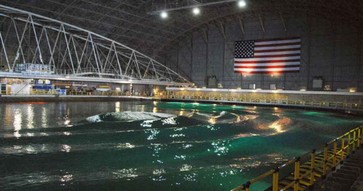
design of WECs. In partnership with the Navy, Sandia will conduct
the tests at the maneuvering and sea-keeping (MASK) basin at the Naval Surface
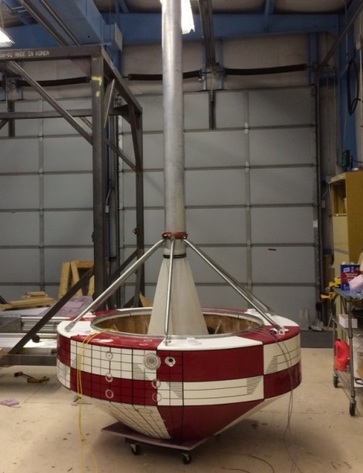
Warfare Center’s Carderock Division (NSWCCD) in Bethesda, MD. The WEC to be
tested (1/17 scale) will be among the largest scale models ever tested in a
wave tank (Fig. 3). While the Carderock facility (see Fig. 4) typically tests
the effects of wave motion on Navy vessels, the upcoming tests provide an
opportunity for Sandia, the U.S. Department of Energy, and the U.S. Department
of Defense to collaborate on advanced wave energy testing. POCs: Ryan
Coe and Giorgio
Bacelli
Figure 3. Float and support arm for 1/17 scale wave energy converter
Figure 4. US Navy's Maneuvering and Seakeeping Basin (MASK) (Photo provided by NSWC Carderock Division/Released)
Sandia releases 2nd edition of the U.S. WEC test site catalogue
Sandia has
released the second edition of the Wave Energy Converter Test Site Catalogue characterizing wave energy resources to
facilitate device deployments and testing. The catalogue presents met-ocean
data at eight U.S. wave energy converter (WEC) test sites. The catalogue will
enable WEC
developers to compare wave resource
characteristics between sites and select the best test sites for their device,
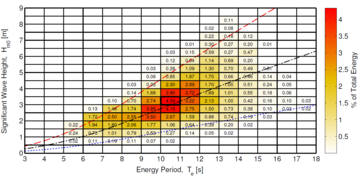
testing needs, and objectives (see Figure 5 for example of wave energy
distribution).
This
catalogue includes critical wave statistics for determining the magnitude and
quality of power resources at wave sites and environmental loads required for
WEC design. Site information includes wave energy resource parameters recommended by the IEC Technical
Specification on Wave Energy Characterization (IEC TS 62600-101 Ed. 1.0), as
well as environmental contours that characterize extreme sea states, weather
windows to facilitate operation and maintenance, and information on test site
infrastructure and services. Both editions of the catalogue thoroughly document
all methodologies used for wave resource characterization (Dallman and Neary
2014, 2015).
The
catalogue can be downloaded on the Water Power
OpenEI site. POCs: Ann Dallman and Vincent Neary
References:
-
IEC TS 62600-101 Ed. 1.0 Marine energy—Wave, tidal and other water current converters—Part
101: Wave energy resource assessment and
characterization.
-
Dallman,
A.R. and V.S. Neary. (2014). “Characterization
of U.S. Wave Energy Converter (WEC) Test Sites: A Catalogue of Met-Ocean Data,
1st Edition.” SAND2014-18206, September
2014, 125 pages.
- Dallman,
A.R. and V.S. Neary. (2015). “Characterization of U.S. Wave Energy Converter
(WEC) Test Sites: A Catalogue of Met-Ocean Data, 2nd Edition.”
SAND2015-7963, September 2015, 304 pages.
Figure 5. Example of wave energy distribution among sea states at a wave site
Dallman, A.R. and V.S. Neary. (2015). “Characterization of U.S. Wave Energy Converter (WEC) Test Sites: A Catalogue of Met-Ocean Data, 2nd Edition.” SAND2015-7963, September 2015, 304 pages.
|