|
 Jan. 31, 2024
|
|
Welcome New Leaders to SCEP
As we start 2024, SCEP has the great fortune to welcome new leadership. Below are the brief intros to our newest members.

|
|
Quick Links
News
- BIL and IRA are Enabling Cities to Reach Their Clean Energy Goal – See What Green Bay, WI, and Columbia, MO Mayors Have to Say to SCEP about It
- February 9, 2024 – Submit a Required Concept Paper for the Latest and Zero Building Energy Codes Funding Opportunity
- February 15, 2024 – Respond to Request for Coordination with DOE’s EECBG Blueprint Cohorts
- February 27, 2024 – Non-Profit Led Partnerships Apply to the Career Skills Training Program
- $20.57 Million in Funding has been Awarded to 32 States, Territories, Local Governments, and Tribes Through the EECBG Program
- ESPC Campaign Kickoff and Their Upcoming Webinar on ESPC and ePX
- Technical Assistance Now Underway for Nonprofits Through DOE’s Renew America’s Nonprofits Program
- February 2, 2024 – Apply to the CONCEPT Phase of the Community Energy Innovation Prize
- February 5, 2024 – Respond to Building Technologies Office’s RFI for a National Definition for a Zero Emissions Building
- April 12, 2024 – Application’s Due for the American-Made SOLVE IT Prize
- April 17, 2024 – Request Funds for FY24 from the Grid Resilience State and Tribal Formula Funding
- Attend the Energy Transition Summit: Grid Modernization Initiative and Clean Energy Cybersecurity
- Pre-Filing Registration Now Available for the IRA Clean Energy Credits
- New Federal Guidance Says LIHEAP Funds Can Cover Community Solar Subscription Fees
- March 19, 2024 – Apply to EPA’s Grant to Address Indoor Pollution at Schools
- Be Part of EPA’s Environmental and Climate Justice Program
- $47 Million has been Awarded to Support Schools in Being Healthy and Sustainable
|
|
BIL and IRA are Enabling Cities to Reach Their Clean Energy Goal – See What Green Bay, WI, and Columbia, MO Mayors Have to Say to SCEP about It
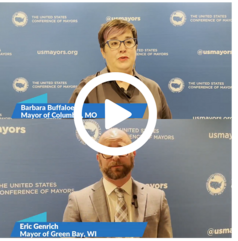
The U.S. Department of Energy’s (DOE) Office of State and Community Energy Programs (SCEP) caught up with two different city mayors to learn more about how the Inflation Reduction Act (IRA) and the Bipartisan Infrastructure Law (BIL) are impacting cities.
At the U.S. Conference of Mayors 92nd Winter Meeting in DC, SCEP talked with Columbia, Missouri Mayor Barbara Buffaloe on how a boost in investments and opportunities from IRA and BIL moves her city planning forward.
SCEP is enabling cities to reach their clean energy goals. SCEP also caught up with Green Bay Wisconsin Mayor Eric Genrich, who says his city can do more because of clean energy funding from the BIL and IRA.
Go to SCEP’s LinkedIn and watch the videos of Mayors Genrich and Buffaloe sharing about how their cities are utilizing BIL and IRA funding.
|
February 9, 2024 – Submit a Required Concept Paper for the Latest and Zero Building Energy Codes Funding Opportunity
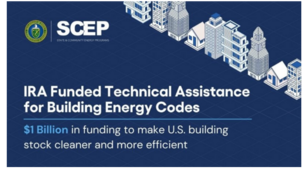
DOE announced that up to $530 million in technical assistance competitive grants is available for the adoption and implementation of the latest model energy codes, zero energy codes, building performance standards, and innovative codes that achieve equivalent energy savings to the latest model and zero energy codes. This Latest and Zero Building Energy Codes Funding Opportunity Announcement (FOA) is open to states, territories, and units of local government that have the authority to adopt building codes. This new competitive funding opportunity expands the pool of eligible grantees to include certain localities and expands qualifying activities to include customized codes and innovative code approaches such as building performance standards. These funding streams are designed to provide flexibility in response to the broad variety of jurisdictional circumstances, allowing eligible grantees to pursue a pathway that fits their state and local context.
Eligible states, territories, or units of local governments with the authority to adopt building codes can submit brief concept papers, which are required, by February 9, 2024, to be eligible to submit their full applications by April 30, 2024.
|
February 15, 2024 – Respond to Request for Coordination with DOE’s EECBG Blueprint Cohorts
Apply through ENERGYWERX, an intermediary, to support DOE’s Energy Efficiency Community Block Grants (EECBG) Blueprint Cohorts. The selected organization(s) will enter into a Partnership Intermediary Agreement (PIA) to support the administration and implementation of the EECBG Program’s Blueprint Cohort Initiative.
The EECBG Program provides formula grants and technical assistance to over 2,700 local, state, and tribal governments to support their clean energy goals. DOE has created 13 Blueprints that grantees may choose to follow with their EECBG Program grant. The selected organizations will provide coordination and technical support to grantees to ensure they have the knowledge and tools they need to successfully execute their EECBG clean energy projects and programs. Further, the Blueprint Cohorts will consist of monthly group-learning virtual meetings and regular trainings; and will provide a venue for peer-learning, sharing of best practices, and Q&A.
Learn more about the work and apply by February 15, 2024 to be considered for this opportunity.
|
February 27, 2024 – Non-Profit Led Partnerships Apply to the Career Skills Training Program
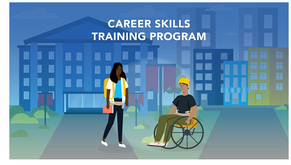
DOE’s Career Skills Training program (CST) will provide up to $10 million in competitive grants for nonprofit partnerships between public or private industry and labor organizations to deliver programs that provide both energy efficiency classroom instruction and on-the-job training. The program seeks to encourage meaningful engagement and participation of workforce organizations, including labor unions, as well as underserved communities and underrepresented groups. To facilitate engagement and partnership-building between the various stakeholders in the Career Skills Training grant, DOE has established a Teaming List that nonprofits can join.
Applications are due February 27, 2024.
|
$20.57 Million in Funding has been Awarded to 32 States, Territories, Local Governments, and Tribes Through the EECBG Program
DOE has announced $20.57 million in funding that will be awarded to 32 states, territories, local governments, and Tribes through the Energy Efficiency and Conservation Block Grant (EECBG) Program. This marks the third round of formula awards granted through the EECBG Program since October 2023. In total, there is more than $431 million available to 2,708 states, local governments, Tribes, territories, and the District of Columbia to implement programs and projects that improve energy efficiency, cut carbon emissions, and reduce overall energy use. The program also contributes to the Biden-Harris Administration’s Justice40 Initiative by supporting eligible governments in directing 40% of overall benefits from EECBG Program-funded programs and projects to disadvantaged communities that are often energy-burdened or left behind in the clean energy transition.
The 15 cities, 9 counties, 5 states, 1 Tribe, and 1 territory, and the District of Columbia receiving funding in this tranche of awards will use funds for activities that include electric bicycle incentive programs, free home solarization for low-income families, municipal fleet electrification, decarbonization waste management strategies, energy audits, and more.
|
ESPC Campaign Kickoff and Their Upcoming Webinar on ESPC and ePX
DOE’s Energy Savings Performance Contracting (ESPC) Campaign kicked off the new year and their campaign this past month with a webinar, during which DOE leadership and ESPC Campaign partners shared their perspectives on the current opportunity to leverage ESPC to make transformative investments in communities nationwide.
The ESPC Campaign is a new initiative to help states, local governments, schools, and other public-sector organizations upgrade their facilities, increase efficiency and resiliency, and realize savings through the use of performance contracting. The ESPC Campaign engages a growing network of governments, public sector institutions, and market stakeholders to share and demonstrate resources, tools, and best practice approaches for performance contracting to support the expansion and success of ESPC projects and programs.
Tune in for one of their webinars on Tuesday, February 27 to learn how ESPC can bridge gaps in capital funding to help modernize facilities, create healthier learning and working environments, reduce carbon footprints and ongoing costs, and optimize the use of available funds. Attendees will also learn how eProject eXpress (ePX) makes it easy for project owners and their Energy Service Companies (ESCOs) to manage project documents, track data, and report on project achievements.
Check out the ESPC Campaign Kickoff Webinar recording and visit the campaign website to learn more, view current partners, and find out how to join.
|
Technical Assistance Now Underway for Nonprofits Through DOE’s Renew America’s Nonprofits Program
DOE’s Renew America's Nonprofits Program will be offering technical assistance (TA) for all nonprofits nationwide to share resources and information about building energy improvements, solar tools and tax credit information, financing opportunities and more!
Email nonprofits@doe.gov to join the inaugural TA offering, Tuesday, February 27 at 4pm ET where they will highlight opportunities and tools available to nonprofits for energy efficiency projects!
Register to learn about the importance of energy efficiency first as an important step in preparing for solar. This webinar will focus on tools for benchmarking, identifying low-cost improvements, and identifying the right financing option. Experts from the DOE, the Environmental Protection Agency, and the Environmental and Energy Study Institute will provide information tailored to the nonprofits sector.
|
February 2, 2024 – Apply to the CONCEPT Phase of the Community Energy Innovation Prize
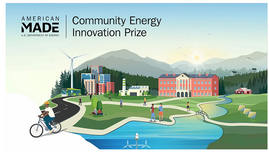
Join the $7.49 million Community Energy Innovation Prize and strategize ways to provide support, build trust, and strengthen relationships and partnerships with underserved communities while advancing the clean energy transition. The prize is open to community-based organizations, the private sector, nonfederal government entities, and collegiate teams. DOE intends for the Community Energy Innovation Prize to serve as a “front door” to its clean energy funding programs and other federal funding opportunities to communities and organizations who have been historically underserved. In addition to cash awards, the prize will provide awardees with mentorship, relevant resources, and connections in their path to forging an inclusive clean energy future.
The Community Energy Innovation Prize is made up of three tracks: the Clean Energy Ecosystem Track, the Manufacturing Ecosystem Track, and the Collegiate Track, each of which has distinct goals and submission requirements over three phases: CONCEPT, PROGRESS, and IMPACT.
Competitors in these tracks should submit applications for the CONCEPT Phase that engage underserved communities; promote environmental, climate, and energy justice; demonstrate strong community ties; and establish bridges between DOE and these communities.
Apply by February 2, 2024 for the CONCEPT Phase of the Clean Energy Ecosystem and Manufacturing Ecosystem Tracks.
|
February 5, 2024 – Respond to Building Technologies Office’s RFI for a National Definition for a Zero Emissions Building
DOE’s Building Technologies Office has released a Request for Information (RFI) to solicit feedback from industry, academia, research laboratories, government agencies, and other stakeholders on a draft National Definition for a Zero Emissions Building. Responses to this RFI will help to develop a National Definition for a Zero Emissions Building that will serve as a clear market signal and consistent target, backed by measurable data, that is intended to help move the building sector to zero emissions.
Respond by February 5, 2024 to this RFI in order for feedback to be considered.
|
April 12, 2024 – Application’s Due for the American-Made SOLVE IT Prize
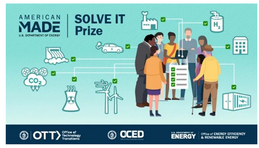
DOE announced that the newest American-Made Challenge, Solutions for Lasting, Viable Energy Infrastructure Technologies (SOLVE IT) Prize, is now accepting submissions.
The SOLVE IT Prize will support communities as they identify and work to implement innovative clean energy solutions in a way that works best to address their unique needs and challenges. By empowering communities to solve their energy-related challenges, the SOLVE IT Prize looks to promote the commercialization of promising energy technologies in a way that will lead to an equitable and just energy transition.
Apply by April 12, 2024 to be considered for the prize.
|
April 17, 2024 – Request Funds for FY24 from the Grid Resilience State and Tribal Formula Funding
DOE has released the Grid Resilience State and Tribal Formula Grant fiscal year 2024 (FY24) Administrative and Legal Requirements Document (ALRD) to open the allocation request and application period for FY24 grant funding.
Supported by BIL and administered by the Grid Deployment Office (GDO), these grants help modernize the electric grid to reduce the impacts of climate-driven extreme weather and natural disasters while also ensuring the reliability of the power sector.
$562 million in funding is available through FY24 grants. Register to attend a webinar on February 1, 2024 about this ALRD too.
Applicants have until April 17, 2024, to request FY24 grant funds.
|
Attend the Energy Transition Summit: Grid Modernization Initiative and Clean Energy Cybersecurity
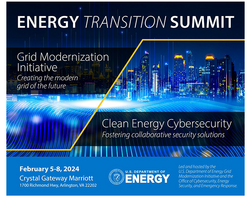
DOE’s Grid Modernization Initiative (GMI) and Office of Cybersecurity, Energy Security, and Emergency Response (CESER) are excited to host the Energy Transition Summit: Grid Modernization Initiative and Clean Energy Cybersecurity in Arlington, Virginia, February 5-8, 2024.
Attendees will learn about opportunities to engage with DOE-led efforts that are modernizing the future power grid and enabling a more resilient, secure, and equitable energy transition. This event will host thought leaders and working sessions to have a dialog about strategies for future energy systems through partnerships and technology transition across government, industry, research organizations, and local communities.
The summit will feature keynote speakers and focused sessions on the two summit themes: the DOE Grid Modernization Initiative and Clean Energy Cybersecurity. View the agenda and register now!
|
Pre-Filing Registration Now Available for the IRA Clean Energy Credits
The Internal Revenue Service (IRS) announced the launch of the IRS Energy Credits Online for taxpayers who intend to make an elective payment or transfer election for a clean energy tax credit. Entities will use IRS Energy Credits Online to complete a required pre-filing registration process and receive a registration number. This registration number must be included on the taxpayer’s annual return when making an elective payment or transfer election for a clean energy credit.
Elective pay allows applicable entities, including tax-exempt and governmental entities that would otherwise be unable to claim certain credits because they do not owe federal income tax, to benefit from some clean energy tax credits. By choosing this election, the amount of the credit is treated as a payment of tax and any overpayment will result in a refund.
|
New Federal Guidance Says LIHEAP Funds Can Cover Community Solar Subscription Fees
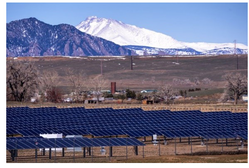
New federal guidance from U.S. Department of Health and Human Services (HHS) Office of Community Services (OCS) may make one form of renewable energy, community solar, much easier to access in these communities through its Low-Income Home Energy Assistance Program (LIHEAP) funds—which are administered by individual states to low- and moderate-income residents to cover their gas, electric, propane and fuel oil energy bills. This guidance now includes community solar subscription fees. The guidance also establishes strong consumer protections for these residents against fraud and other scams.
Community solar is a form of solar energy generation that allows multiple households, businesses, nonprofits, or others to access the meaningful benefits of renewable energy, such as lower energy bills, grid resilience, and workforce opportunities.
With this new guidance, DOE’s National Community Solar Partnership (NCSP) is partnering with HHS on the Low-Income Clean Energy Connector, a digital tool that makes community solar with verified savings and strong consumer protections more accessible to households participating in LIHEAP. In addition, NCSP is working through its States Collaborative to share best practices and lessons learned from early adopters.
|
|
|
March 19, 2024 – Apply to EPA’s Grant to Address Indoor Pollution at Schools
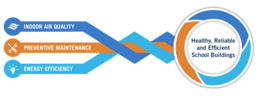
The Environmental Protection Agency (EPA) has opened a Notice of Funding Opportunity (NOFO) that solicits applications from Tribes, states, territories, local governments/educational agencies, and nonprofit organizations to enable more low-income, disadvantaged, and Tribal kindergarten through twelfth grade (K-12) schools and/or school districts1 across rural, suburban, and/or urban areas to monitor and reduce greenhouse gas (GHG) emissions and indoor air pollutants through the development and adoption of comprehensive indoor air quality (IAQ) management plans consistent with EPA’s IAQ Tools for Schools Action Kit and Framework, Energy Savings Plus Health Guidance, Preventive Maintenance Guidance, and other EPA recommended IAQ best practices.
Indoor air pollutants are of concern because most people spend about 90 percent of their time indoors. Indoor pollution in schools is a particular concern because children’s developing bodies breathe more air in proportion to their body weight than adults. This NOFO is working to fund investments in improving school air quality.
Submit your application by March 19, 2024 to be considered.
|
Be Part of EPA’s Environmental and Climate Justice Program
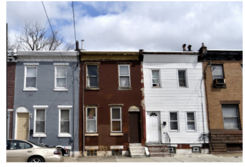
EPA has established Environmental and Climate Justice Program (ECJ Program), created by the Inflation Reduction Act (IRA). ECJ Program provides funding for financial and technical assistance to carry out environmental and climate justice activities to benefit underserved and overburdened communities.
EPA has created the EPA IRA Disadvantaged Communities map layer to assist potential applicants seeking to identify whether a community is disadvantaged for the purposes of implementing programs under the IRA.
Programs and Funding Opportunities that are part of the ECJ Program include:
|
$47 Million has been Awarded to Support Schools in Being Healthy and Sustainable
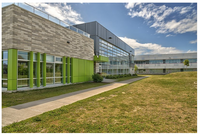
The U.S. Department of Education has awarded eight new grant awards today totaling more than $47 million over five years under the Supporting America’s School Infrastructure (SASI) program and one new grant for $10 million over five years under the National Center on School Infrastructure (NCSI) program. This $47 million investment, issued by the U.S. Department of Education, bolsters the capacity of states to support school districts in improving school facilities with the goal of more equitable access to healthy, sustainable, and modern learning environments for all students.
The SASI program intended to increase state capacity to support underserved school districts to improve their school facilities. States receiving SASI funds will be able to conduct school facility needs assessments in high-need school districts; hire new staff; and develop or improve public school infrastructure data systems, among other actions. The NCSI program will establish a national clearinghouse and technical assistance center that will consolidate federal resources related to public school infrastructure improvements that support safe, healthy, sustainable, and equitable public school facilities. NCSI will also provide targeted technical assistance to SASI grantees to expand state expertise in school infrastructure.
|

Events
U.S. Department of Energy: Grid Deployment Office
📅 February 1 | 2:00 PM to 3:30 PM EST
U.S. Department of Energy: GMI and CESER
📅 February 5-8 | Washington, D.C.
U.S. Department of Energy: Office of State and Community Energy Programs
📅 February 6 | 1:00 PM to 3:00 PM EST
U.S. Department of Energy: Office of State and Community Energy Programs
📅 February 6 | 3:00 PM to 4:00 PM EST
U.S. Department of Energy: Building Technologies Office
📅 February 15 | 1:00 PM to 2:00 PM EST
U.S. Department of Energy: Office of State and Community Energy Programs
📅 February 16 | 12:00 PM to 2:00 PM EST
U.S. Department of Energy: Office of State and Community Energy Programs
📅 February 27 | 3:00 PM to 4:00 PM EST
U.S. Department of Energy: Office of State and Community Energy Programs
📅 February 27 | 4:00 PM to 5:00 PM EST
U.S. Department of Energy: Office of State and Community Energy Programs
📅 March 5 | 1:00 PM to 3:00 PM EST
U.S. Department of Energy: Office of State and Community Energy Programs
📅 March 14 | 2:00 PM to 3:00 PM EST
U.S. Department of Energy: Office of State and Community Energy Programs
📅 March 15 | 12:00 PM to 2:00 PM EST
U.S. Department of Energy: Office of State and Community Energy Programs
📅 March 19 | 12:00 PM to 12:30 PM EST
U.S. Department of Energy: Building Technologies Office
📅 March 21 | 1:00 PM to 2:00 PM EDT
U.S. Department of Energy: Federal Energy Management Program
📅 March 26–28, 2024
U.S. Department of Energy: Building Technologies Office
📅 April 2-4 | Washington, D.C.
U.S. Department of Energy: Office of State and Community Energy Programs
📅 April 9 | 1:00 PM to 3:00 PM EST

|
|
Available Grants and Funding Opportunities
Learn about what types of funding are available for state and local governments. To view all open funding opportunity announcements, access:
|
|
|
The State and Local Solution Center is an online technical assistance portal that provides technical assistance resources to enable strategic investments in energy efficiency and renewable energy technologies through the use of innovative practices across the United States by a wide range of stakeholders, in partnership with state and local organizations and community-based nonprofits.
The State and Local Solution Center is managed by DOE's Office of State and Community Energy Programs (SCEP). SCEP supports DOE's mission to accelerate the research, development, demonstration, and deployment of technologies and solutions to equitably transition America to net-zero greenhouse gas emissions economy-wide by no later than 2050, and ensure the clean energy economy benefits all Americans, creating good paying jobs for the American people—especially workers and communities impacted by the energy transition and those historically underserved by the energy system and overburdened by pollution.
|
DOE Facebook
DOE Twitter
Energy Saver Facebook
DOE YouTube
SCEP LinkedIn
|
|
|
You received this message because you are subscribed to updates from DOE Office of State and Community Energy Programs. Get this as a forward? Sign up to receive updates.
SUBSCRIBER SERVICES:
Manage Subscriptions | Unsubscribe All | Help
|
|
|
|
|


 SCEP LinkedIn