|
Putting people and communities first. |
|
RFI At-A-Glance
We’re more than halfway into the response period for our Request for Information (RFI) on using a consent-based siting process to identify federal interim storage facilities. Ready to share your thoughts? You still have five weeks left to respond!
What
We are requesting information on how to use a consent-based siting process to site Federal facilities for the temporary, consolidated storage of spent nuclear fuel.
Who
We anticipate that the following groups may be interested in responding to the RFI:
- Communities
- Governments at the local, State, and Tribal levels;
- Members of the public;
- Energy and environmental justice groups;
- Organizations or corporations; and
- Other stakeholders
We especially welcome insight from people, communities, and groups that have historically not been well-represented in these discussions.
See the full RFI by clicking here. Translated versions of the RFI can also be found here.
How
Interested parties may submit comments electronically to consentbasedsiting@hq.doe.gov. More detailed instructions can be found in the RFI. You can also check out the draft consent-based siting process and the summary of public comments referenced in the RFI at energy.gov/consentbasedsiting.
When
Responses to the RFI must be received by March 4, 2022, by 5:00 p.m. (ET).
|
|
 What is Spent Nuclear Fuel?
Get up to speed with these 5 fast facts on used fuel that’s generated from nuclear power.
|
 How is Spent Fuel Transported?
Here are 5 common myths, and corresponding facts, about transporting spent nuclear fuel.
|
|
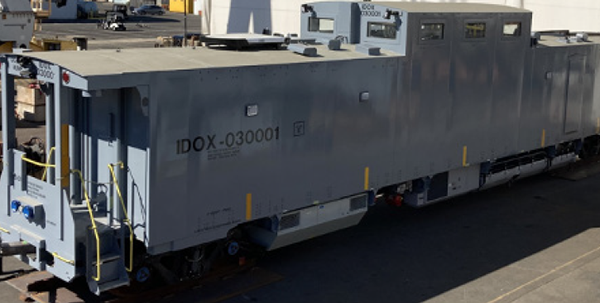 A new high-tech railcar we developed with the U.S. Navy is currently en route from Oregon to a site near Pueblo, Colorado for multiple-car testing. The Rail Escort Vehicle (REV), specifically designed to transport security personnel during the shipment of spent nuclear fuel (SNF) and high-level radioactive waste, is the last piece needed for a complete railcar system. This system is required to transport SNF to disposal and storage facilities across the country.
While the new REV provides a comfortable living and working environment for the security personnel onboard, it is no ordinary caboose. The REV is equipped with security features, including cameras and communications equipment, to provide enhanced surveillance of SNF shipments throughout the journey.
When the REV arrives at the test-site in late-February 2022, it will be connected to Atlas, a 12-axle railcar we are developing, and buffer railcars to form a complete train. The entire train will then undergo two years of multiple-car testing, which will allow us to achieve initial operations capabilities as early as 2024.
Seeking Proposals: Build and Test Second High-Tech Cask Railcar Design
 |
|
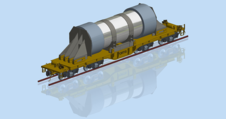
We recently issued a request for proposals for the fabrication and testing of a prototype eight-axle railcar to carry the nation’s spent nuclear fuel and high-level radioactive waste.
The proposal includes fabricating a prototype Fortis railcar, acquisition of instrumented wheelsets necessary to measure railcar performance, and conducting required railcar testing. We will provide the contractor the design for the Fortis railcar, and the Fortis project will continue to receive technical support for fabrication and testing from Pacific Northwest National Laboratory.
|

|
|
|
|