|
|
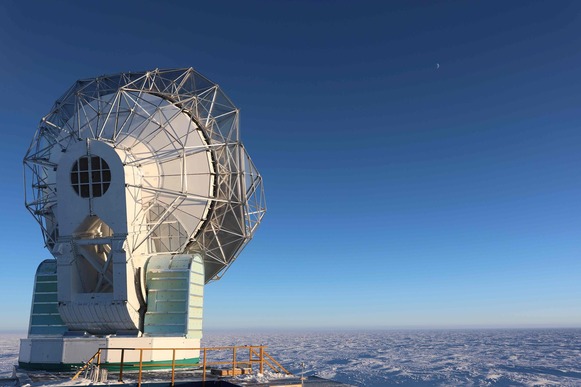
A figure in red trudges across a blanket of white. Snow squeaks under the scientist’s feet, too dry to be slick or soft. Only a line of flags and a few large buildings – the scientist’s destination – break up the landscape. The sun hovers on the horizon, never quite setting against a blue sky devoid of clouds.
This is summer at the bottom of the world.
In addition to ice and snow, Antarctica hosts the South Pole Telescope (SPT) and BICEP projects. Researchers use these experiments – supported by the U.S. Department of Energy’s (DOE) Office of Science, the National Science Foundation, and their partners – to investigate the earliest moments of the universe. As we can’t travel back in time, astrophysicists use the telescopes at the U.S. National Science Foundation Amundsen-Scott South Pole Station to examine heat left over from early in the universe’s evolution. Combining data from the SPT, BICEP, and other telescopes allows them to sort through competing electromagnetic signals. One elusive signal in particular – the B-mode signal in the polarization of the cosmic microwave background – could help us understand the very beginning of existence.
Learn more about how scientists are using tools at the South Pole to learn more about the early universe.
|
|
Altermagnetism: Scientists have theorized for years that there is a third type of magnetism that bridges the two known types. While there has been increasing proof of altermagnetism, there hasn’t been conclusive experimental evidence of it. Recently, a team led by researchers at DOE’s SLAC National Accelerator Laboratory have demonstrated a material that shows characteristics that are impossible for scientists to explain without altermagnetism. Materials with these characteristics could be useful for advanced electronics, including quantum technologies. |
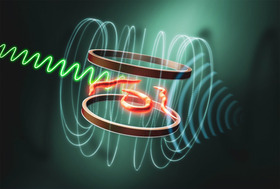
Spin waves: Superconducting circuits are an important component of many quantum computers. Spin waves support the flow of information in a single direction. Researchers at DOE’s Argonne National Laboratory and University of Illinois Urbana-Champaign have demonstrated a way to couple superconducting circuits with moving spin waves in the magnetic state of a material. This hybrid system can leverage the strengths of these two different ways of carrying information. Scientists fabricated the superconducting resonators at the Center for Nanoscale Materials, a DOE Office of Science User Facility. |
|
Dwarf planet candidate: In the far reaches of our Solar System beyond the orbit of Pluto, there is a new dwarf planet candidate, 2026 ED138. The NSF-DOE Vera C. Rubin Observatory has spotted a large, bright trans-Neptunian object. If confirmed, ED138 would be among the largest dwarf planets ever discovered in this region of the Solar System. The Rubin Observatory has an unprecedented ability to capture movement among vast numbers of cosmic objects. With the use of computer codes, scientists picked out this dwarf planet candidate. After an initial sign, the researchers found 20 more observations from Rubin and several from the DOE-fabricated Dark Energy Camera. While DOE focuses on Rubin Observatory’s astrophysics research, its partnership with the National Science Foundation enabled this discovery. |
Fusion ignition: Fusion energy researchers typically rely on an equation called the Lawson criterion to judge if a plasma in a fusion device will be hot and dense enough to sustain itself. This is called fusion ignition. However, this equation is missing several important conditions. Researchers from DOE’s Princeton Plasma Physics Laboratory have reworked that equation so that it better reflects real-world factors. They then laid out a pathway to reach ignition that uses less energy than conventional approaches. Many fusion devices raise the density of the plasma first, then add heat. This route recommends doing the opposite. It also provides other ways to reduce the energy needed to reach ignition. These findings could help scientists build more efficient fusion devices in the future. |
|
Atmospheric river: Atmospheric rivers are narrow bands of moisture that transport huge amounts of water vapor. When they hit land, they can result in intense precipitation. Researchers at DOE’s Oak Ridge National Laboratory have identified a record-breaking atmospheric river as a key cause of catastrophic flooding in the United Arab Emirates and surrounding Gulf region in April 2024. In this event, parts of the region reached more than 170 percent of the country’s average annual rainfall in just three days. This finding helps scientists better understand the role of atmospheric rivers in extreme rainfall events and how forecasting can take them into account. |
Perovskite crystals: Perovskite crystals can absorb and emit light very efficiently, as long as their atomic structure is nearly perfect. Scientists grow perovskite crystals in laboratories by arranging atoms in precise, repeating patterns. Scientists at DOE’s Argonne National Laboratory helped develop a new mechanism that gives researchers more control over how these crystals assemble. With this mechanism, scientists can produce perovskite crystalline layers with more stable performance. These improvements could help manufacturers use perovskites in better electronics. Scientists conducted much of the work at the Advanced Photon Source and Center for Nanoscale Materials, both DOE Office of Science User Facilities. |
|
Quantum biosensors: Magnetic fields influence several biological processes. This happens because certain reactions create correlated pairs of free radicals (ions, molecules, or atoms with unpaired electrons). Through a series of influences, weak magnetic fields can change free radicals’ quantum spin states and shift which pathways biochemical reactions follow. In this study, scientists from DOE’s SLAC National Accelerator Laboratory and Stanford University discovered that weak magnetic fields affect the brightness of fluorescent proteins that involve free radicals. They used magnetic fields to control these radicals and affect the proteins’ brightness. As such, the proteins can act as a quantum biosensor, even in live animals. Scientists could use this sensing to study interactions between plants, bacteria, and fungi. |
|
|
New York Times: Gaze at the cosmic dawn in dizzying detail
The Lumina computer simulation offers a look back to the conditions of the early universe. The program took about a year to run on a supercomputer at DOE’s Oak Ridge National Laboratory.
|
|
Physics to Fusion: Bringing Lab-Developed Sensor Tech to Future Energy Markets
|
|
|
Often, technology that scientists develop to make basic research possible has practical uses in other applications as well. That’s exactly what happened at DOE’s Thomas Jefferson National Accelerator Facility (Jefferson Lab).
In the early 2000s, nuclear physicists at Jefferson Lab began using silicon photomultipliers (SiPMs). SiPMs convert photons (particles of light) into electric signals. The Lab was an early adopter of this technology. SiPMs were a key part of one of the detectors in the upgrade of the Continuous Electron Beam Accelerator Facility, a DOE Office of Science User Facility.
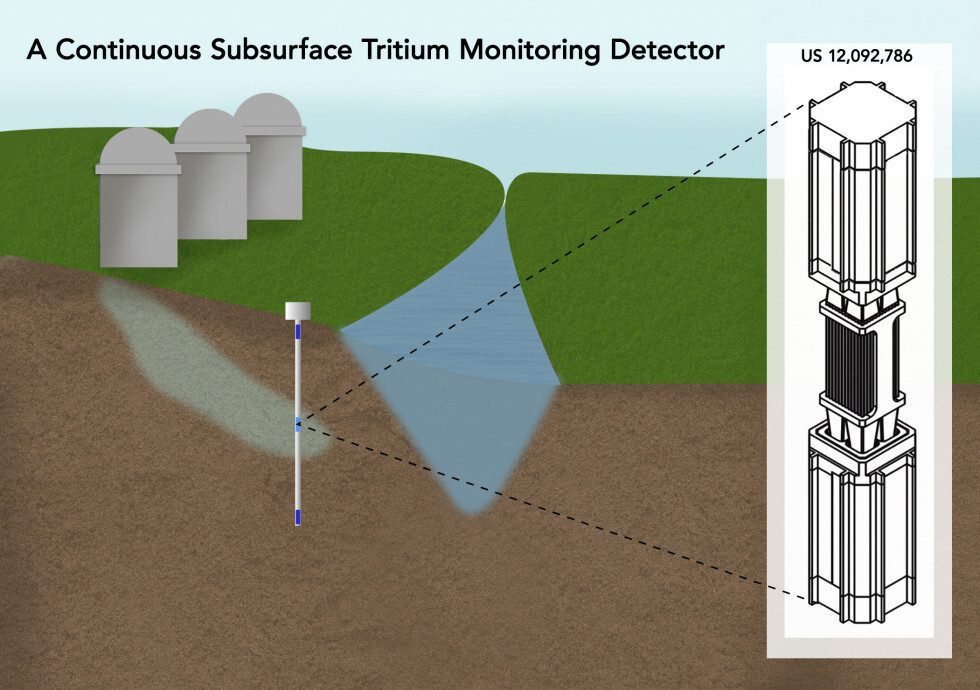
Now, Jefferson Lab is working with a private partner to develop a new technology based on SiPMs. Through a Cooperative Research and Development Agreement, Jefferson Lab and Canary Instruments are building a radiation sensing system for fusion systems. The Subsurface Continuous Radioisotope Environmental Monitor is designed to keep groundwater near future fusion facilities free of radioactive materials such as tritium.
|
|
DOE Supports Early Career Researchers Driving Discovery
|
|
|
The DOE Office of Science has selected 67 early career scientists to receive a combined $96 million through the 2026 Early Career Research Program. This program supports exceptional researchers pursuing rigorous, mission-driven research in areas critical to America’s scientific and technological leadership. The selectees represent 39 universities, 11 DOE National Laboratories and Office of Science User Facilities, and 26 states.
To learn more about the awardees, read some of the press releases from their institutions:
|
|
|
Research News Update provides a review of recent Office of Science Communications and Public Affairs stories and features. Please see the archive on Energy.gov for past issues.
|
|
|
|
|
|