|
|
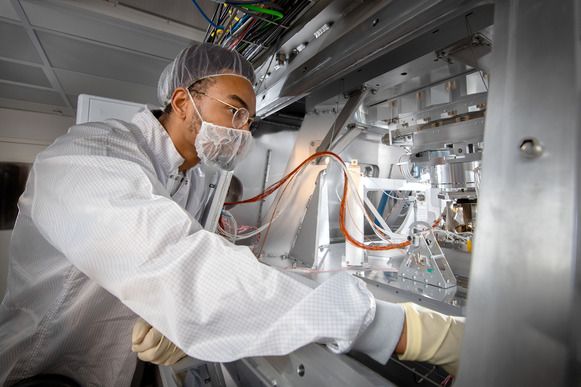
Your shiny new smartphone and laptop can multitask between video calls, superfast searches, and detailed data crunching because of small, powerful microchips – the digital brains behind every computer’s brawn. Some analysts say that the modern chip may soon run up against the limits of Moore’s Law, the concept that the number of transistors in a circuit doubles about every two years. But thanks to a technique called extreme ultraviolet (EUV) lithography, it could be decades before microchips run out of room for improvement.
Learn how researchers from the U.S. Department of Energy’s (DOE) Lawrence Berkeley National Laboratory collaborated with leaders in the microelectronics industry to develop EUV lithography.
|
|
Spacecraft heat shields: Researchers used the Advanced Light Source (a DOE Office of Science User Facility) to study how a type of heat shield material used on spacecraft degrades when they reenter Earth’s atmosphere. Scientists from NASA and the University of Illinois Urbana-Champaign used the light source to recreate the relevant conditions and observe the process in real time. The findings offer detailed, time-lapse, 3D images of this process. The research offers new details that will help engineers create better heat shields for upcoming space missions. The ALS is located at DOE’s Berkeley Lab. |
Qubit performance: Understanding why some qubits (the heart of quantum computers) hold onto information for longer than others is key to developing practical quantum computers. It is often difficult to tease out why seemingly identical qubits perform differently. Researchers at the Superconducting Quantum Materials and Systems Center (led by DOE’s Fermi National Accelerator Laboratory) have conducted one of the most comprehensive studies of this subject. The researchers compared 22 superconducting transmon qubits. They then compared how differences in materials and their structures related to variations in performance. The results can inform how scientists fabricate such devices. |
|
Nuclear matter: The Relativistic Heavy Ion Collider (a DOE Office of Science User Facility) produced the quark-gluon plasma during its quarter-century span of operations. The quark-gluon plasma is an exotic form of matter that is similar to the conditions of the very early universe. Nuclear scientists map the conditions where this form of matter shows up on a nuclear phase diagram. Researchers study where on this phase diagram the way nuclei transform into these exotic forms of matter changes. Scientists studying data from RHIC – including scientists from DOE’s Brookhaven National Laboratory – have found an intriguing spot in their data from a relatively unexplored part of the diagram. It appears at the point where the particle collisions produce the highest-density nuclear matter. The work used the National Energy Research Scientific Computing Center (NERSC), which is also a DOE Office of Science User Facility. |
Strontium: Nearly all naturally-occurring elements formed in stars. There are three possible ways that elements heavier than iron form. However, there are a few elements – including strontium – that aren’t formed by these processes. Scientists do not fully understand their origin. A team including researchers from the Facility for Rare Isotope Beams (FRIB, a DOE Office of Science User Facility) has studied the nuclear physics reaction essential for understanding how strontium is produced. With the use of tools from FRIB and the Argonne Tandem Linac Accelerator System (another DOE Office of Science User Facility), the researchers studied how the element krypton captures neutrons. Their work showed the neutron capture rate is consistently lower than theory predicts. They found the new rate improved models’ predictions of how much strontium stars produce compared to astronomical observations. |
|
Cancer therapy: Targeted alpha therapy is an emerging treatment for cancer. It uses specially created radioactive isotopes, including actinium-225. (The process to develop actinium-225 was developed by DOE National Laboratories.) Currently, there is not a reliable way to take images of actinium-225. But researchers at DOE’s Berkeley Lab have developed a new way to construct images of how actinium-225 moves through the body. This process can create images from data collected by PET scanners that clinicians currently use. The study used the National Energy Research Scientific Computing Center, a DOE Office of Science User Facility. |
Growing thin films: Many microelectronics depend on very thin films of substances to function. Scientists grow these thin films on a supporting base called a substrate. In the past, scientists assumed that this substrate mainly provides a platform for production and has little effect on how the film works. Researchers from DOE’s Argonne National Laboratory and partners found that sapphire substrates can have a significant effect on the films grown on them. Testing vanadium dioxide films, they found that changes in the film strain the sapphire substrate, which in turn affects the film and changes its behavior. Vanadium dioxide is used in computers that mimic how the brain works. |
|
Helping lithium ions flow: When a battery charges and discharges, ions move from one end of the battery to the other. These ions move through materials called electrolytes. Superionic conductors (SIC) are solids that have ions that act like liquids. One SIC is a promising material for solid-state batteries. Researchers at Duke University and DOE’s Oak Ridge National Laboratory studied how lithium ions move through this material’s structure. The findings show researchers how to improve ion flow in solid-state battery materials. This change could increase their performance and safety. The research used the Spallation Neutron Source, a DOE Office of Science User Facility. |
|
Mapping the Path Towards Quantum Computers and Super Intelligence for Science
|
|
|
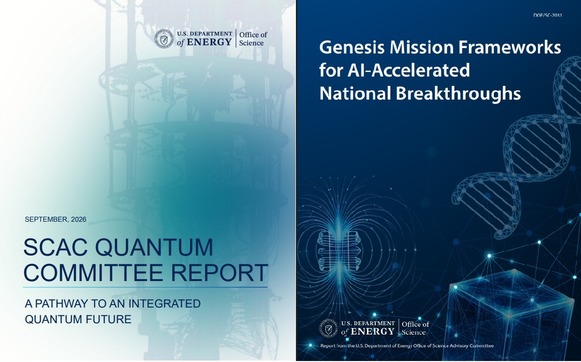
Both quantum computing and Super Intelligence (SI) are on the brink of redefining the boundaries of scientific discovery. Recently, the DOE Office of Science Advisory Committee released two reports charting a path forward for how scientists can use these technologies most effectively.
The "SCAC Quantum Committee Report: Path to an Integrated Quantum Future” proposes that success in quantum must be measured in scientific utility. This is a shift away from measuring progress through building the largest quantum computer with the most qubits. Instead, the scientific community should judge quantum computers on how useful they are for solving intractable problems. It also lays out a three-phase framework to fulfill the goals of the National Quantum Initiative.
The “Genesis Mission Frameworks for AI-Accelerated National Breakthroughs” report provides a deep dive into three major areas: harnessing biology at digital speed, SI-accelerated fusion energy, and rebuilding magnet sovereignty. The report will help guide efforts to apply SI to achieve breakthroughs in research.
|
|
Texas A&M Accelerates Discovery in Nuclear Physics
|
|
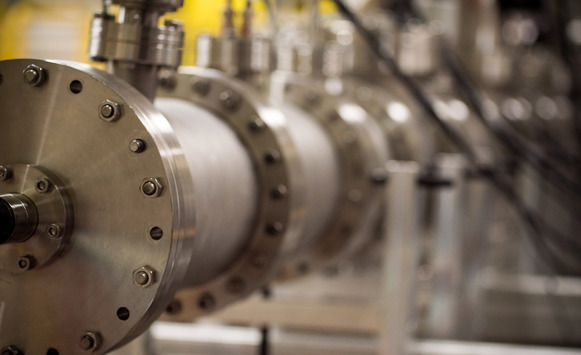 Most physics experiments produce vast amounts of data, a perfect application for Super Intelligence (SI). However, SI can also be useful for helping manage experimental tools that are delicate and complex. A single machine may have more than 20 experimental parameters, all of which can shift subtly during the course of an experiment.
Jonas Karthein at Texas A&M University is working on a project that addresses the second challenge. With support from the Genesis Mission Phase I funding from the DOE’s Office of Science, he is leading a project to create a “digital twin” – a precise digital model – of actual nuclear physics experiments. These twins will be able to find the best settings in minutes rather than hours, suggest adjustments, and flag problems. Along with other collaborators from Texas A&M University’s Cyclotron Institute, he is also working with researchers from DOE’s Argonne National Laboratory, MIT, and FRIB at Michigan State University.
This project will help improve experiments that study exotic isotopes (forms of atoms). The work will help scientists increase the amount of time they can use these machines and do so more effectively. As many other research tools have similar challenges, the team’s work could also help scientists who use those machines.
|
|
|
Research News Update provides a review of recent Office of Science Communications and Public Affairs stories and features. Please see the archive on Energy.gov for past issues.
|
|
|
|
|