|
|
Electrons zipping through transistors, powering the screens on our smartphones. Light zooming from distant stars to Earth, moving faster than anything else in the universe. Protons enabling MRI machines to analyze people’s injuries. Even though quantum particles make common technologies possible, we don’t experience these behaviors in our everyday world.
That’s why a discovery in 1985 was such a big deal. At the University of California, Berkeley, a team of three scientists supported by the Department of Energy’s (DOE) Office of Science showed that a system you could see could demonstrate quantum behavior. Four decades later, John Clarke, Michel Devoret, and John Martinis were awarded the Nobel Prize for that research.
Since then, researchers have transformed what at the time seemed like an interesting discovery into a full-blown technological field. Learn about how scientists have built on this Nobel Prize-winning research to turn superconducting qubits into one of the most promising approaches to quantum computing.
|
|
Baryon number: Physicists use the baryon number to describe an essential part of a particle’s quantum identity. It relates to the number of quarks and antiquarks in a particle. Scientists assumed the three main quarks inside a proton or neutron carried the baryon number. But research at the Relativistic Heavy Ion Collider (a former DOE Office of Science User Facility at Brookhaven National Laboratory), suggests that the gluons that hold quarks together inside of protons play a central role in baryon number as well. The finding suggests that a Y-shaped junction of gluons connecting the proton’s three main quarks are what carries the baryon number. |
AI training data: In the past, developing new catalysts required trial and error. Artificial intelligence (AI) now allows scientists to run a simulation to see how well a proposed catalyst would perform. AI can also help researchers study conditions that would be difficult to replicate in the laboratory. However, the results from AI are only as good as the data used to train it. Researchers at DOE’s SLAC National Accelerator Laboratory led a team that tested catalysts at four different laboratories. The resulting variability of results demonstrated how important standardization is in collecting this data. The team then developed guidance for producing reliable data for AI models. |
|
Hydrogels: Hydrogels are flexible materials that are used in medical implants, contact lenses, and soft robots that mimic natural organisms. Producing hydrogels requires chitin, which is usually derived from crustaceans. Researchers from DOE's Oak Ridge National Laboratory and the University of Tennessee, Knoxville developed a new way to derive chitin from fungi. They then used it to create hydrogels that are stronger and tougher than existing ones. The chitin from fungi is also less likely to cause allergic reactions and requires less processing than the type from crustaceans. The research used the Center for Nanophase Materials Sciences, a DOE Office of Science User Facility. |
Strange quarks: Researchers at DOE’s Thomas Jefferson National Accelerator Facility have found evidence of two unexpected structures that could give new insights into subatomic particles. In searching through data from the GlueX Experiment, the team found evidence of a pair of new structures that could be “strange.” (Strange structures are made up of strange quarks.) This discovery expands the potential types of measurements that researchers can do with this experiment. The work used the Continuous Electron Beam Accelerator Facility, a DOE Office of Science User Facility. |
|
Ultrathin materials: Researchers at DOE’s Lawrence Berkeley National Laboratory have found that an ultra-thin version of a common material is ferroelectric. Ferroelectric materials exhibit a spontaneous electrical alignment. Scientists can use an external magnetic field to change the direction of this alignment. As a result, ferroelectric materials can operate at a much lower voltage than standard computer hardware. Discovering ferroelectricity in an ultrathin version of titanium oxide – and potentially other common materials – could provide new, more efficient ways to power microelectronic devices. The research used the Advanced Light Source, Stanford Synchrotron Radiation Lightsource, and the Molecular Foundry, all DOE Office of Science User Facilities. |
Quantum state: In a Bose-Einstein Condensate, many particles act collectively as a single object. In this quantum state, particles lose their individual identities and behavior. Researchers have sought to create these states from pairs of electrons and holes (areas that are missing electrons) in materials. This could be a potential way to reach quantum coherence – being able to stay in a quantum state – on a larger-than-quantum scale. It could be very useful for quantum technologies. A team led by DOE’s Berkeley Lab observed a Bose-Einstein Condensate in these electron-hole pairs at high temperature in an extremely thin semiconductor. They also found that they could use a magnetic field to switch the internal structure of the condensate. |
|
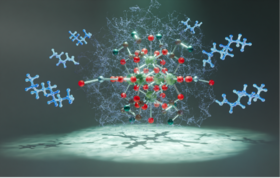
Detecting PFAS: Per- and polyfluoroalkyl substances (PFAS) are a group of artificial “forever chemicals.” When they contaminate the environment (such as groundwater), they can lead to serious human health risks. Existing methods to measure PFAS are expensive and technically complex. Researchers studied nanoclusters as a possible sensor for PFAS. They found that the clusters light up when they interact with PFAS. The detection is better than similar current techniques and easy to deploy. The method is suitable for real-world applications, such as in water treatment facilities. The researchers used tools at the Center for Functional Nanomaterials, a DOE Office of Science User Facility at Brookhaven National Laboratory. |
|
Oak Ridge National Laboratory Collaborates on Fusion Tech
|
|
|
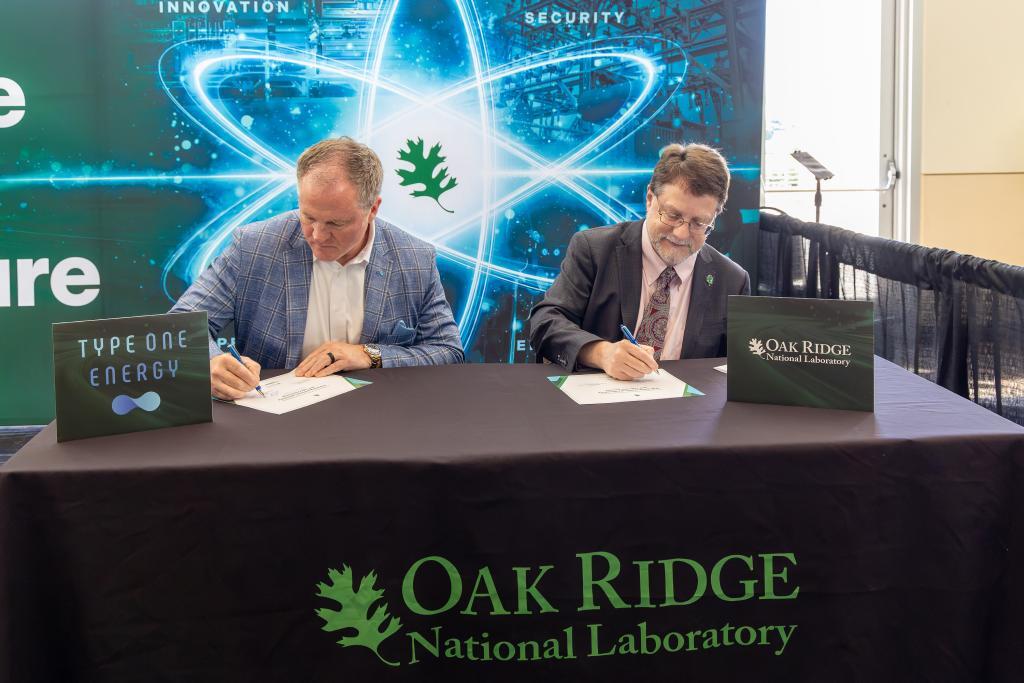
Developing a commercial fusion energy device will require collaboration between organizations in the public and private sectors. Recently, DOE’s Oak Ridge National Laboratory (ORNL) announced steps forward in this effort.
ORNL licensed a suite of technologies to design and operate cryogenic pellet fueling systems to Type One Energy. These systems form solid pellets of hydrogen at extremely cold temperatures and then inject them into a fusion plasma at high speed. These systems can be more effective at fueling the core of a plasma than other methods. Type One Energy is developing next-generation technology for a type of fusion device called a stellarator. The company has previously worked with ORNL on several major collaborations.
In addition, DOE has committed funding to establish UNITY-3, a fusion breeding blanket test facility at ORNL with Kyoto Fusioneering (KF). Breeding blankets capture energy from fusion neutrons and produce tritium, an isotope of hydrogen used as fuel for fusion. This facility will be the first one to generate high-energy neutrons that would be typical of those from a burning plasma. It will allow scientists to evaluate possible blanket designs in fusion-like conditions.
|
|
Training the Future Fusion Workforce
|
|
|
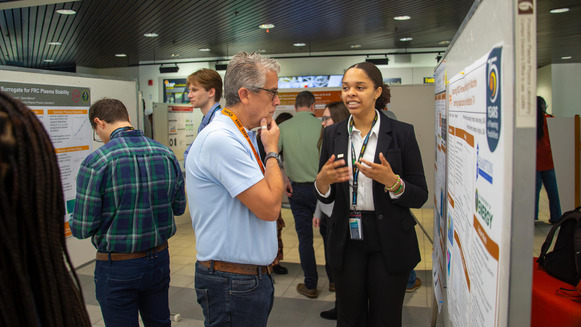
To tackle some of the world’s most challenging issues – such as developing fusion energy – DOE provides support for some of America’s brightest minds. To help reach that goal, DOE’s Princeton Plasma Physics Laboratory hosted more than 30 interns and 15 Plasma Pathways Summer School students this year. Many of these students were through the Science Undergraduate Laboratory Internship and Community College Internship programs run by the Office of Workforce Development for Teachers and Scientists at DOE’s Office of Science.
These students came from across the country to participate in hands-on research, technical training, and professional development experiences. Through these activities, the laboratory introduced them to plasma physics, fusion energy, and the technologies that support those areas of research.
|
|
|
Research News Update provides a review of recent Office of Science Communications and Public Affairs stories and features. Please see the archive on Energy.gov for past issues.
|
|
|
|
|