|
|
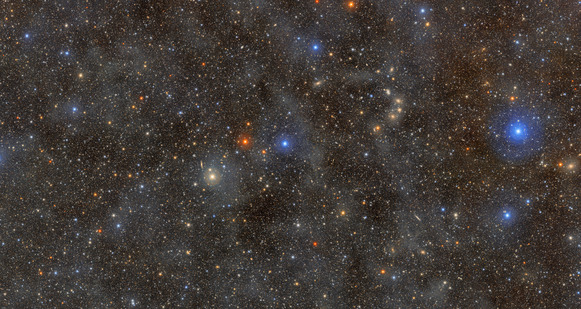
From a mountaintop in Chile, under clear dark skies, NSF–DOE Vera C. Rubin Observatory has begun the revolutionary Legacy Survey of Space and Time (LSST). The ten-year survey is Rubin’s signature campaign to create the most comprehensive, cinematic record of the Universe in history.
NSF–DOE Rubin Observatory, funded by the U.S. National Science Foundation and the U.S. Department of Energy’s (DOE) Office of Science, is now capturing the cosmos in unprecedented detail, transforming the way we study the dynamic Universe.
Over the next ten years, Rubin will relentlessly observe the entire southern sky every few nights to create an ultra-wide, ultra-high-definition time-lapse record of our Universe. This long-awaited milestone is the culmination of years of effort by thousands of people around the world.
Learn more about the LSST and what scientists expect to learn from it.
|
|
Alpha decay: Alpha decay is an important form of radioactivity. In this process, an alpha particle (a system of two neutrons and two protons bound together) tunnels through the nucleus that holds it. While scientists have known about the process for more than a century, they still don’t know how the alpha particle forms in heavy nuclei. Researchers at the University of Tennessee, DOE’s Oak Ridge National Laboratory, and their partners have made critical measurements of how the isotope tellurium-104 breaks down. As tellurium-104 can provide special insight into alpha decay, measuring its lifetime and decay energy is an important step towards understanding this fundamental process. |
Supply chains for quantum computers: One of the key barriers to improving quantum computers is “noise” from the materials used to make them. A collaborative effort between DOE’s Oak Ridge National Laboratory and Pacific Northwest National Laboratory supported by the DOE’s Office of Isotope R&D and Production has developed new technologies to produce materials that are much purer than ever before. These technologies can produce ultra-enriched silane and germane that are extremely low in the contaminant isotopes that create noise. They are 100 times more depleted of isotopic noise than any commercially available material worldwide, an important milestone for quantum computing. |
|
Steering molecules: Both controlling chemical reactions with laser light and taking images of chemical reactions are useful to materials scientists, chemists, and biologists. But until now, scientists couldn’t combine those two functions. For the first time, researchers at DOE’s SLAC National Accelerator Laboratory took images of a chemical reaction as they controlled it with laser light. Using X-rays from the Linac Coherent Light Source (a DOE Office of Science User Facility), they illustrated how atoms move in a molecule as scientists controlled that molecule. This technique will allow scientists to study how the structures of molecules change during coherently-controlled chemical reactions. |
Modeling quantum mechanics: Certain natural processes are too complex for even the most powerful classical computers to analyze. One example is hadronization, which is when two quarks bind together to form composite particles such as protons and neutrons. Quantum computers offer the potential to simulate these processes. A researcher at DOE’s Lawrence Berkeley National Laboratory recently simulated a simplified version of hadronization on an IBM quantum computer accessed through the Quantum Computer User Program. The program is managed by the Oak Ridge Leadership Computing Facility, a DOE Office of Science User Facility. This study lays the groundwork for physicists to effectively use quantum computers in the future. |
|
High-temperature superconductors: Superconducting materials can conduct electricity without losing energy as heat. While room temperature superconductors could lead to more efficient generation and delivery of electricity, most are only superconducting at temperatures near absolute zero. Researchers from the University of Houston and DOE’s Argonne National Laboratory have developed a superconductor that works at 30 degrees higher than the best previously known high-temperature superconductor. Unlike similar efforts that require extremely high pressures to be superconducting, this material maintained that property at room temperature. The researchers used the Advanced Photon Source, a DOE Office of Science User Facility. |
Quantum computing toolkit: Quantum computers cannot use the same algorithms as classical computers. To run calculations on them, scientists must develop new algorithms. Currently, there are a few simple, standardized operations that allow quantum computers to leverage their unique functions. However, scientists are still missing many of these fundamental building blocks. Researchers at DOE’s Brookhaven National Laboratory and their partners developed a new quantum algorithm that addresses a common function in engineering and physics. It provides a way to apply this algorithm to quantum states and run it on a quantum computer. This finding could help expand quantum computing’s impact on real-world science. |
|
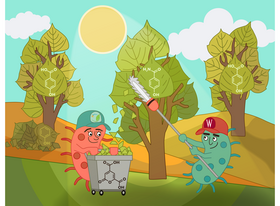
Transforming waste: To produce biofuels and other plant-based products, manufacturers must break apart parts of plant cell walls. This process produces leftover liquid with hazardous compounds. Being able to convert this waste into valuable products could make biofuel production more cost effective. Researchers from the DOE-supported Great Lakes Bioenergy Research Center studied the potential for transforming this liquid waste into fuels or valuable chemicals. They identified molecules that could be made into valuable chemicals and evaluated how the production process affects these compounds. Finally, they tested using microbes to convert these compounds into chemicals for plastics, adhesives, and medicines. |
|
First Genesis Mission Projects Selected to Accelerate AI-Driven Scientific Discovery
|
|
|
DOE recently announced the first projects selected under the Genesis Mission Request for Applications. The 278 projects involve 342 participating institutions, including DOE National Laboratories, universities, private companies, non-profit organizations, and other institutions.
The Genesis Mission brings together DOE’s world-class scientific capabilities, advanced artificial intelligence (AI), high-performance computing, and the nation’s leading researchers to transform how scientific discovery is conducted. It aims to strengthen American leadership in science and technology and double America’s scientific productivity. These research teams will help develop and demonstrate AI-enabled scientific workflows to accelerate breakthroughs in energy, discovery science, and national security.
|
|
Installing ITER’s Solenoid Module
|
|
|
Achieving commercial fusion energy will require a variety of projects and experiments that improve our technology and knowledge.
Once built, ITER will be the world’s largest tokamak, one of the most promising designs for future fusion power plants. The project is a collaboration between 34 nations to investigate and demonstrate a burning plasma. This is when fusion reactions produce enough energy to maintain the temperature of the plasma. ITER will also test various technologies needed for a fusion power plant. DOE’s Office of Science is a major partner on the project.
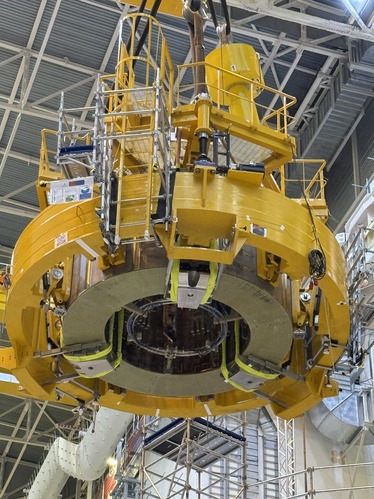
One of ITER’s key technologies is a set of superconducting magnets called solenoids. ITER’s Central Solenoid creates and sustains the plasma current for fusion. It will also help control the plasma’s position and shape.
Recently, the team lifted the sixth and final module of ITER’s Central Solenoid into place. After years of manufacturing, transportation, and assembly, this was a major step forward in constructing one of ITER’s most important systems.
|
Research News Update provides a review of recent Office of Science Communications and Public Affairs' stories and features. Please see the archive on Energy.gov for past issues.
|
|
|
|
|
|