|
|
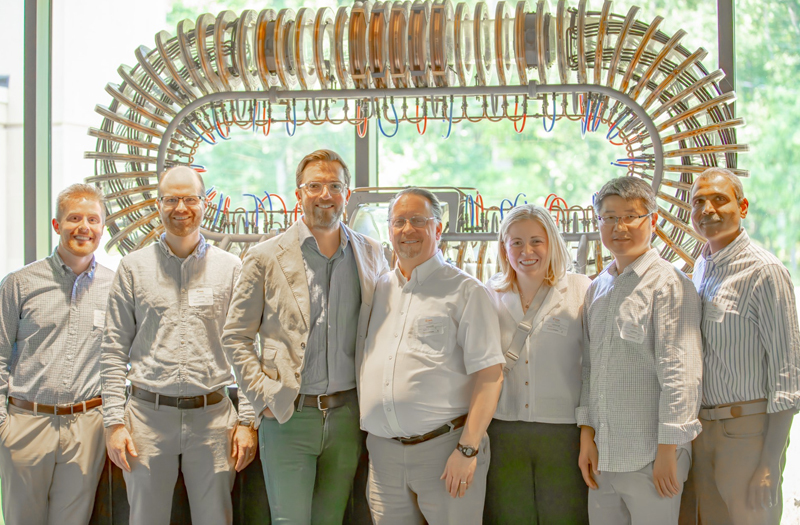
Fusion reactions power our sun and other stars. Studying those reactions and recreating them in the laboratory helps physicists understand the forces that shape our universe. That basic research may also lead to fusion energy technology that could generate limitless energy on Earth.
To create fusion reactions, physicists use several types of devices. Two of these — stellarators and tokamaks—mimic the stars. They use powerful magnetic fields to squeeze together light elements. These experiments turn light elements into plasma, the hot, charged state of matter filled with free electrons and atomic nuclei.
Learn how the Department of Energy has been building the research foundations that support fusion technology – including stellarators – for decades.
|
|
Artificial muscles: Harvard University researchers have developed a strategy for 3D printing that creates programmable materials that bend, twist, expand, or contract when heated or cooled. They are a major step towards mimicking the complexity of biological muscles. The process begins with thin filaments that it transforms into building blocks for complex structures. Potential applications include soft robotic grippers, active filters and valves, and filaments for medical situations that need rapid clotting of tissues. The researchers used the National Synchrotron Light Source-II, a DOE Office of Science User Facility. |
Matterchat: Researchers at DOE’s Lawrence Berkeley National Laboratory have developed a new artificial intelligence (AI) framework called Matterchat. It connects a large language model with a physics-based AI that models the forces between atoms. This solution allows researchers to leverage the functionality of a large language model with the ability to analyze high-resolution, 3D physical data. Researchers aim for it to generate step-by-step instructions for creating new materials. The researchers used the National Energy Research Scientific Computing Center, a DOE Office of Science User Facility. |
|
Longer-lasting batteries: When lithium-ion batteries fail, it is often because their cathodes have cracked after repeated charging and discharging. Researchers at DOE’s SLAC National Accelerator Laboratory and Stanford University found a way to solve this problem in nickel-rich layered-oxide cathodes. Batteries for data centers and energy storage use this type of cathode. The team found that small adjustments to the heating process during manufacturing could create more uniform structures that are less likely to crack. The team used the Stanford Synchrotron Radiation Light Source and the National Synchrotron Light Source-II, both DOE Office of Science User Facilities. |
Soft materials: Many materials shift between holding their shape like a solid and flowing like a liquid. Scientists do not fully understand this process, especially inside of dense, opaque fluids. Researchers at DOE’s Argonne National Laboratory and the University of Chicago tracked materials as they yielded and flowed. They found that tiny differences in how materials attract and repel each other have a major influence on how the material flows or turns solid under stress. These results could help engineers design better products and manufacturing processes. The researchers used the Center for Nanoscale Materials and the Advanced Photon Source, both DOE Office of Science User Facilities. |
|
Medical radioisotopes: Radium-226 (Ra-226) is a rare and valuable feedstock for cancer-fighting therapies. Irradiating Ra-226 can convert it into several important radioisotopes that target radiation directly at tumors. DOE’s Office of Isotope R&D and Production within the Office of Science and the Department of Commerce’s National Institute of Standards and Technology recently recovered significant qualities of Ra-226 from radiological waste at NIST facilities. The agencies collaborated with DOE’s Pacific Northwest National Laboratory to convert these unused materials into a useful resource. This project is part of a larger effort to identify, recover, and repurpose legacy Ra-226 materials. |
Materials for artificial vision: Visual systems in humans act as both sensors and processors. While scientists have not been able to reproduce this system, they have discovered materials that can mimic some aspects of vision. Optoelectronic synapses are materials that conduct electricity better after they absorb light. A team of scientists from DOE’s National Laboratory of the Rockies, DOE’s Berkeley Lab, Texas A&M University, and Istituto di Struttura della Materia-CNR have learned why a particular vanadium-oxide material has this characteristic. They discovered how the chemical structure of this material contributes to this property. It opens the door to creating new materials with machine vision. |
|
Nuclear shape: When particle colliders crash heavy ions into each other at high speeds, it creates the quark-gluon plasma. This state of matter was present at the very beginning of the universe. Scientists at the Facility for Rare Isotope Beams (FRIB, a DOE Office of Science User Facility) studied collisions between larger lead-208 nuclei and smaller neon-20 nuclei. The neon-20 has the shape of a bowling pin, which produces patterns in how particles flow after a collision. These particles provide evidence of these collisions forming the quark-gluon plasma. This study also demonstrates that nuclear shapes can leave a “fingerprint” of how particles flow in such collisions. This information can provide insights into how matter behaved at the beginning of the universe. |
|
Novel Detector Technologies Improve Breast Cancer Imaging and Cancer Treatment
|
|
|
Advanced technologies originally developed at DOE’s Thomas Jefferson National Accelerator Facility (Jefferson Lab) for studying the tiniest particles inside matter have been adapted to aid doctors in diagnosis and treatment of breast cancer patients.
Regular screening with mammography is the gold standard. An alternative screening technique used alongside mammography – called molecular breast imaging (MBI) – can reduce the number of false positive screening results. It can also spot cancers too small to see via mammography.
Many of the technologies that enable MBI were developed at Jefferson Lab for use in discovery science research. A suite of patents licensed by Dilon Technologies, Inc., was further developed into the first MBI system on the market. Deployed in dozens of clinics nationwide, these systems have saved women’s lives.
Now, Jefferson Lab researchers are working to improve MBI with even better image quality and more precise tumor location abilities. They are adding a new device called a variable-angle slant hole collimator. Preliminary tests have demonstrated that the new device enables existing MBI systems to provide up to six times more contrast in images of tumors. It also maintains the same or better image quality while halving radiation dose to patients.
|
|
Argonne Celebrates How Science Saved the World in “Project Hail Mary”
|
|
|
While science fiction often isn’t very realistic, the book and movie “Project Hail Mary” have some major scientific chops. The heroes draw on science, engineering, and collaboration to save the world from an organism “eating” the sun. In fact, author Andy Weir interned at DOE’s Sandia National Laboratories as a teenager!
To dig deeper into the science behind the story, DOE’s Argonne National Laboratory organized several outreach efforts related to the movie. First, the lab and the University of Chicago hosted a special prerelease screening of the movie, followed by a panel discussing the science. The lab then followed up with a series of video shorts connecting the movie with the lab’s research and a panel at the Chicago Comic and Entertainment Expo. From microbes to astrophysics, the panel expanded fans’ knowledge far beyond the stars described in the movie.
|
|
|
Research News Update provides a review of recent Office of Science Communications and Public Affairs stories and features. Please see the archive on Energy.gov for past issues.
|
|
|
|
|