|
|
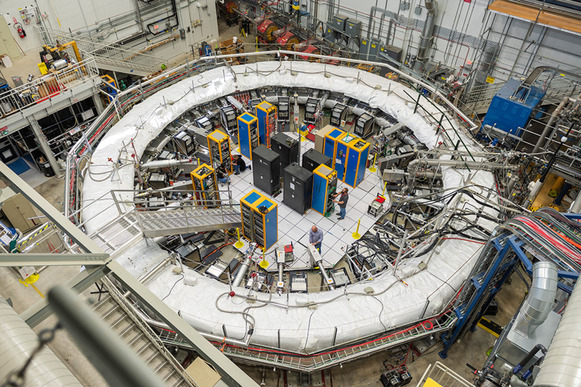
A small wobble may not seem like a big deal. But when that small wobble could answer some of the most important questions in physics, scientists pay attention. The wobble in question belongs to the muon, a fundamental particle that’s the cousin of the more familiar electron.
For tackling the question of why experimental measurements of this wobble didn’t match what theory predicted, the Muon g-2 collaboration received this year’s Breakthrough Prize in Fundamental Physics. The Breakthrough Prize recognizes the world’s top scientists working in the fundamental sciences – the disciplines that ask the biggest questions and find the deepest explanations.
Learn more about how the Muon g-2 collaboration spanned nearly 60 years of scientific research, most of it supported by the Department of Energy’s (DOE) Office of Science.
|
|
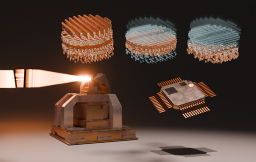
Superconductors by design: Electricity flows through superconductors without losing energy to heat. If scientists could create superconductors that work at or near room temperature, they could be extremely useful in a variety of technologies. Scientists at DOE’s Argonne National Laboratory and Northwestern University are working to predict and design new superconductors and other materials. In particular, they are working to understand and control how these materials’ atomic structures form. The team created 10 different compounds that had the same ratio of elements, but different structures. The team used the Advanced Photon Source and the Center for Nanoscale Materials, both DOE Office of Science User Facilities. |
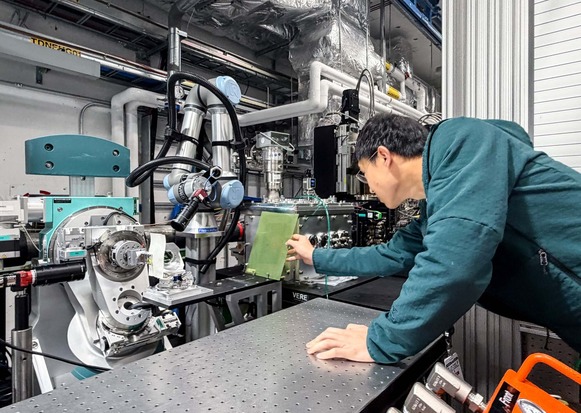
Accelerating drug discovery: Normally, discovering new medical drugs is a time-consuming process of trial and error. In many cases, scientists create 3D models of proteins to help them decide where and how a drug molecule may fit into and influence that protein. Scientists at the National Synchrotron Light Source-II (a DOE Office of Science User Facility) are piloting a program to make this process faster, more efficient, and less expensive. This process uses fragments of drug-like molecules to see if they latch onto specific protein targets instead of whole ones. These fragments are simpler and easier to work with, enabling scientists to investigate more deeply. This approach also simplifies the process of refining these complexes into new drugs. |
|
Altermagnetism: Scientists have found that hematite (rust) has a key signature of altermagnetism. Altermagnetism is a type of magnetism where electron spins align in opposite directions. In this state, spin currents flow without creating a net electric charge. Altermagnetic materials may be ideal for spintronics, a type of technology that relies on electron spin rather than electron flow. They could be extremely valuable in wireless communication, quantum computing, and other technologies. Hematite is especially appealing because it is inexpensive and extremely common. This study used the Spallation Neutron Source, a DOE Office of Science User Facility. |
Designing proteins: Researchers used the Stanford Synchrotron Radiation Lightsource and Advanced Light Source (both DOE Office of Science User Facilities) to create a new way to design proteins. It combines two separate methods, crystallographic fragment screening and directed evolution. This new approach could offer a simpler way to improve enzymes and medications. To test it, the scientists redesigned a well-known protein into two new proteins. These proteins were just as active as natural ones. This process could open the door to creating less toxic enzymes or complex molecules for pharmaceuticals. |
|
Quantum chemistry: Graphic processing units were originally used in video gaming systems, but now are widely used in supercomputers. A team of researchers that included members from DOE’s Pacific Northwest National Laboratory demonstrated that software created for this hardware can solve the hardest calculations in quantum chemistry. This software solved two chemical structures that are usually seen as too complex to tackle. This discovery could help researchers design new catalysts and improve our understanding of behavior in materials. |
Magnetizing plasma: Researchers at DOE’s Princeton Plasma Physics Laboratory discovered the mechanism that allows plasma to spontaneously generate its own magnetic fields. This information could contribute to the development of direct-drive inertial fusion. In this type of fusion, powerful lasers compress a small fuel-filled capsule. The lasers heat the capsule until fusion reactions occur. Magnetic fields can change how the heat moves through the plasma, affecting the plasma’s behavior and temperature. |
|
Fast scanning microscope: It is possible for scientists to take images using X-ray microscopes at the nanometer scale. However, it can take a long time and cause radiation damage. Researchers at DOE’s Brookhaven National Laboratory developed a high-speed, low-maintenance X-ray microscope that can take images at this resolution in about an hour. Previously, this task took a full day. In addition to its current use, this tool also sets the stage for the next generation of high-resolution X-ray microscopes. |
|
Upgrading the Linac Coherent Light Source
|
|
|
Located at SLAC National Accelerator Laboratory, the Linac Coherent Light Source (LCLS) is a DOE Office of Science User Facility that captures ultrafast images of processes. It’s currently in the process of being upgraded. When the upgrade is complete, LCLS will have a significant increase in X-ray output.
Before that happens, scientists must ensure that the equipment at the LCLS can handle this increase. One of these tools is the X-ray Pump Probe Instrument, which scientists use to study everything from quantum information storage to X-ray optics. To prepare for the upgrade, the team at SLAC recently finished a rebuild of the X-ray Pump Probe Instrument. It’s now back online for researchers to use.
While the SLAC team was completing that project, another key part of the upgrade was happening at DOE’s Fermilab. The team at Fermilab has now completed building and delivering the final component it is providing to the LCLS upgrade. Fermilab previously provided a superconducting accelerator to the tool, which allows it to produce X-ray laser beams 10,000 times brighter than before. Now, the upgrade will be adding 23 more cryomodules. These are pieces of particle accelerators that accelerate the beams. Fermilab recently completed its contribution to the cryomodules.
|
|
Fermilab Welcomes Baby Bison
|
|
While DOE’s Fermilab is best known for its scientific research, it also has an unusual spring tradition – the birth of the first newborn American bison calf. The bison herd dates back to the beginning of the lab, when founder Robert Wilson intended to connect the laboratory with the Illinois prairie ecosystem. The current herd has two bulls and 23 female cows, tended to by the lab’s herdsman. Each year, the lab welcomes about 20 new calves over the course of spring and summer. This year, the first calf was born on April 21. You can see the bison – including the calves – on the lab’s bison cam. |
|
|
Research News Update provides a review of recent Office of Science Communications and Public Affairs stories and features. This is only a sample of our recent work promoting research done at universities, national labs, and user facilities throughout the country.
|
|
|
|
Please see the archive on Energy.gov for past issues.
No. 154: 18 May 2026
|
|
|
|