|
|
A tree rises up through the forest canopy. Its tall branches split off into twigs with sharp needles sprouting from each one. The needles are green all year long, whether in the sunny summers or snowy winters of the Rocky Mountains.
But look closer. Even closer. So close that you need a microscope to see the tiny inhabitants of this pine needle.
With that help, you’ll find a vast diversity of microbes, complex enough to rival a city. This level is where microbiologists work. They explore these interconnected communities full of bacteria, viruses, fungi, and archaea. The knowledge they gain can provide information about keeping both agricultural crops and natural ecosystems healthy.
Learn about how microbiologists used the powerful resources at the Joint Genome Institute (a Department of Energy [DOE] Office of Science User Facility) to dive into the microbial communities that live on the surfaces of conifer needles and what they found.
|
|
3D map of the universe: The Dark Energy Spectroscopic Instrument has finished the five-year mission it was originally planned for. It has mapped more than 47 million galaxies and quasars, far more than researchers expected to be able to gather data on. This is the largest high-resolution 3D map of the universe to date and the project is continuing observations to expand it even further. By comparing how galaxies clustered in the past with how they do today, this extended map will provide even more insight into the accelerating expansion of the universe (dark energy). |
Scalable quantum systems: Modern electronics rely heavily on silicon, which can be reliably manufactured at scale. While many quantum technologies use specialized materials, scientists are looking to use silicon instead. This switch would allow them to scale up production of quantum technologies. Researchers at DOE’s Brookhaven National Laboratory who are part of the Co-design Center for Quantum Advantage recently built superconducting quantum interference devices using a class of materials that is compatible with silicon. The work used the Center for Functional Nanomaterials, a DOE Office of Science User Facility. |
|
Viral hijacking: Bacteriophages are a type of virus that infect bacteria and replicate inside of them. These viruses have genes that make it possible to take over bacterial cellular machinery. Researchers from DOE’s Pacific Northwest National Laboratory studied how viral hijacking via these genes affects cellular metabolism. They found that the virus needs to hijack only 17 targeted reactions to trigger a result that changes more than 30 percent of the host cell’s metabolic network. The work used the Environmental Molecular Sciences Laboratory, a DOE Office of Science User Facility, and included interns supported by the Office of Workforce Development for Teachers and Scientists. |
Iridium chemistry: The metal iridium is essential in a variety of applications, including aerospace, electronics, and metal extraction. Researchers at DOE’s Argonne National Laboratory studied iridium’s chemical reactions at the boundary where a solid electrode’s surface meets a water-based electrolyte. (This is important because iridium is used in electrochemical processes.) The reactions at this border affect how iridium behaves and how stable it is. The team found that the metal’s behavior changes substantially depending on the metal’s crystal structure and how much voltage scientists applied. |
|
Modeling cosmic storms: Turbulence is the unstable flow of heat and mass. Understanding turbulence is important for studying how plasma moves and behaves in supernovae and fusion reactors. Researchers from DOE’s Argonne National Laboratory used Frontier at the Oak Ridge Leadership Computing Facility (a DOE Office of Science User Facility) to train an artificial intelligence model that simulates magnetic turbulence within a plasma. This model is far more detailed than previous ones. |
Neutrinos: Neutrinos are fundamental, extremely common particles that are incredibly difficult to detect. There are three known types of neutrinos and many unanswered questions about them. Finding a potential fourth type of neutrino – known as the sterile neutrino – could answer a number of these questions. The ICARUS experiment – hosted at DOE’s Fermi National Accelerator Laboratory – will search for the sterile neutrino and advance techniques for other neutrino experiments. The ICARUS collaboration announced its first physics results from their research on how and when neutrinos change types. |
|
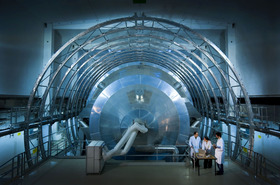
Neutrino mass: The mass of a neutrino has major implications for our understanding of nuclear and particle physics, as well as the universe overall. While scientists have known that the neutrino has a mass since 1998, the actual mass is still unknown. The international KArlsruhe TRItium Neutrino (KATRIN) experiment has made an incredibly precise measurement of the neutrino’s mass. Unlike similar experiments, KATRIN’s direct method relies only on the fundamental fact in physics that energy is conserved. Based on these measurements, scientists determined that the mass of a neutrino is more than one million times lighter than the mass of an electron. |
|
Using Microbes to Turn Waste Gases into Valuable Chemicals
|
|
|
Fossil fuels are the source of chemicals found in countless products we use every day, from plastics to soaps. In the search for alternatives, a team of scientists from LanzaTech, Northwestern University, and DOE’s Oak Ridge National Laboratory (ORNL) has developed technology that harnesses industrial emissions to produce valuable chemicals.
This technology uses microorganisms as tiny but powerful factories to convert carbon in gases released by agriculture, industry, and municipal waste into acetone and isopropanol. Companies use these chemicals to make thousands of products, from fuels and solvents to fabrics and clear acrylic.
LanzaTech is currently scaling up the technology. The process can be inserted into existing systems and deployed for use around the world. In addition to Oak Ridge’s contributions, the research also used the Joint Genome Institute, a DOE Office of Science User Facility.
|
|
Graphite Reactor Physicist Returns to Oak Ridge National Laboratory
|
|
|
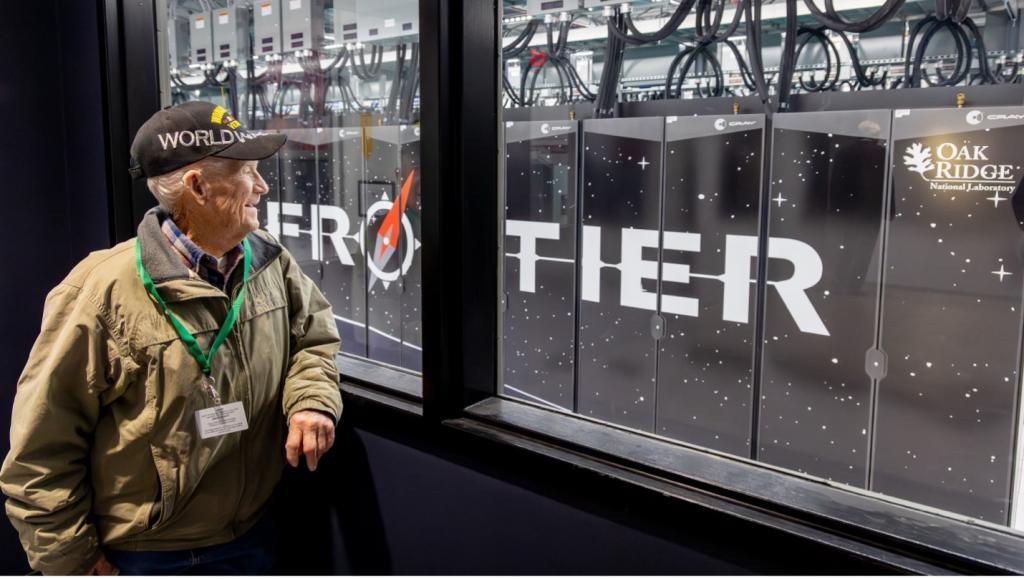
The Department of Energy and its predecessors have witnessed several major historical events – and so has Ross E. Blevins.
A veteran of both World War II and the Korean War, Blevins worked from December 1956 until April 1969 in nuclear physics research at DOE’s Oak Ridge National Laboratory. He worked at several locations at the lab, including the Graphite Reactor and the High Flux Isotope Reactor (a DOE Office of Science User Facility). At the Graphite Reactor, he tested the major metallic elements in the Periodic Table of Elements, contributing important information about their properties. He later went on to work at the Tennessee Valley Authority to establish the organization’s first nuclear power plants.
Recently, Blevins revisited ORNL and shared memories about his experiences there as well as the many famous people he met throughout the years.
|
|
|
Research News Update provides a review of recent Office of Science Communications and Public Affairs' stories and features. Please see the archive on Energy.gov for past issues.
|
|
|
|
|