|
|
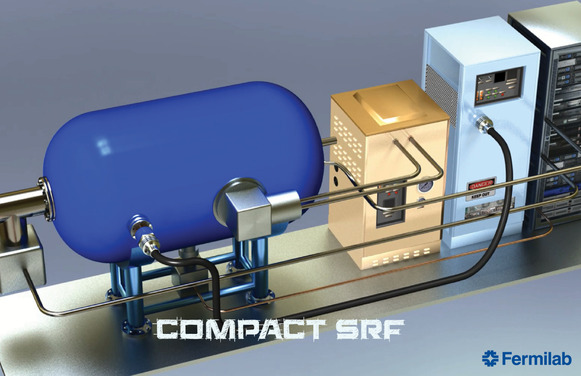
Particle accelerators are an important scientific tool, allowing researchers to study the tiniest particles that make up the universe and the forces that shape those particles. But particle accelerators are for much more than research. Accelerators are widely used in industry, with more than 30,000 in operation worldwide. These accelerators support medicine, transistor manufacturing, material processing, waste treatment, and national security. Today’s particle accelerators work at room temperature, are not very energy efficient, and can be the size of a small building. This limits their use to specific applications.
But imagine if particle accelerators could make house calls. A team from the Department of Energy’s (DOE) Fermi National Accelerator Laboratory is working to make that possible. Learn more about how they’re developing a powerful, compact, and mobile electron accelerator.
|
|
Superconducting qubits: Qubits enable quantum computers to make calculations, just as bits enable conventional computers to do so. However, qubits are very sensitive to background “noise” and prone to errors. Gamma rays can act as a source of that noise. Researchers at DOE’s Fermilab used a special underground lab to study how gamma rays affect superconducting qubits and what other sources could cause bursts of energy that move through quantum chips. These results could help improve both qubits for quantum computers and sensors for particle physics research. |
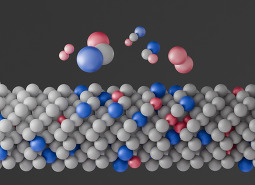
Protein self-assembly: Understanding how proteins form on a solid surface is important for developing catalysts, biosensors, and biomedical devices. Researchers at DOE’s Pacific Northwest National Laboratory and the Center for Science of Synthesis Across Scales (a DOE Energy Frontier Research Center) found that algorithms to design proteins are missing important physical forces. The team used machine learning to analyze how protein nanoribbons oriented themselves on a surface made of mica. They found that water molecules on the surface affected the protein assembly. |
|
Hubble tension: The Hubble constant is the rate at which the universe is expanding. However, there are two different rates, depending on whether researchers calculate it from measurements of stars and supernovae or measurements of the cosmic microwave background. A team that includes researchers from DOE’s SLAC National Accelerator Laboratory did computer simulations of the first hundred thousand years of the universe. They found that by including magnetic fields early in the simulation of the universe, they could potentially resolve this discrepancy. |
Improving chestnuts: The American chestnut tree was once present across eastern forests and essential as a source of both food and wood. However, two fungal species wiped out almost all of them in the 1900s. Researchers at DOE’s Oak Ridge National Laboratory and the Joint Genome Institute (a DOE Office of Science User Facility) are part of a team identifying genes and strategies to improve resistance to blight in American chestnut trees while maintaining their positive attributes. Drawing on capabilities developed as a result of Office of Science investments, the ORNL researchers looked at what chemicals blight-resistant chestnut trees produce. |
|
Designing materials: Carbon is an incredibly versatile element that develops new properties under extreme conditions. Researchers at DOE’s Argonne National Laboratory examined nanodiamonds similar to those formed in explosive environments with extreme temperatures and pressures. They simulated how the nanodiamonds transform atom by atom, using computers at the Argonne Leadership Computing Facility and the Oak Ridge Leadership Computing Facility (both DOE Office of Science User Facilities). By then feeding this data into an AI model, they developed a way to predict what nanocarbon will form depending on a given set of conditions. This information will help scientists design materials faster and more efficiently. |
Catalysts: Catalysts are essential to speeding up chemical reactions in a variety of applications, including chemical manufacturing and energy production. Finding new ones that are better than existing ones is a slow and expensive process. Researchers at DOE’s Brookhaven National Laboratory developed a multi-layer machine learning approach that follows the same type of process that scientists would conduct in trial-and-error experiments. They tested the new model by having it look for catalysts to convert carbon dioxide to methanol. It outperformed conventional models in the test. It also revealed new information about how scientists can control key reactions that influence a catalyst’s effectiveness. The study used the Center for Functional Nanomaterials, a DOE Office of Science User Facility. |
|
Semiconductors: Modern electronics rely on semiconductors. Many semiconductors consist of one element with small amounts of other elements that can form subtle patterns. These patterns affect how electrons move, influencing how the material conducts electricity or light. Understanding and controlling these patterns could allow researchers to design faster and more efficient devices. Researchers at DOE’s Lawrence Berkeley National Laboratory visualized and analyzed these atomic motifs for the first time. |
|
Waste Leads to Versatile, Reusable Adhesive
|
|
|
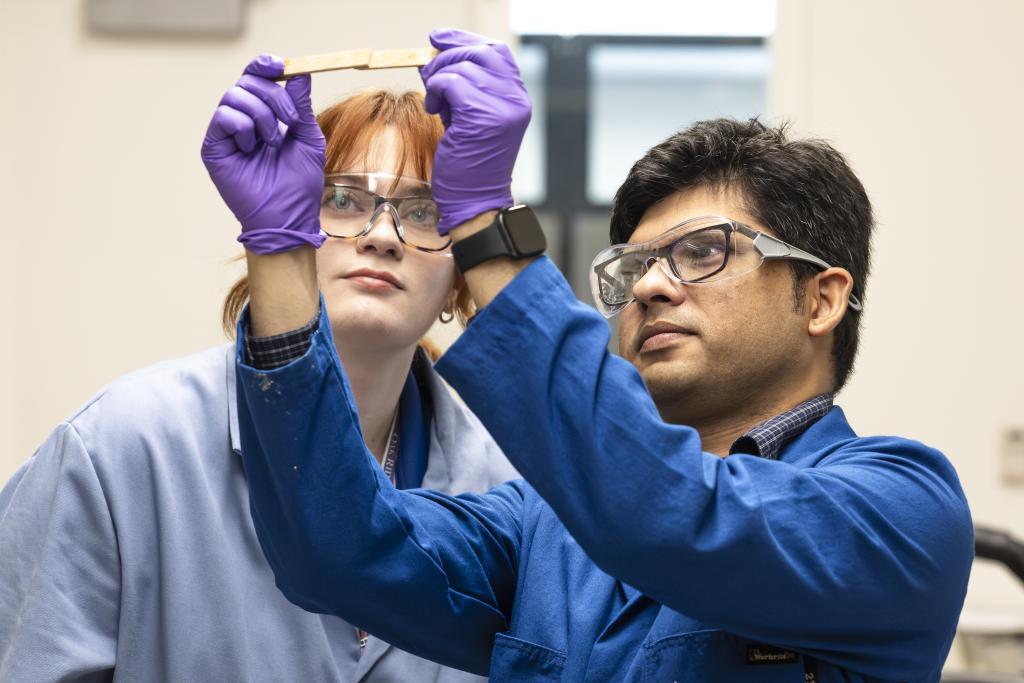
Adhesives are useful for all sorts of applications, from making crafts to joining together automobile components. But each of these applications requires a different type of glue depending on the surface of the material. A new adhesive developed by scientists at DOE’s Oak Ridge National Laboratory may make that a thing of the past.
The ORNL team developed a reusable adhesive that is tougher than commercial glues, works in a variety of environments, and bonds a number of different materials. In contrast to glues that set permanently after one use, it creates Velcro-like crosslinks that can soften, detach, and be reused. The new adhesive is made from waste polymers from beverage bottles, fabric fibers, and packaging films. As such, it may potentially save time and energy in manufacturing. In the research, the scientists used the Center for Nanophase Materials Sciences, a DOE Office of Science User Facility.
|
|
40 Years of Nuclear Physics at ATLAS
|
|
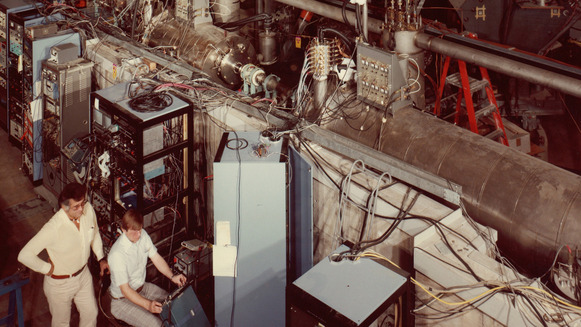
By studying the building blocks of matter, nuclear physicists shed light on reactions inside stars and the processes that created most elements. For 40 years, the Argonne Tandem Linac Accelerator System (ATLAS) – a DOE Office of Science User Facility – has been a key tool in that exploration. Commissioned in 1985, physicists designed ATLAS to be an unprecedented tool for nuclear physics. It was one of the first tools to use superconducting technology to speed up heavy-ion beams so that scientists could study atomic nuclei. Since then, the facility has continued to expand its capabilities, enabling research on rare isotopes, gamma rays, and nuclear astrophysics. |
|
|
Research News Update provides a review of recent Office of Science Communications and Public Affairs stories and features. This is only a sample of our recent work promoting research done at universities, national labs, and user facilities throughout the country.
|
|
|
|
Please see the archive on Energy.gov for past issues.
No. 152: 6 April 2026
|
|
|
|
|