|
|
Choongseok (C.S.) Chang, a physicist at the Department of Energy’s (DOE) Princeton Plasma Physics Laboratory, has spent decades focused on the region where one of the hottest types of matter in the universe brushes up against the machine designed to hold it. In his role at the lab, he’s dedicated his career to achieving fusion energy.
Fusion energy promises a future of abundant, reliable power by essentially recreating the process that powers the sun. To do this, scientists use magnetic fields to trap a hot, charged gas called plasma. Special devices produce these magnetic fields to hold this plasma steady. This allows the plasma to keep producing energy while safely managing the intense heat it constantly releases.
Learn more about C.S.'s and his team’s research into controlling heat in tokamaks to improve fusion technology.
|
|
Caging plutonium: Plutonium has an incredibly diverse and complex chemistry. It exists in several coordination compounds, molecules in which a central metal atom is surrounded and bound by other types of molecules or ions. Polyoxometalates are a class of clusters that can exist in these compounds. These clusters can act as rigid, inorganic molecular cages for metal ions. Researchers at DOE’s Lawrence Livermore National Laboratory, Sandia National Laboratories, and Oregon State University recently investigated how one of these clusters binds plutonium. They built it and then studied its stability and structure. |
Qubits in silicon: As the quantum equivalent of conventional bits, qubits are the heart of quantum computers and sensors. Using quantum devices for practical applications requires that manufacturers produce them on large scales. As the semiconductor industry already uses silicon, it would be very helpful to have qubits based on silicon platforms. Researchers at the University of California, Santa Barbara identified a new qubit in silicon called the CN center. This area consists of carbon and nitrogen atoms and is more structurally stable than previous qubits in silicon. This research used the National Energy Research Scientific Computing Center, a DOE Office of Science User Facility. |
|
Astrophysics alerts: The NSF-DOE Vera C. Rubin Observatory has issued its first scientific alerts. These alerts document changes spotted by the observatory, including asteroids, supernovae, and variable stars. The start of these alerts is one of the last steps before the observatory begins the Legacy Survey of Space and Time, a decade-long project to scan the Southern Hemisphere’s night sky. As part of the survey’s massive time-lapse record of the universe, the system will produce about seven million alerts per night. The observatory is jointly funded by the National Science Foundation and DOE’s Office of Science. |
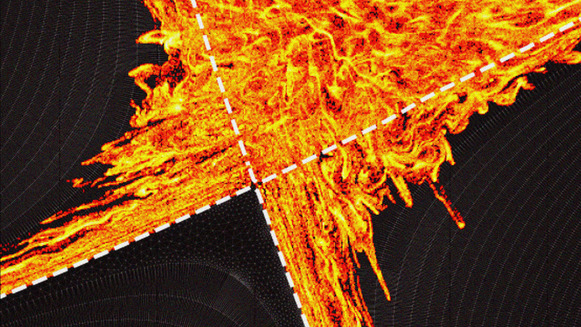
Fusion simulations: Tokamaks are devices used to fuse atoms together. Scientists are working to improve them so that one day, we could use them to produce electricity from fusion. One of the challenges is understanding how the incredibly hot plasma particles inside the device move. This information would help scientists improve devices so they can better handle the plasma’s heat. Researchers at DOE’s Princeton Plasma Physics Laboratory created a new computer simulation based on the DIII-D tokamak (a DOE Office of Science User Facility) that better illustrates where plasma fuel lands in the device’s exhaust system. |
|
AI sensors: Scientists use cameras that detect colors outside of the visible light spectrum to study objects’ material and structural properties. To improve data collection, some applications – including semiconductor manufacturing and crop monitoring – have started to pair these cameras with machine learning. However, sending data from the sensors to digital processors creates a bottleneck. Researchers from DOE’s Lawrence Berkeley National Laboratory, UC Berkeley, and UCLA figured out how to integrate AI algorithms into the sensor itself. The resulting device is an intelligent sensor that can quickly and efficiently identify chemicals and analyze materials. |
Proton structure: Understanding the internal structure of protons is key to answering many questions in nuclear physics. Unfortunately, it is difficult to compare calculations based on theories and observations from experiments. Researchers on the HadStruc collaboration at DOE’s Thomas Jefferson National Accelerator Facility have proposed a new method to improve how scientists compare these results. It involves comparing the slices of experimental data with the best resolution and theoretical calculations that are the most precise. Scientists could use this new method to study several different questions related to proton structure. |
|
Spin currents: Instead of using electrical charges to carry information like today’s devices, future spintronic devices would use the spin of electrons (also called spin waves). These devices could be smaller, faster, and more energy-efficient than today’s devices. Researchers at DOE’s Brookhaven National Laboratory showed that a technology called Resonant Inelastic X-ray Scattering can detect a pure spin wave current. This method is sensitive to tiny changes in the momentum and energy of spin waves. This discovery marks a major step toward controlling spin currents and developing the electronics that would use them. |
|
Advancing Domestic Capabilities for Producing Quantum Materials
|
|
|
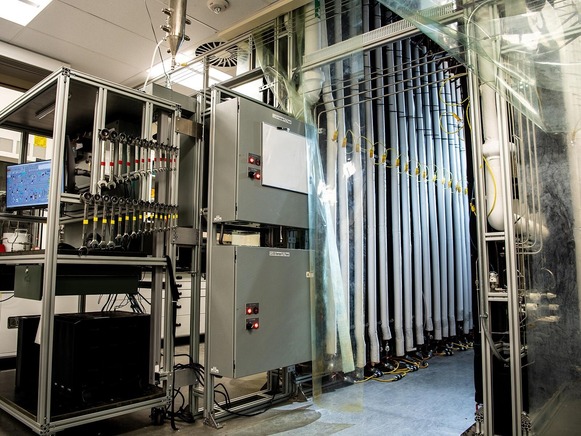
Developing quantum and other advanced technologies requires next-generation materials, including materials that are isotopically enriched. Isotopes are distinct forms of elements. They have the same number of protons as the main element, but different numbers of neutrons. Researchers enrich materials with isotopes to provide them with different types of properties than they would have otherwise.
Recently, DOE has made substantial advances in strengthening the supply chain for these isotopically enriched materials. With the support of the Office of Isotope R&D and Production, DOE’s Pacific Northwest National Laboratory has developed systems that can convert these materials into gases essential for research and development in quantum information science. They are also relevant for other advanced technology areas that rely on similar materials, such as next-generation semiconductors. Improving the availability of these materials supports the Genesis Mission led by DOE.
|
|
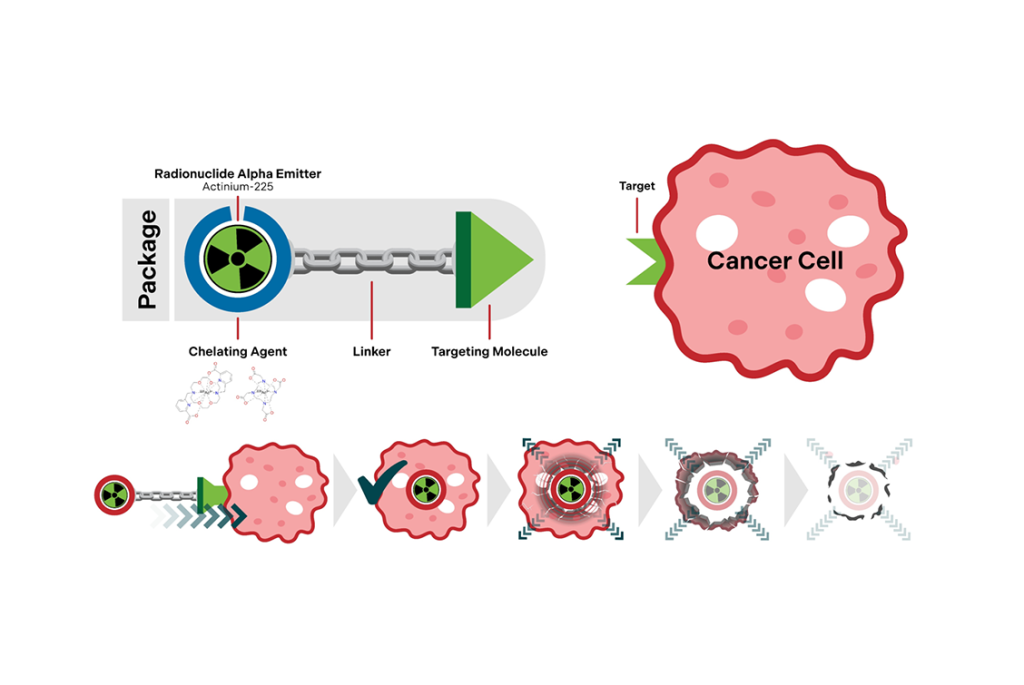
How Actinium-225 Attacks a Tumor
|
|
Targeted alpha therapy is a promising treatment for certain cancers. It uses radioactive isotopes that decay in very specific ways to target cancer cells. Actinium-225 is an isotope that has major potential as a treatment. As it decays into a stable isotope, it releases four alpha particles. (Each alpha particle is two protons and two neutrons bound together.) In targeted alpha therapy, another molecule carries these alpha particles to a cancerous cell. It damages the targeted cell while causing minimal damage to other cells. Read DOE’s Oak Ridge National Laboratory’s animation and explanation of this process. |
|
|
Research News Update provides a review of recent Office of Science Communications and Public Affairs stories and features. Please see the archive on Energy.gov for past issues.
|
|
|
|
|