|
|
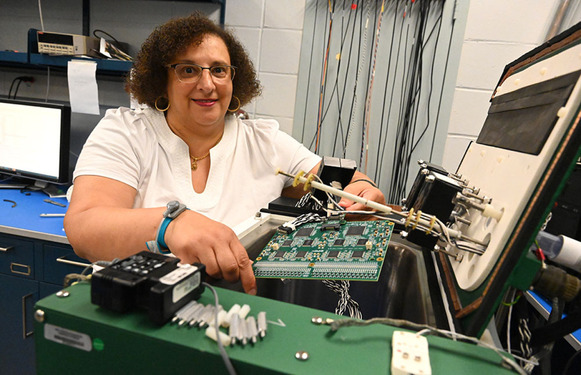
Scientists recognized by the Department of Energy (DOE) Office of Science Distinguished Scientists Fellows Award are pursuing answers to science’s biggest questions. Mary Bishai is a senior physicist at DOE’s Brookhaven National Laboratory.
If it wasn’t for a magazine, I may have become a completely different type of scientist.
In 1985, my uncle – who was a prominent marine biology professor – was tutoring me in high school biology. As a science lover, he had copies of National Geographic lying around. Intrigued, I convinced my parents to get me a subscription. One article caught my eye: “Worlds Within the Atom.” It described how physicists used massive particle accelerators to study the tiniest things in existence.
Even though I was born in and living in Egypt, I was enthralled by the research in Europe and the United States. I decided I would one day work at CERN in Switzerland or the Tevatron collider at DOE’s Fermilab.
Learn more about the history of neutrino research and how Mary Bishai became a leading scientist in the field.
|
|
Simulating rockets: A team at Georgia Tech has modeled the turbulent interactions of a 33-engine rocket. This simulation was 20 times larger and four times faster than any previous fluid dynamics simulation. Beyond rocket science, researchers can use the same methods to model fluid mechanics in medicine, energy, and other fields. The team used Frontier at the Oak Ridge Leadership Computing Facility (a DOE Office of Science User Facility) and El Capitan at DOE’s Lawrence Livermore National Laboratory. For this work, the team was a finalist for the 2025 Gordon Bell Prize, considered the Nobel Prize of supercomputing. |
Quantum vacuum: When physicists create a vacuum, they suck the air out of a space. But that doesn’t mean nothing is there. Rather, vacuums are filled with ever-changing fields of energy. These fields create entangled pairs of “virtual” particles that blink in and out of existence. Researchers at DOE’s Brookhaven National Laboratory found that when collisions of particles produce matter, that matter still has a key feature of virtual particles. This insight will help scientists understand how the quantum vacuum can provide the components to turn virtual “nothingness” into matter. The research used the Relativistic Heavy Ion Collider, a DOE Office of Science User Facility. |
|
Microbial genetics: A team that includes researchers at DOE’s Oak Ridge National Laboratory has identified a unique genetic code in certain microbes. This code has the capability to expand the number of cellular building blocks in these microbes. This discovery opens the door for developing new custom microbes that could create fuels, chemicals, and materials. It could also help scientists create better medicines and medical treatments. |
Energy dissipation: To build better electronics, we need to understand how they use and lose energy. However, these devices are non-equilibrium systems that are changing or can change over time. It’s difficult to understand energy flow in these systems. Scientists at Stanford University and DOE’s SLAC National Accelerator Laboratory developed a way to calculate how energy is used during one of these processes with ultrahigh sensitivity. They measured a characteristic of quantum dots, which are a form of nanocrystal. This information could inform the development of future computers and other devices. |
|
Synthetic jet fuel: Airplanes mainly use jet fuel made of petroleum. Scientists are aiming to design microbes that could transform plant material into high-performance jet fuels. However, the unpredictability of biological systems has made that difficult. Researchers at the Joint BioEnergy Institute managed by DOE’s Lawrence Berkeley National Laboratory have found two new and complementary ways to speed up this process. One way combines artificial intelligence and lab automation to test and improve the genetics of microbes. The other approach turns a microbe’s natural property into a biosensor that narrows groups of microbes down to the most productive strains. |
Nuclear physics: Nuclear physicists study theoretical models of nuclei to better understand them. But models have difficulty predicting the properties of complex and unstable nuclei like that of the element ruthenium. Having accurate models requires comparing them to real-world laboratory observations. Researchers at DOE’s Argonne National Laboratory have now made extremely precise measurements of ruthenium nuclei. They closely match the predictions from the models. This information improves the reliability of the models, which scientists use to describe astrophysical processes like how elements are made in exploding stars. The team used the Argonne Tandem Linac Accelerator System, a DOE Office of Science User Facility. |
|
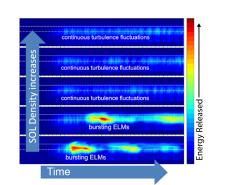
Protecting fusion devices: Tokamaks are a type of fusion device that hold promise for producing fusion energy in the future. The plasma inside these devices can develop instabilities that release strong bursts of energy. These bursts can damage the interior of the device. However, there are situations where the plasma produces small bursts that don’t cause damage. Researchers at the DIII-D National Fusion Facility, a DOE Office of Science User Facility, showed that high density in the edge of the plasma produces more mild turbulence that doesn’t cause damage compared to the large bursts that do. |
|
Accelerating Scientific Discovery through Advanced Computing
|
|
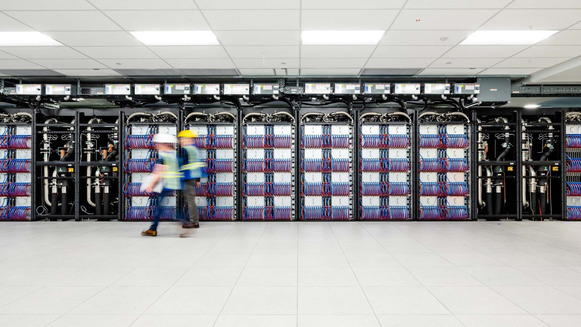
As long as computing has existed, it has been important to research. DOE has played a key role in establishing top supercomputing systems as well as networks used around the world. Today, scientists and engineers use these machines for groundbreaking research. The DOE Office of Science’s Scientific Discovery Through Advanced Computing (SciDAC) program brings together diverse experts to tackle scientific challenges that serve the DOE mission. From astrophysics to fusion, SciDAC has enabled discoveries that would otherwise be impossible. |
|
Mu2e Reaches a Major Milestone
|
|
|
When a muon (a particle that’s the electron’s heavier cousin) decays into an electron, it produces two neutrinos (tiny fundamental particles), at least according to the Standard Model of Particle Physics. However, there are many natural phenomena like dark matter that the Standard Model does not explain.
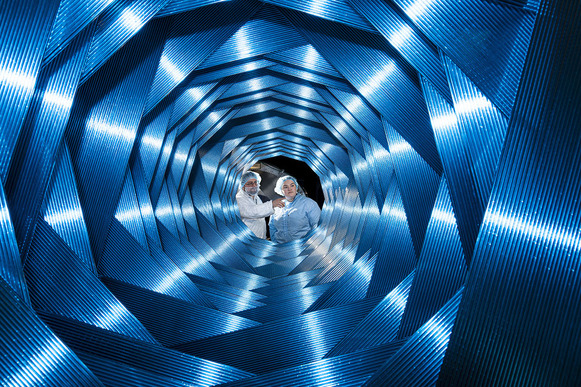
The Mu2e experiment at DOE’s Fermi National Accelerator Laboratory will look for muons directly converting into electrons without producing any neutrinos. This hypothetical conversion would happen less than once every 1 trillion times a muon decays. However, if this experiment does spot this conversion, it could expand physics beyond the Standard Model.
Engineers and scientists recently reached an important milestone in constructing the experiment. They moved a key component of the experiment into the hall where it will be constructed. The team is currently in the process of integrating the components to feed into the data acquisition system.
|
|
|
Research News Update provides a review of recent Office of Science Communications and Public Affairs stories and features. Please see the archive on Energy.gov for past issues.
No. 150: 20 February 2026
|
|
|
|