|
|
For the Department of Energy’s (DOE) Office of Science, 2025 was a year of unveiling scientific instruments and developing plans for future discoveries. In a variety of scientific fields, researchers supported by the DOE Office of Science made major advances.
Learn more about the Office of Science’s 2025 accomplishments in artificial intelligence, supercomputing, Nobel awards, quantum science, astrophysics, and fusion.
|
|
Axions: Physicists proposed the idea of an axion as a fundamental particle in the 1970s. Axions' existence could lead to major insights into problems such as dark matter. However, they have never been detected. A team including researchers from DOE’s Argonne National Laboratory have made significant steps towards developing a new method for hunting for axions. The researchers found a way to harness quasiparticles (particles that act as a single unit) to search for dark matter and develop new quantum technologies. |
Frustrated magnets and AI: Frustrated magnets are advanced materials where the electron spins do not settle on an orientation. These materials have unique properties that could be useful for energy and information technology applications. A researcher at DOE’s Brookhaven National Laboratory who participated in the DOE’s AI Jam Session in 2025 recently published a paper on work he started at that event. With the help of artificial intelligence, he solved a specific frustrated magnet model that had previously been unsolved. |
|
Measuring conductivity: Warm dense matter forms at extreme temperatures and pressures, such as at the center of stars. It’s also relevant to the process of nuclear fusion. Understanding warm dense matter’s ability to conduct electricity would be very helpful for understanding its physics. However, traditional methods of measuring conductivity require the measurement tool touch the material. Researchers at DOE’s SLAC National Accelerator Laboratory developed a new way to measure electrical conductivity in this type of matter without contact. The team used the Linac Coherent Light Source, a DOE Office of Science User Facility, to develop the new method. |
Spintronic materials: Spintronic materials could potentially use the spin of electrons to store and transmit data. They could be very helpful in advanced computing and memory devices. A team that includes scientists at DOE’s Ames National Laboratory found a feature in an alloy that could lead to developing a new class of spintronic materials. This feature allows scientists to read and control spin-based signals electrically. Previously, scientists had mainly observed this feature in much simpler samples. In the potential new class of materials, it would take much less energy to manipulate the electrons’ spins. |
|
Wildfires: Researchers at the University of California, Irvine have identified the chief driver of the most destructive wildfires. They found that fire complexes – clusters of fires ignited by lightning – cause the most destruction. When fires in a complex merge, they can produce atmospheric conditions that lead to extreme fire behavior. This behavior can then trigger even more fires and make it harder to suppress the current ones. This information could help agencies better manage such fires and prioritize limited resources. |
Plant genes: Even though scientists can edit genes in a plant with relative ease now, it is still hard to know how to revise a specific gene to lead to a specific trait. Researchers at the Joint BioEnergy Institute at DOE’s Lawrence Berkeley National Laboratory have developed a new technology that should make that process easier. ENTRAP-seq can scan thousands of the proteins that affect how a gene is expressed in a trait. It greatly speeds up the process of investigating and controlling gene expression in plants. |
|
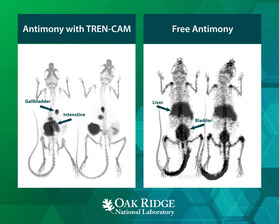
Unlocking antimony’s potential: Antimony-119 is a radioactive isotope that is promising for use in targeted cancer therapy. However, there is a lack of molecules that could tightly hold antimony in the body. These binding molecules are necessary for the isotope to be able to target and destroy cancer cells. Researchers at DOE’s Oak Ridge National Laboratory and University of Wisconsin Madison have identified a binding molecule that can serve this purpose. It forms a highly stable, protective molecular cage around the antimony when tested in mice and human blood. It’s an important step towards using antimony in medical applications. |
|
Using AI to Usher in a New Era of Nuclear Power
|
|
With demands for electricity higher than ever, nuclear power is on the rise. Building new reactors and renewing licenses can involve huge amounts of documentation. Tech startup company Atomic Canyon and Diablo Canyon (California’s only currently operational nuclear power plant) used the Frontier supercomputer at DOE’s Oak Ridge Leadership Computing Facility to develop new artificial intelligence models to help them sort through records. (OLCF is a DOE Office of Science User Facility.) These models will reduce the time, labor, and resources to sort through billions of pages of complex documents. They are also available to anyone in the nuclear industry to use. As the models can search the entire history of the U.S. nuclear industry, they required Frontier’s vast computing power to develop. |
|
DOE National Laboratories’ Top Research Stories of 2025
|
|
|
The DOE Office of Science’s National Laboratories had quite a year of discoveries, ranging from new insights into dark energy to further expanding quantum technology. Here’s just a selection of the accomplishments:
-
Oak Ridge National Laboratory: Researchers took steps forward on protecting quantum networks, announced new supercomputers, and found new applications for artificial intelligence.
-
Fermilab National Accelerator Laboratory: Scientists made progress on the largest neutrino experiment in the world, revealed results from the Muon g-2 experiment, and demonstrated superconducting systems that could lead to better quantum computers.
-
Lawrence Berkeley National Laboratory: The laboratory led the announcement of new results from the Dark Energy Spectroscopic Instrument that suggest that dark energy may evolve over time, launched a new open-access dataset of 100 million molecular snapshots, and developed a new method for producing the heaviest elements on the Periodic Table.
-
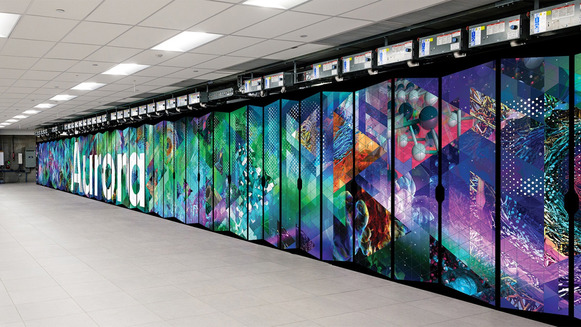
Argonne National Laboratory: The laboratory introduced the new Aurora exascale computer, set a world record with its upgraded Advanced Photon Source, and enabled the discovery of a promising HIV vaccine candidate.
|
|
|
Research News Update provides a review of recent Office of Science Communications and Public Affairs stories and features. Please see the archive on Energy.gov for past issues.
|
|
|
|
|