|
|
Created by an Executive Order, the Genesis Mission will harness artificial intelligence (AI) and supercomputing to double the productivity and impact of American science and engineering within a decade. It will create a platform that connects the world’s most powerful supercomputers, AI systems, next-generation quantum systems, and the DOE National Laboratories’ advanced scientific instruments. Using this platform, researchers will focus on three major challenges: energy, discovery science, and national security.
By drawing on experts at the National Laboratories, industry, and academia, the Genesis Mission will strengthen the nation’s technological leadership and global competitiveness.
Learn more about the Genesis Mission in the press release, the mission’s website, and the letter to the community by the project’s director, DOE Under Secretary of Science Darío Gil.
|
|
Dark matter: Dark matter makes up about 85 percent of mass in the universe but has never been directly detected. Physicists have theorized that dark matter may be a type of particle called weakly interacting massive particles (WIMPs). The LUX-ZEPLIN (LZ) experiment – managed by the DOE’s Lawrence Berkeley National Laboratory – is the world’s most sensitive dark matter detector. The LZ collaboration recently released new results. The results did not see any direct evidence of dark matter events and set the most precise limits yet on WIMPs as a candidate. |
X-ray imaging: The Linac Coherent Light Source (LCLS) X-ray laser, a DOE Office of Science User Facility at SLAC National Accelerator Laboratory, can take “movies” of proteins and viruses. Researchers at SLAC have created a new machine learning method called X-RAI to improve how they analyze LCLS data. X-RAI takes millions of X-ray laser images and creates a 3D image of the target particle. This technology could expand the data that scientists can analyze and use it more effectively. In addition, it could allow scientists to look at molecules while they are in motion. |
|
Viruses: A virus infecting a cell triggers a signal in the cell. That signal turns on defenses from the immune system. Researchers from the Innovative Genomics Institute found that viruses have evolved a large and diverse set of enzymes that destroy these alarm signals. By eliminating the signals, viruses can evade or prevent the immune response. To conduct the research, the team used the Stanford Synchrotron Radiation Lightsource and the Advanced Light Source, both DOE Office of Science User Facilities. |
Sterile neutrinos: For years, physics experiments have shown neutrinos acting in a way that is inconsistent with the Standard Model of Particle Physics, scientists’ main explanation for the building blocks of the universe. Physicists theorized that a fourth type of neutrino, called the sterile neutrino, might explain those inconsistencies. However, scientists on the MicroBooNE experiment at DOE’s Fermi National Accelerator Laboratory have announced they have found no evidence of that fourth type. This result allows scientists to rule out an explanation involving a single sterile neutrino with 95 percent certainty. |
|
Neutrinoless double beta decay: Scientific theories state that the Big Bang should have created equal amounts of matter and antimatter. However, they would have annihilated each other and left the universe empty. As there is matter today, there must have been slightly more matter than antimatter. One possible explanation is that neutrinos may be their own antimatter partner, antineutrinos. Observing a process called neutrinoless double beta decay could provide evidence of that being true. Researchers on the CUORE collaboration (co-led by DOE’s Berkeley Lab) have published the largest dataset of its kind of this process. They determined that this process occurs in an atom of tellurium on average no more than once every trillion trillion years. |
Nanoparticles: Medical techniques use liquid nanoparticles to deliver cancer drugs, gene therapies, and vaccines into cells. While scientists assumed that lipid nanoparticles all had about the same shape and structure, a team of researchers from the University of Pennsylvania, DOE’s Brookhaven National Laboratory, and Waters Corporation found that isn’t true. These nanoparticles have several configurations and their internal shape and structure relate to how they deliver cargo to a destination in the body. This finding could help improve specific medical therapies. The research used the National Synchrotron Light Source-II, a DOE Office of Science User Facility. |
|
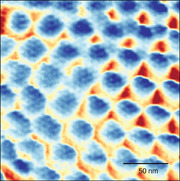
Wigner crystal: Crystals have repeated groups of atoms or other particles with consistent gaps between the groups. In 1934, Eugene Wigner predicted a type of crystal made of electrons. Previous experiments found indications of Wigner crystals existing, but not direct evidence. For the first time, researchers from Princeton University took images of a Wigner crystal. It was in a material made of two layers of graphene (a one-dimensional material). This finding both confirmed the long-held theory and demonstrated a new technique for studying electrons. |
|
Powering the Future of Quantum
|
|
In November, Under Secretary of Science Darío Gil spoke at the Chicago Quantum Summit. In his speech, he discussed his vision for quantum information science and DOE’s role in this area. He also announced the renewal of the National Quantum Information Science Research Centers. Read the post summarizing his speech on the DOE Office of Science’s website. |
|
A Quarter-Century of Surprises: Exploring the Quark-Gluon Plasma
|
|
|
Two huge metal rings, each more than two miles around. Gold ions smashing together at more than 99.99 percent the speed of light. House-size machines with masses of neon green wires.
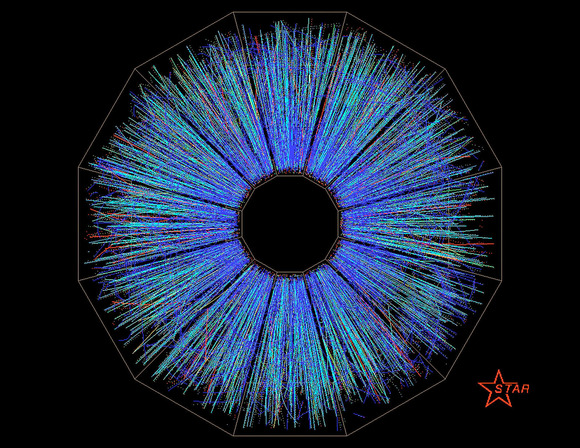
Inside this set of colossal structures known as the Relativistic Heavy Ion Collider (RHIC) roiled a tiny fireball. It was four trillion degrees Celsius, more than 250,000 times hotter than the core of the sun. Here, the building blocks of the universe were emerging. The protons and neutrons that make up ordinary matter were melting into their component particles: quarks and gluons.
This state of matter existed for less than a billionth of a trillionth of a second. But at that moment in 2000, it was the first time in history that humans could study the quark-gluon plasma – although none of the scientists knew they had produced it just yet. Before that, this state of matter had mainly existed previously 13.7 billion years ago, just after the Big Bang.
Learn more about how scientists supported by the Department of Energy’s (DOE) Office of Science discovered and investigated the quark-gluon plasma.
|
|
|
Research News Update provides a review of recent Office of Science Communications and Public Affairs stories and features. This is only a sample of our recent work promoting research done at universities, national labs, and user facilities throughout the country.
|
|
|
|
Please see the archive on Energy.gov for past issues.
No. 147: 15 December 2025
|
|
|
|
|