|
|
Considered the highest honor in science, the Nobel Prizes recognize decades of research in the basic sciences. This year, the Department of Energy’s (DOE) Office of Science was proud to have supported the research of four different Nobel Prize winners: three in physics and one in chemistry.
In physics, John Clarke, a former senior scientist at DOE’s Lawrence Berkeley National Laboratory (Berkeley Lab), Michel Devoret at Yale University, and John M. Martinis at University of California, Santa Barbara were recognized for their work in quantum science. While scientists usually observe quantum mechanical properties on the smallest of scales, their research showed that these effects could be observed in a system that’s big enough to hold in your hand. Their work on quantum effects in superconductors that was supported by DOE’s Office of Science set the foundation for advances in quantum computers, cryptography, and sensors. In addition, all three worked on Clarke’s team at Berkeley Lab when they conducted the Nobel Prize-winning research. Currently, both Devoret and Martinis are associated with the recently renewed DOE Quantum Information Science Research Centers.
In chemistry, Omar M. Yaghi at University of California, Berkeley was awarded the Nobel Prize for his research on metal-organic frameworks, along with Susumu Kitagawa of Japan and Richard Robson of Australia. Because of their research, metal-organic frameworks (MOFs) now provide chemists with a powerful tool to facilitate and manage chemical reactions. MOFs can separate pollutants from water, capture water in deserts, and hold reactive gases. To date, chemists have developed tens of thousands of different MOFs, which have numerous potential applications. Learn more about Yaghi’s Nobel Prize-winning research.
|
|
Quantum networking: Scientists at DOE’s Fermilab and Caltech have demonstrated a way to use “squeezed light” to improve quantum networks. This research has the potential to increase the rate at which quantum networks can generate pairs of entangled particles over long distances. Difficulty in generating these pairs is currently a major barrier to building large-scale quantum networks and connecting quantum computers. |
AI for fusion: To produce electricity from fusion, fusion devices must be able to monitor and control the ultra-hot, swirling plasma inside of them. The edge of the plasma is the most important part to monitor, but it’s also the most difficult. This monitoring requires complex, precise sensors. A team that includes researchers at DOE’s Princeton Plasma Physics Laboratory has developed an artificial intelligence (AI) tool that can fill in data when there is not a sensor in a certain location or a sensor is damaged. |
|
Phase changes: The Relativistic Heavy Ion Collider (a DOE Office of Science User Facility) smashes particles together to “melt” protons and neutrons into their building blocks of quarks and gluons. This creates the quark-gluon plasma, a substance that existed just after the Big Bang. Members of the STAR collaboration, a group of physicists that work on RHIC, are working to identify the critical point where quarks and gluons transform from one phase of matter into another. The collaboration released new data that suggest an important signature of this critical point. |
Quantum spin liquids: In quantum spin liquids, electron spins are constantly moving and fluctuating. That unusual property makes them a good potential candidate for the building blocks of quantum computers. While scientists have not yet achieved this state in the laboratory, a team with researchers from DOE’s Argonne National Laboratory and Oak Ridge National Laboratory has gotten significantly closer. Using the Advanced Photon Source (a DOE Office of Science User Facility), the team compressed a specific crystalline material to 1,000 times the pressure of the bottom of the ocean. The material showed clear signs of approaching a spin liquid state. |
|
Ice: For the first time, researchers from DOE’s Pacific Northwest National Laboratory were able to directly observe molecules of water undergoing the shift from liquid water to ice. Most techniques that scientists use to view individual atoms are not compatible with this transition. The team developed a new technique to conduct this research. They found that ice is surprisingly flexible. This finding has implications for forecasting ice behavior in aviation and preserving biological samples. The research used the Environmental Molecular Sciences Laboratory, the Molecular Foundry, and the National Energy Research Scientific Computing Center, all DOE Office of Science User Facilities. |
Semiconductors: Semiconductors are essential to all microchips, including those used in computers and smartphones. As a material, they are crystals made of different elements arranged in repeating lattice structures. They usually consist of a main element with trace amounts of a few other elements. A team led by researchers at DOE’s Berkeley Lab found that atoms in semiconductors arrange themselves in specific patterns in areas of the material. This research could provide a foundation for designing specialized semiconductors for quantum computers and other devices. This research used the Molecular Foundry. |
|
Resisting stress: As organisms conduct certain functions like breathing and converting food into energy, they produce reactive oxygen species. These unstable molecules put stress on the organism. Yeasts used to make biofuels are often exposed to high levels of these molecules, limiting the yeasts’ production. Researchers at the Great Lakes Bioenergy Research Center supported by DOE studied strains of yeast that are naturally resistant to this stress. To understand how this resistance evolved, they used machine learning to study hundreds of yeasts’ genes. The study highlights genes that scientists could target to make better strains of yeast for biofuels and bioproducts. |
|
Building the Future of Supercomputing
|
|
|
DOE recently announced the development of four new supercomputers designed for AI, two at Oak Ridge National Laboratory and two at Argonne National Laboratory.
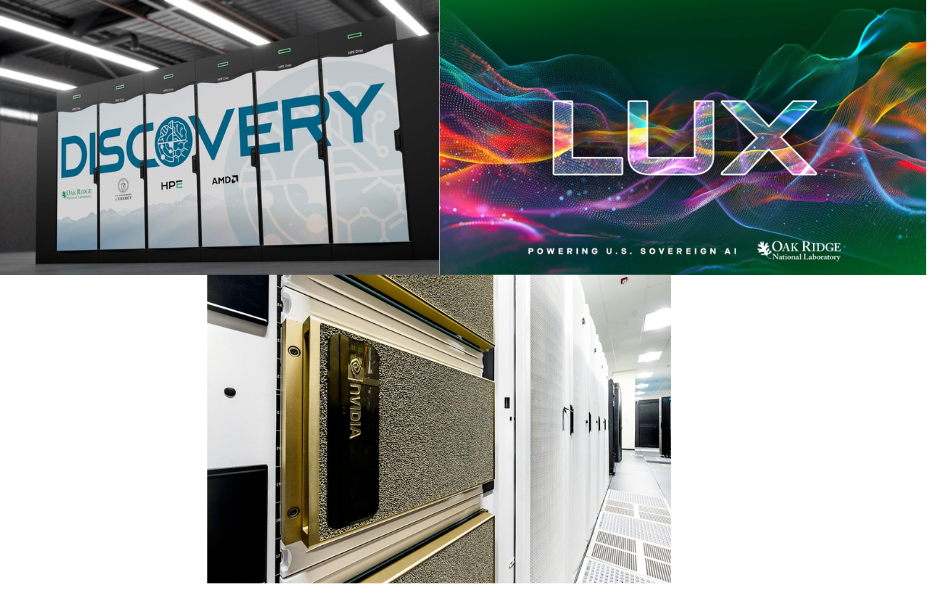
At Oak Ridge, the Lux AI cluster will be launched in early 2026 to expand DOE’s near-term AI capacity. It will focus on meeting critical national priorities, including fusion, fission, materials discovery, quantum information sciences, advanced manufacturing, and grid modernization. A new public-private partnership with AMD will enable Lux to be built exceptionally quickly. Oak Ridge is also building the successor to the first exascale computer in the world, Frontier. The new computer, Discovery, is expected in 2028.
The next day, Argonne announced that it is developing the Solstice and Equinox systems. Solstice will be the largest AI supercomputer in the DOE’s National Lab complex. While it is a smaller supercomputer, Equinox will be available sooner. Like Lux, it is expected to be delivered in 2026.
Projects at both laboratories are relying on a new model of partnership that enables shared investments and shared computing power between government and industry.
|
|
Inspiring the Next Generation of Exascale Computing Experts
|
|
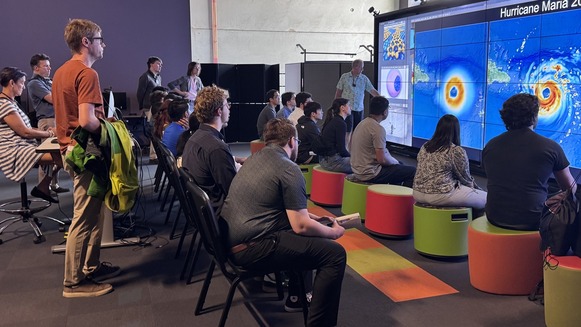
Using the world’s most powerful supercomputers isn’t a feat for the faint-of-heart. It requires extensive training and hands-on experience. Thankfully, there are plenty of scientists ready to tackle the challenge. This year, 74 of them attended the Argonne Training Program on Extreme-Scale Computing. The program is a two-week intensive training organized by DOE’s Argonne National Laboratory. It provides knowledge and practice to help early career scientists learn key skills, approaches, and tools to carry out research on current and next-generation supercomputers. More than 900 attendees have participated in the program since it was launched in 2013. |
|
|
Research News Update provides a review of recent Office of Science Communications and Public Affairs stories and features. Please see the archive on Energy.gov for past issues.
No. 146: 20 November 2025
|
|
|
|
|