|
Ryugu asteroid: In 2020, an uncrewed spacecraft returned to Earth with samples from the asteroid Ryugu. Scientists used the National Synchrotron Light Source-II (NSLS-II, a DOE Office of Science User Facility) to analyze a part of a sample. Analysis revealed new details of the asteroid’s composition and origin. This information could help us understand how water and organic matter arrived on Earth during the earliest stages of its history. |
AutoBot: A research team at DOE’s Lawrence Berkeley National Laboratory (Berkeley Lab) has built and demonstrated AutoBot, an automated experimentation platform. The team specifically designed the platform to quickly make and characterize advanced materials. Using machine learning algorithms, AutoBot took a few weeks what it would have taken up to a year to do with a traditional trial-and-error approach. |
|
Excited protons: Most of the knowledge that scientists have of the proton is from experiments involving high energy where there is a large amount of momentum transferred to the proton. But nuclear physicists have far less information about the proton at lower energies or when less momentum is transferred. In these situations, the proton can move into an excited state. Results from an experiment at DOE’s Thomas Jefferson National Accelerator Facility (Jefferson Lab) are offering a new way to gain insight into proton structure. The measurements allow scientists to explore signals from excited proton states and aspects of the strong interaction. The research used the Continuous Electron Beam Accelerator Facility, a DOE Office of Science User Facility. |
Structure of metals: Manufacturers use the process of additive manufacturing – also called 3D printing – to make metal components for several critical sectors. But there are still challenges with consistently achieving a certain level of quality and repeatability. Researchers at DOE’s Argonne National Laboratory, Oak Ridge National Laboratory, and university partners have developed a way to see how the microstructure of metals changes in real time during 3D printing. This information could improve the reliability of the 3D printing process. The team used the Advanced Photon Source, a DOE Office of Science User Facility. |
|
Spintronics: Spintronics is a field that studies the spin of electrons (their intrinsic angular momentum). If scientists can control electron spin, they could develop devices that store and transmit information faster and more efficiently. But measuring spin currents (how spin flows through a material without an electric charge current) is extremely difficult. Researchers used the NSLS-II to detect a current formed by the flow of magnons. Magnons are a form of excitations in a material’s magnetic structure. This technique will help scientists dig deeper into how magnons move. |
Subatomic stress: When engineers and architects design a bridge, it’s important to consider the types of stress it will be under. Scientists also want to understand how stress affects atoms. At the atomic level, stress is the internal forces a system undergoes while the system is being deformed. Researchers at DOE’s Jefferson Lab have developed a new approach to taking the effects of stress into account in the quantum world. Information about stress at the quantum level could help nuclear physicists better understand the building blocks of our universe. |
|
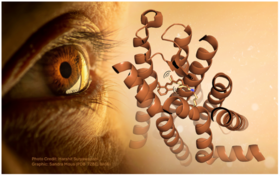
Mechanism of vision: Rhodopsin is a type of protein that responds to light and enables us to see. But scientists don’t exactly know how light activates the rhodopsin molecule. Using a new technique, researchers at DOE’s SLAC National Accelerator Laboratory and the Paul Scherrer Institute captured the ultrafast reaction of this molecule. This research will expand our understanding of how rhodopsins transform light into a physiological signal that then gets sent to the brain. The team used the Linac Coherent Light Source, a DOE Office of Science User Facility. |
|
Expanding the Quantum Prairie
|
|
|
Like California’s Silicon Valley, the Quantum Prairie in Illinois is quickly becoming known as a technological hub. Drawn by cutting-edge research being done at DOE National Laboratories and universities, companies are establishing research centers in the area.
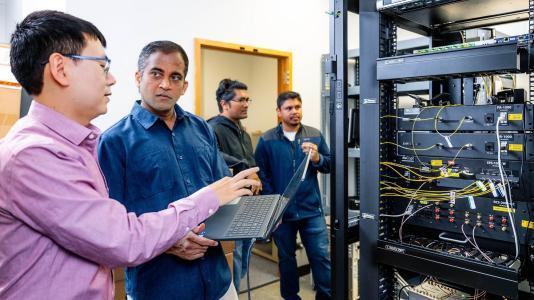
DOE’s Argonne National Laboratory is at the forefront of this evolution. Researchers at the lab are investigating new ways to create materials for and build qubits, which are the heart of quantum computers and other quantum tech. The lab also manages several quantum testbeds where scientists can test new technologies, including the Chicago Quantum Network. Similarly, the Argonne Quantum Foundry focuses on developing semiconductor quantum systems. The lab is also the host of Q-NEXT, a DOE National Quantum Information Science Research Center that focuses on controlling, storing, and transmitting quantum information. Q-NEXT supports the next generation of quantum researchers, including students and postdocs.
The DOE Office of Science User Facilities at Argonne play a major role in this growth. The Advanced Photon Source, Center for Nanoscale Materials, and Argonne Leadership Computing Facility all enable quantum research.
From the new materials to the people developing them, these efforts are ensuring that DOE remains a leader in quantum information science research.
|
|
Students Are Building Their STEM Futures and Changing the World
|
|
|
Internships can be essential for students to gain hands-on experience and make connections to support their careers. DOE’s Office of Science’s paid internships are unique in the opportunities they provide for students at our National Laboratories and beyond.
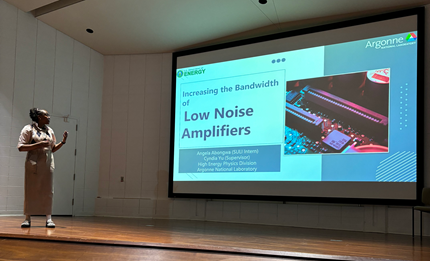
Students who participate in the Science Undergraduate Laboratory Internships collaborate with a mentor who is a leading science expert. They focus on a specific science area and use leading-edge facilities at the labs to conduct research. For example, Angela Abongwa interned at DOE’s Argonne National Laboratory, where she studied a technology that enhances quantum signals. She also earned first place in the DOE’s Workforce Development for Teachers and Students program’s Ignite Off Competition for a presentation on her research.
Participants in the Community College Internship program work as part of a team to develop their knowledge in a science and technology area relevant to DOE’s mission. Interns develop their knowledge and skills on equipment in state-of-the-art facilities. Mayolo Valencia interned at DOE’s Los Alamos National Laboratory, where he’s studying artificial intelligence and machine learning. Although his Community College Internship was only for two months, the laboratory has decided to keep him on for an entire year. The Community College Internship program has provided him with a major boost in his journey from not having WiFi until he was fifteen to being on the cutting edge of computer technology.
Applications for the Spring 2026 term of internships are open now and due on October 1, 2025. Learn more and apply on the Workforce Development for Teachers and Students website.
|
|
|
Research News Update provides a review of recent Office of Science Communications and Public Affairs stories and features.
|
|
|
|
Please see the archive on Energy.gov for past issues.
No. 145: 30 September 2025
|
|
|
|