|
|
The Basic to Breakthrough series chronicles how investments at the Department of Energy’s (DOE) National Laboratories have established the foundation for new technologies that are changing our world.
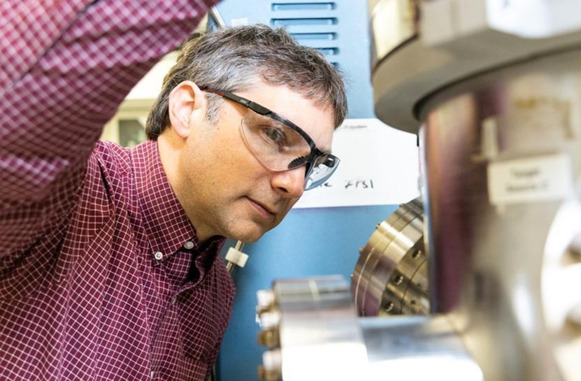
A gooey science experiment with his kids inspired Gabriel Veith – a researcher at the DOE's Oak Ridge National Laboratory (ORNL) – to develop a material that prevents lithium-ion batteries from bursting into flames.
ORNL scientists have worked for decades to understand the complexities of the foundational science behind batteries. In a lithium-ion battery, a thin piece of plastic separates the two electrodes, the points where electricity moves between parts of the battery. If the battery is damaged and the plastic layer fails, the electrodes can come into contact and cause the battery's liquid electrolyte to catch fire.
The eureka moment came when Veith and his kids were playing with a mix of cornstarch and water known as oobleck. “The mixture flows like a liquid until you start poking it, and then it becomes a solid,” Veith said. After the pressure is removed, the substance liquefies again. He realized this reversible behavior, known as shear thickening, could be exploited to make batteries safer.
Learn more about how Veith’s insight led to a technology that can make batteries safer, lighter, and cheaper.
|
|
Catalyst size: Researchers from the DOE’s Brookhaven National Laboratory have discovered that the size of catalytic nanoparticles determines how their shape and structure change during chemical reactions. This discovery provides scientists with insights into the nanoparticles’ atomic-scale behavior as they convert carbon dioxide into useful fuel. This information may help scientists design more effective catalysts for industrial applications. The team used the National Synchrotron Light Source-II, the Center for Functional Nanomaterials, and the Advanced Light Source, all DOE Office of Science User Facilities. |
Bioenergy crops: By conducting a deep dive on the compounds released by plant roots into the environment, scientists from DOE’s Oak Ridge National Laboratory have gained a huge amount of data about the diversity and relative amounts of compounds in the soil. To do so, they developed a new analytic framework based on the study of small molecules. This data helps scientists better understand the interactions between plants and microbes in the soil. These insights can help them develop bioenergy crops that yield higher amounts and resist stress as well as microbes that improve plant resilience. |
|
New gold compound: Gold usually doesn’t react easily with other chemicals. But a team led by scientists at DOE’s SLAC National Accelerator Laboratory formed a solid binary gold hydride. This is a compound made only of gold and hydrogen atoms. The researchers did so in the process of working to study how long it takes compounds made of carbon and hydrogen to form diamonds under extremely high pressure and heat. This discovery suggests that there is a lot of potential to form exotic compounds at extreme conditions. These conditions occur inside both stars that fuse hydrogen and certain planets. It also offers a way to study dense atomic hydrogen under extreme conditions. |
AI to protect fusion vessels: A team with researchers from DOE’s Princeton Plasma Physics Laboratory, DOE’s Oak Ridge National Laboratory, and private company Commonwealth Fusion Systems has developed a new artificial intelligence approach to fusion. The AI helps scientists find spaces protected from the heat of plasma in a fusion device, known as magnetic shadows. These areas are important for protecting the insides of fusion vessels from the hot plasma. The AI system is designed to simulate a section of SPARC, a fusion device under construction by Commonwealth Fusion Systems. The AI system could lead to software that makes it faster to design future fusion systems. |
|
Tracking an electron: Valance electrons are the electrons in the outermost shell of an atom. They play important roles in chemical reactions and forming bonds with other atoms. Scientists on an experiment at SLAC National Accelerator Laboratory took images of the impact of the motion of a valance electron in real-time throughout a chemical reaction. The team used extremely bright X-ray pulses from the Linac Coherent Light Source-II, a DOE Office of Science User Facility. The results could help scientists better understand fundamental chemistry and control the results of chemical reactions. |
Active memory for AI: Researchers at DOE’s Pacific Northwest National Laboratory have co-designed a new hardware-software architecture for science. In collaboration with private company Micron, they created the Crete prototype system. The system has 15 terabytes of active memory in the system processors, a unique configuration among high-performance computers. The testbed is available for DOE-funded researchers who have applications that require more memory than is available on most of today’s computing architectures, such as computational chemistry. It will be particularly useful for applications that integrate AI with simulations and data analysis. |
|
Robotic lab: A team of researchers at the Center for Advanced Bioenergy and Bioproducts Innovation have developed a laboratory that integrates electronics, computer-aided design, and information science. This biofoundry is fast, is automated, and has high throughput. The team used it to genetically engineer plants to produce more oil. By automating key steps of the process to improve plants, this research accelerates the development of better bioenergy crops. |
|
Supercharging Battery Research with Aurora and the Advanced Photon Source
|
|
|
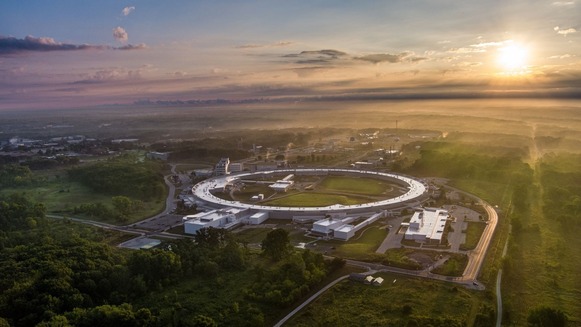
Batteries are a key technology for powering the modern world. Researchers at DOE’s Argonne National Laboratory are leveraging the Advanced Photon Source and the Aurora exascale supercomputer at the Argonne Leadership Computing Facility to bring us the next generation of battery technology. Both the Advanced Photon Source and the Argonne Leadership Computing Facility are DOE Office of Science User Facilities.
With the Advanced Photon Source, scientists can watch chemical reactions as the batteries charge and discharge in real time. Researchers can then process that massive amount of data on Aurora. That data helps scientists understand the issues in the battery and how to design better battery materials. Aurora is specifically designed for AI, so scientists are experimenting with ways to use AI to find new potential materials.
|
|
DOE Explains…Superheavy Elements
|
|
Superheavy elements have 104 or more protons in each atom. On the Periodic Table of the Elements, they are far beyond the elements we encounter every day. In fact, they’ve only been observed after scientists have created them in the laboratory. Our latest entry in the DOE Explains… series is focused on what superheavy elements are and DOE’s role in finding new elements. Read more at DOE Explains…Superheavy Elements. |
|
|
Research News Update provides a review of recent Office of Science Communications and Public Affairs stories and features promoting research done at universities, National Labs, and User Facilities throughout the country.
|
|
|
|
Please see the archive on Energy.gov for past issues.
No. 143: 8 September 2025
|
|
|
|