|
|
The Early Career Research Program provides financial support that is foundational to early career investigators, enabling them to define and direct independent research in areas important to Department of Energy (DOE) missions. The Early Career Award Winner series provides awardees with an opportunity to explain the results of their research in their own words.
Accurate nuclear data are critical for advancing our knowledge of many different fields. These include nucleosynthesis, weak interaction physics, dark matter interactions, nuclear reactors, nuclear forensics, non-proliferation, and stewardship of our nuclear weapons stockpile.
Data on neutron cross-sections (the likelihood of a neutron interacting with the nucleus of an atom) for many nuclei have large uncertainties. There are also discrepancies between past measurements. To improve the situation, new measurements are needed. Researchers can make these new measurements with modern experimental techniques and advanced radiation detection technologies.
The DOE Early Career award enabled me and my team to propose and carry out new measurements of reactions with incident neutrons.
Learn more about how the Early Career award enabled Marian Jandel’s research on neutrons.
|
|
Heavy elements: Researchers from DOE’s Lawrence Berkeley National Laboratory, University of California, Berkeley, and the University of Alabama have developed a new way to make and detect molecules that have heavy and superheavy elements. They used the method to create molecules with the element nobelium (element 102). It was the first time scientists have directly measured a molecule with an element greater than 99. This method will make it much easier to study these challenging-to-research elements. |
Three-particle components: Nucleons (clusters of protons and neutrons) can briefly interact inside of atoms. While scientists had studied how nucleons pair up at short distances, they had never been able to detect similar correlations between three nucleons. Using the Continuous Electron Beam Accelerator Facility, a DOE Office of Science User Facility at Jefferson Lab, scientists have seen hints of these three-nucleon short-range correlations for the first time. This research could give insights into nuclear interactions both here on Earth and inside of neutron stars. |
|
Blue LEDs: It’s surprisingly difficult to produce deep blue light. A team led by researchers at Rutgers University have developed a new approach for manufacturing light-emitting diodes (LEDs) that emit a specific color of deep blue light. Blue LEDs are particularly important because they are used with red and green LEDs to produce white light. This technique could improve the performance and longevity of solid-state lightning and displays. The team used the Center for Functional Nanomaterials, the Molecular Foundry, and the Advanced Light Source, all DOE Office of Science User Facilities. |
Ultrafast snapshots: Researchers from DOE’s Argonne National Laboratory and their collaborators have developed a new X-ray technique. The technique – called stochastic Stimulated X-Ray Raman Scattering – can capture detailed images of interactions between atoms. Compared to past techniques, it takes much more detailed snapshots of the energy levels in atoms that determine their chemical properties. The technique could be useful for developing new materials for electronics or nanotechnology. The research used the Argonne Leadership Computing Facility, a DOE Office of Science User Facility. |
|
Quantum echo: Scientists at DOE’s Ames National Laboratory and Iowa State University have discovered a “quantum echo” in a superconducting material. (Electricity moves through superconductors without resistance.) This quantum echo comes about from an interaction between a set of collective vibrations in superconductors and quasiparticles. These echoes can encode, store, and retrieve quantum information in these materials. The research improves the ability to control quantum coherence (the length of time a quantum material can maintain information) in superconductors. It could be used to improve quantum computing and sensing. |
Superheated gold: For the first time, a team of researchers has directly measured the temperature of atoms in warm dense matter – a state that can reach hundreds of thousands of degrees Kelvin and is notoriously hard to measure. As part of the experiment, the team superheated solid gold far beyond the limits that theory predicted was possible. The findings suggest that there may not be an upper limit for superheated materials as long as they are heated fast enough. The team included scientists from DOE’s SLAC National Accelerator Laboratory and used the Linac Coherent Light Source, a DOE Office of Science User Facility. |
|
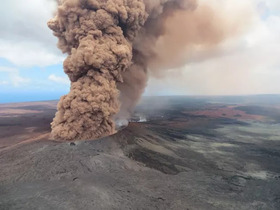
Anticipating earthquakes: Scientists from DOE’s Los Alamos National Laboratory examined how artificial intelligence may be able to predict earthquakes. They adapted an AI foundation model designed for speech recognition to analyze seismic signals from Hawaii’s 2018 Kīlauea volcano eruption. The findings suggest that AI models may be able to track signals that faults emit as they slip. While it doesn’t mean that AI can predict earthquakes, it is a step towards understanding how faults behave and scientists may be able to track them. |
|
Improving Next-generation Aircraft with Supercomputing and AI
|
|
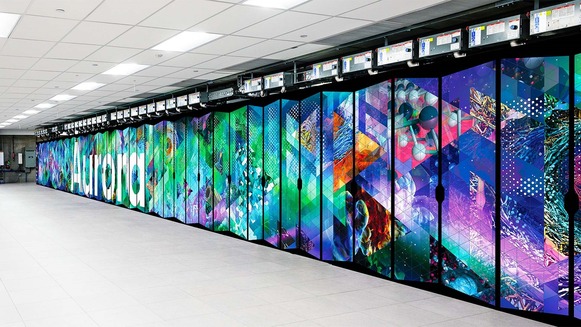
The physics of how air flows around different parts of an airplane is staggeringly complex. Improving our understanding of these flow patterns could help engineers design more fuel-efficient planes that are still effective in worst-case scenarios. A team led by researchers at the University of Colorado Boulder is using the exascale computer Aurora to study this airflow. (Aurora is at the Argonne Leadership Computing Facility, a DOE Office of Science User Facility.) The team is working to develop computer models that are better at predicting how turbulent air moves, especially in challenging weather conditions. Improving computer models of airflow can reduce the need to use expensive wind tunnel and flight tests. |
|
Scientists and Engineers Craft Radio Telescope Bound for the Moon
|
|
|
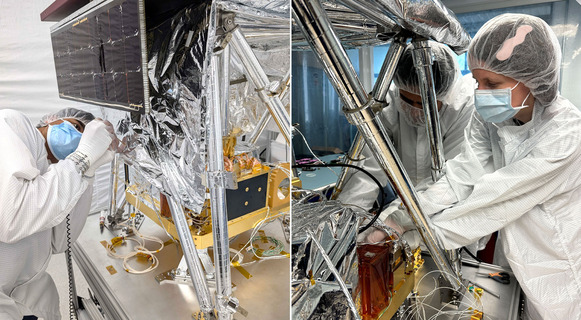
How can you design a telescope to work on the “far side” of the moon, a place of brutal environmental conditions? Very carefully. A team at DOE’s Brookhaven National Laboratory has now completed the overall design of the Lunar Surface Electromagnetics Experiment-Night (LuSEE-Night) telescope. They have also procured and constructed the telescope’s components.
Scientists are building LuSEE-Night to survive on the lunar far side (the side that cannot be seen from Earth) to detect the “Dark Ages signal.” These are radio waves from an early era of history about 380,000 years after the Big Bang. Past efforts to detect this signal have been unsuccessful because of the vast amount of radio interference from both the Earth and the Sun. However, the moon’s own mass shields its dark side from this interference, making it the perfect place to listen in. Detecting and analyzing this signal could reveal new information about how the universe formed and expanded over time.
|
|
|
Research News Update provides a review of recent Office of Science Communications and Public Affairs stories and features from universities, national labs, and user facilities throughout the country.
|
|
|
|
Please see the archive on Energy.gov for past issues.
No. 142: 21 August 2025
|
|
|
|