|
|
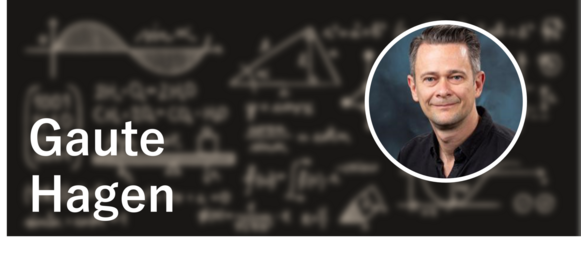
The Early Career Research Program provides financial support that is foundational to early career investigators, enabling them to define and direct independent research in areas important to Department of Energy (DOE) missions. The Early Career Award Winner series provides awardees with an opportunity to explain the results of their research in their own words.
The frontier of nuclear physics aims to understand the nature of atomic nuclei and how they may be used to answer fundamental questions such as: Why is there more matter than antimatter in the universe? What is the nature of the neutrino? How do properties of nuclei impact the physics of neutron stars and astrophysical processes?
These questions lie at the heart of my 2013 DOE Early Career Award to investigate state-of-the-art computations of weak processes in nuclei.
Learn more about how the Early Career award enabled Gaute Hagen’s nuclear physics research.
|
|
New type of superconductor: Physicists have long thought that superconductivity (the ability to conduct electricity without resistance) and magnetism cannot exist in the same material. But scientists at the Massachusetts Institute of Technology (MIT) have discovered a “chiral superconductor” that is superconductive and intrinsically magnetic. Interestingly, this material is a form of graphite, which is used in pencils. Graphite is made from layers of graphene. The scientists found that if sheets of graphene are stacked in a specific pattern, they have exceptional electronic properties. |
|
Carbon fiber: Researchers at DOE’s Oak Ridge National Laboratory have developed a new technique that uses carbon nanofibers to improve binding in carbon fiber and similar composites. It resulted in a 50 percent improvement in tensile strength and almost doubled the materials’ toughness. This process can make structural materials for automobiles, airplanes, and other applications stronger and more affordable. The research used the Center for Nanophase Materials Sciences and the Oak Ridge Leadership Computing Facility, both DOE Office of Science User Facilities. |
Attosecond imaging: Scientists at DOE’s Lawrence Berkeley National Laboratory are part of a team that has generated the shortest pulses of high-energy X-rays ever. They used a powerful laser to excite the electrons closest to the nucleus of an atom. Scientists could use these very short pulses to study phenomena on the quantum scale that could not otherwise be studied. The team used the Linac Coherent Light Source, a DOE Office of Science User Facility. |
|
AI assistant: Scientists at DOE’s Brookhaven National Laboratory have developed a new voice-controlled AI assistant to help researchers use scientific equipment. Users can tell the Virtual Scientific Companion what they would like to do on an instrument and the AI will take on the task. The AI is specifically tailored to that instrument and reduces the time scientists need to spend setting up software parameters. Researchers at the Center for Functional Nanomaterials and the National Synchrotron Light Source-II (both DOE Office of Science User Facilities) co-developed the tool to alleviate bottlenecks at these in-demand facilities. |
Inverse problems: To solve inverse problems, scientists need to work backwards from an outcome to figure out the cause. As many nuclear physics experiments use the results of particle collisions to understand the structure of the atomic nucleus, nuclear physicists run into many inverse problems. Researchers at DOE’s Jefferson Lab and Argonne National Laboratory led the development of an AI technique that can solve these types of problems on supercomputers at large scales. They tested it at the Argonne Leadership Computing Facility, a DOE Office of Science User Facility. |
|
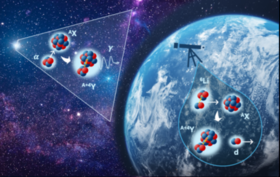
Alpha processes: Fusion reactions induced by alpha particles (two protons and two neutrons bound together) drive the life cycle of stars. They are also a key reaction in how astrophysical processes produce elements heavier than lithium. To improve estimates of what happens inside of stars, researchers rely on properties they infer from reactions that are easier to measure. Scientists from the Facility for Rare Isotope Beams (a DOE Office of Science User Facility) and DOE’s Lawrence Livermore National Laboratory made calculations that allowed them to reassess the alpha fusion rate that formed lithium-6 during the Big Bang. The calculation confirmed one existing discrepancy between observations and theory and explained a different discrepancy. |
|
Groundbreaking Cancer Therapy Clinical Trial Using DOE’s Accelerator-Produced Actinium-225
|
|
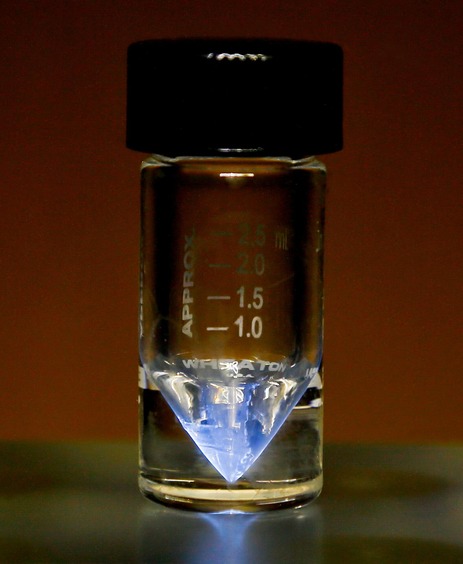
The DOE’s Isotope Program will soon supply a U.S.-based company with samples of the isotope actinium-225 (Ac-225) produced using an accelerator. It will be the first time that Ac-225 produced in this way has been provided in support of a U.S. clinical trial for cancer therapy in humans. Ac-225’s previous production method was extremely slow and complicated, severely limiting its supply. In addition, that previous process could not be scaled up to provide more of this radioisotope. This step forward is a culmination of years of support that DOE’s Office of Science put into developing accelerator-produced Ac-225. |
|
Students Graduate from Fermilab Quantum Science Program
|
|
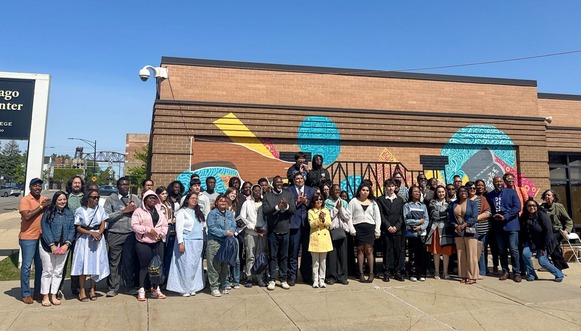
Congratulations to the first graduates of the quantum science education outreach program put on by DOE’s Fermilab! With classes taught by quantum scientists and subject matter experts, 40 high school students from Chicago Public Schools gained the foundation to become the next generation of quantum researchers. Over the 10-week course, students learned about quantum mechanics, superconducting technology, quantum computing, and more. |
|
DOE’s Office of Science Research News Update provides a review of recent Office of Science Communications and Public Affairs work, including feature stories, science highlights, media coverage, and more. |
|
|
Please see the archive on Energy.gov for past issues.
No. 141: 5 August 2025
|
|
|
|