|
|
The NSF-DOE Vera C. Rubin Observatory, a major new scientific facility jointly funded by the U.S. National Science Foundation and the U.S. Department of Energy's Office of Science, released its first imagery on June 23 at an event in Washington, D.C. The imagery shows cosmic phenomena captured at an unprecedented scale. In just over 10 hours of test observations, NSF-DOE Rubin Observatory has already captured millions of galaxies and Milky Way stars and thousands of asteroids. The imagery is a small preview of Rubin Observatory's upcoming 10-year scientific mission to explore and understand some of the universe's biggest mysteries.
Learn about the Rubin Observatory and see more of the First Look images and videos.
|
|
Cement ingredients: Portland cement is the most common type of cement and takes a lot of energy to produce. Using metal oxalates instead of limestone and other minerals to produce cement could be a good alternative. Researchers from the University of Michigan have developed a method to capture carbon dioxide and turn it into metal oxalates. While previous methods required large amounts of hazardous lead catalysts, the team drastically reduced the amount of lead needed. |
Magnetic reconnection: The DOE’s Princeton Plasma Physics Laboratory has debuted the Facility for Laboratory Reconnection Experiments (FLARE), a new device for studying fundamental plasma physics. The new device allows scientists to study magnetic reconnection. This phenomenon occurs when magnetic field lines snap apart and join back together. This process – which releases huge amounts of energy – powers solar flares on the sun and occurs inside of certain types of fusion devices. |
|
Quark-gluon plasma: The quark-gluon plasma is an incredibly hot “soup” of particles that existed at the beginning of the universe. Now, it only exists in a few places in the world where scientists use huge machines to smash together particles. These collisions release quarks and gluons from the protons and neutrons that they are usually contained in. One of these places is the Relativistic Heavy Ion Collider, a DOE Office of Science User Facility. Using RHIC, researchers found that the quark-gluon plasma “splashes” sideways when it is hit by a jet of energetic particles. The research reveals new information about the nature of the quark-gluon plasma. The researchers also used the National Energy Research Scientific Computing Center, another DOE Office of Science User Facility. |
Platinum catalysts: Carbon monoxide oxidation is an important chemical reaction used in numerous applications in the chemical industry. A team led by researchers from DOE’s Lawrence Berkeley National Laboratory designed and made catalysts that increase the speed of this reaction by nine times. Catalysts increase the speed of chemical reactions and are essential for many industrial processes. In this new fabrication approach, the team made precise, atomic-level changes to the catalysts. This technique allowed them to tailor the catalyst to have specific chemical properties. Beyond this single example, this approach sets the stage for major advances in catalyst design. |
|
Quantum computing: Magnetic materials could be key to transmitting and processing quantum information and developing quantum computers. Being able to control the collective magnetic properties of atoms in real time would be extremely useful. Scientists are investigating magnons – the collective vibrations of the magnetic spin of atoms – for this purpose. Researchers at DOE’s Argonne National Laboratory have found a way to control these magnons in real time. This step is necessary for using them to process information. The researchers used the Center for Nanoscale Materials, a DOE Office of Science User Facility. |
Quantum membrane: While the material strontium titanate can be used as a substitute for diamond in jewelry, scientists are also investigating properties it has that may be useful in quantum materials and microelectronics. A team at DOE’s SLAC National Accelerator Laboratory created a thin, flexible membrane out of strontium titanate. They then stretched the membrane in a way that the material generates its own electric field. By turning this field on and off and using X-rays to track the arrangement of ions, the scientists studied this transition. The researchers used the Advanced Photon Source, a DOE Office of Science User Facility. |
|
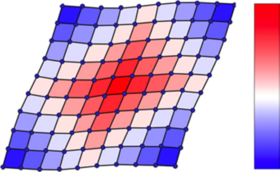
Thermoelectric materials: Thermoelectric materials convert heat into electricity. They can provide a way to use heat that would otherwise go to waste. To improve their use, scientists want to understand them better. Researchers at Columbia University studied the crystal structure of the thermoelectric material germanium telluride. They found that the material maintains its crystalline structure under different conditions. It also has a process that slows the materials’ ability to conduct heat. Both of these properties are useful for potential thermoelectric devices. |
|
Data Pipelines to Accelerate Discovery
|
|
|
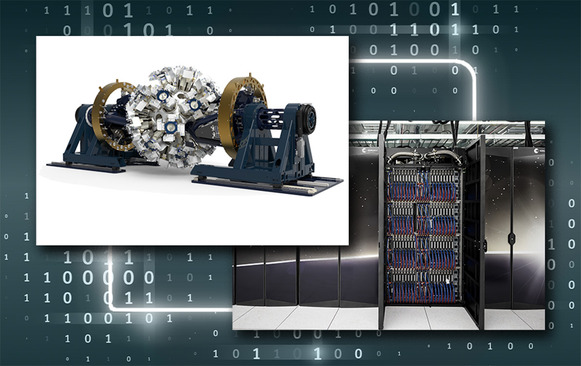
To understand the building blocks of matter, nuclear physicists use extremely sensitive detectors. Recently, these scientists have been using DOE’s supercomputers to analyze data as the machines produce it. But moving the information back and forth between devices and computers takes many steps and delays researchers’ work.
To minimize this problem, researchers at DOE’s Berkeley Lab and Oak Ridge National Laboratory are developing a piece of software called DELERIA (Distributed Event Level Experiment Readout and Analysis). It’s a data pipeline that will allow scientists to share analysis and feedback in real time across long geographic distances. This quick response time will enable scientists to use a broader array of high-performance computing facilities than those available at the institution where the device is. Scientists are developing DELERIA to share information between the Gamma Ray Energy Tracking Array (GRETA), which will be installed at the Facility for Rare Isotope Beams (a DOE Office of Science User Facility) and DOE’s supercomputing User Facilities. The data will be sent via EsNET, another DOE Office of Science User Facility. Read more about DELERIA in features on Berkeley Lab’s and Oak Ridge National Lab’s websites.
|
|
Advanced Photon Source Sets New World Record for Electron Beam Emittance
|
|
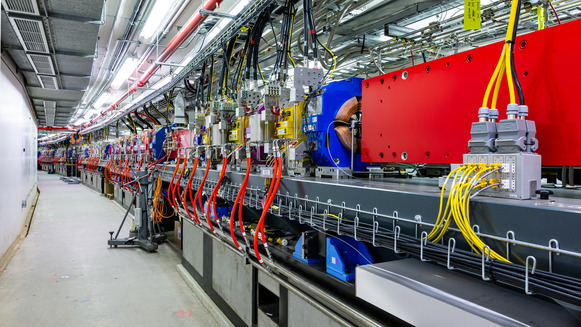
The upgraded Advanced Photon Source (APS), a DOE Office of Science User Facility at Argonne National Laboratory, has set a new global benchmark in synchrotron science. The facility’s electron storage ring has achieved a horizontal emittance of just 33 picometers-radians. This is the lowest ever measured at a synchrotron X-ray light source. The emittance is the electron beam's size and spread (measured by angle). The lower the emittance, the brighter and more focused the X-rays can be. The record was possible because of the APS's recent upgrade. The upgrade made it possible for the beams to be up to 500 times brighter than before. |
|
DOE’s Office of Science Research News Update provides a biweekly review of recent Office of Science Communications and Public Affairs work, including feature stories, science highlights, media coverage, and more. |
|
|
Please see the archive on Energy.gov for past issues.
No. 140: 10 July 2025
|
|
|
|