|
|
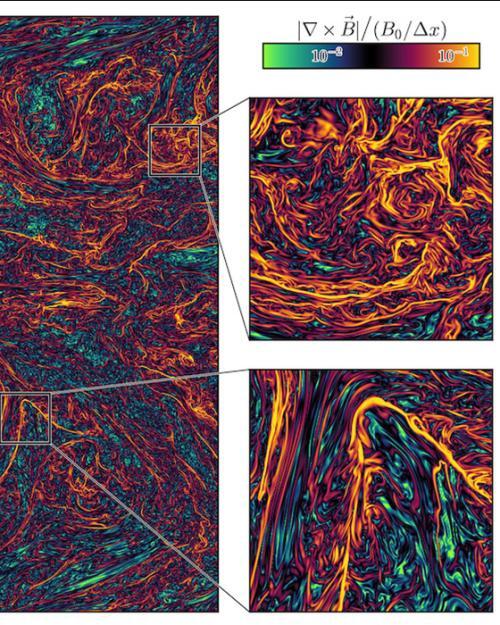
More than a century ago, scientists pondered how evolution might be driven by mutations caused in part by cosmic rays that bombard Earth after the explosive demise of faraway stars. How cosmic rays move through space has been an open question in astrophysics for decades.
Cosmic rays are atoms stripped down to their nuclei and accelerated by stars, supernovae, black holes, and galactic collisions. While they are sparse, these cosmic rays together have large effects as some of the most energetic particles ever known. They spiral around magnetic field lines as they race along those lines at more than 99 percent of light speed.
Cornell University’s Drummond Fielding and his co-workers are working out the kinks of how bends in magnetic field lines scatter cosmic rays in the space between the stars.
Learn more about how simulations made on the Department of Energy’s (DOE) powerful supercomputers are helping researchers understand how our galaxy evolved.
|
|
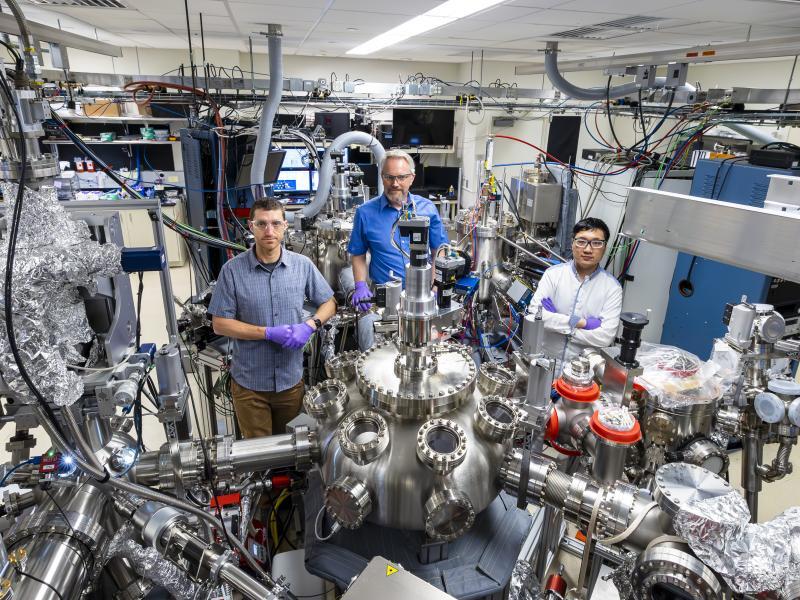
Superconducting qubits: Superconducting qubits are one of the most promising types of qubits, the building blocks for quantum computers. However, they can only retain information for very short periods of time. Researchers at DOE’s Brookhaven National Laboratory and Pacific Northwest National Laboratory have discovered an interface layer in a certain type of qubit that may be reducing its performance. The researchers used the National Synchrotron Light Source-II and the Center for Functional Nanomaterials, both DOE Office of Science user facilities. |
Axions: Axions are theoretical particles that could explain the dark matter that exists throughout the universe that scientists have yet to detect. Researchers at DOE’s Ames National Laboratory and Harvard University have observed magnetic excitations that mimic the properties of these theoretical particles. The researchers created these quasiparticles by using laser pulses to generate magnetic excitations in a specific magnetic two-dimensional material. This discovery has the potential to answer several questions in quantum science. |
|
Quantum computing: Quantum computers could be much better than classical computers at certain tasks. In collaboration with researchers from DOE’s Oak Ridge National Laboratory, D-Wave Quantum Inc. has shown that one of its quantum computing prototypes has the potential to operate faster than leading supercomputing systems. The company’s Advantage2 computer surpassed classical systems in simulating magnetic materials. This is a major step forward for this cutting-edge topic. |
3D-printed superconductors: Unlike traditional superconductors, which require extremely cold temperatures to function, high temperature superconductors can function at slightly warmer temperatures. This property makes them more practical for applications. Researchers at DOE’s Fermilab and Northwestern University have invented a new process for 3D printing high-temperature superconductors. It is the first method that scientists can use to print a specific type of ceramic superconductor. |
|
RNA: RNA molecules have many duties, including carrying the genetic information encoded in DNA to protein production sites. But the functions of RNA molecules that don’t do this activity are largely unknown. Researchers at DOE’s SLAC National Accelerator Laboratory, Stanford University, and the National Institutes of Health found large, complex, multistrand complexes made entirely of RNA. This was the first time this sort of structure had been seen in nature. It expands our understanding of RNA and could inspire similar designs for biomedical purposes. The research used the Stanford Synchrotron Radiation Lightsource, a DOE Office of Science user facility. |
Fractured symmetry: Some physics experiments explore the strong force (the force that holds protons and neutrons together) by ripping apart nuclei. This process frees quarks from protons and neutrons. The quarks then pair up with other strongly interacting particles. Usually, the different types of quarks fragment into new particles in a symmetrical way. But researchers at DOE’s Jefferson Lab found that this fragmentation process doesn’t always result in symmetry. These results suggest that the strong interaction is more complicated than physicists assumed. The research used the Continuous Electron Beam Accelerator Facility, a DOE Office of Science user facility. |
|
Symbiotic fungi: Most plants have symbiotic relationships with certain types of fungi in their roots. Researchers at Stanford University and the University of Washington investigated how these fungi influence the distribution and abundance of plants. They found that the presence of specific host fungi can determine which plants dominate over others. However, the fungi can also help multiple plants coexist by letting them access different nutrient pools. |
|
Harnessing AI for the Labs of the Future
|
|
|
Artificial intelligence is helping scientists at DOE’s national laboratories rethink how laboratories look and function.
At DOE’s Oak Ridge National Laboratory, the Interconnected Science Ecosystem – called INTERSECT – connects several autonomous labs together. In these labs, a combination of robots and artificial intelligence (AI) runs experiments and analyzes data. The labs range in focus from chemistry to additive manufacturing. This network of robotics and AI reduces the time it takes to do research and supports scientists in their efforts to achieve breakthroughs.
Over in California, researchers at DOE’s Lawrence Berkeley National Laboratory are also exploring new ways to conduct research with the help of AI. The A-Lab (for automated-lab) helps scientists rapidly test new materials. In one day, it can process 50 to 100 times more samples than a human can. The AI also determines which materials to test, pulling ideas from Berkeley Lab’s Materials Project and data from Google DeepMind. By taking on some of the physical labor, the robots give researchers more time to design experiments. Other scientists at Berkeley Lab are using AI in synthetic biology, chemical characterization, and particle physics data analysis.
At DOE’s Pacific Northwest National Laboratory, researchers are creating specialized AI models that are trained on specific databases and scientific literature. These tools will allow scientists to gather information on the molecular and physical properties of chemicals. This work will help accelerate catalysis research, which is essential for improving manufacturing.
Accelerators are the focus of AI applications at DOE’s Jefferson Lab. Scientists recently completed three projects focused on ways to use AI and machine learning to make superconducting radio frequency particle accelerators more stable and efficient. This research could improve the use of the Continuous Electron Beam Accelerator Facility, a DOE Office of Science user facility. This work helps scientists collect more data with less downtime.
|
|
The Next Frontier in Nuclear Physics
|
|
Nuclear physics examines the very building blocks of the matter that makes up everything we can detect. It also studies the fundamental forces of physics. Researchers investigate which forces bind protons and neutrons together in atoms, how these interactions result in elements, and what rare nuclei can show us about the origin of matter. Researchers at DOE’s Argonne National Laboratory use the Argonne Tandem Linac Accelerator System (ATLAS), a DOE Office of Science user facility, to explore these issues. The team of researchers is exploring new ways to make ATLAS ever more effective, from using AI to creating a “digital twin” where scientists can test beam settings in a virtual space. |
|
DOE Office of Science Research News Update provides a review of recent Office of Science Communications and Public Affairs work, including feature stories, science highlights, media coverage, and more. |
|
|
Please see the archive on Energy.gov for past issues.
No. 138: 27 May 2025
|
|
|
|
|