|
Boosting growth: A team of scientists with two DOE Bioenergy Research Centers has discovered a gene in poplar trees that can boost photosynthesis. By increasing the expression of the gene, scientists increased tree height by 30 percent in the field and as much as 200 percent in the greenhouse. The gene also increased biomass of a non-poplar species. This discovery could be used to help boost the growth of bioenergy crops without using more land, water, or fertilizer. The research used the Joint Genome Institute and the Oak Ridge Leadership Computing Facility, both DOE Office of Science user facilities. |
Fast ions: Mixed organic ion-electric conductors draw on the strengths of both electronic signaling used by computers and ion signaling used by biological systems. They allow both ions and electrons to move at the same time, which is important for battery charging and other energy storage. Researchers at Washington State University and DOE’s Lawrence Berkeley National Laboratory have discovered a way to make ions move more than 10 times faster in these conductors. The research used the Advanced Light Source, a DOE Office of Science user facility. |
|
Solar fuel: One way to store solar energy is to use it to create hydrogen, known as photocatalysis. However, there are some major challenges with materials that can carry out this process. The common mineral titanium dioxide is a promising material that is limited by how well electrons come to its surface. Researchers at the University of Texas at Austin explored the properties of titanium dioxide in the context of a quasiparticle that may be critical at bringing electrons to the surface. This discovery could make titanium dioxide a better photocatalyst and improve the process of making solar fuels. The research used the National Energy Research Scientific Computing Center and the Argonne Leadership Computing Facility, both DOE Office of Science user facilities. |
Unconventional superconductivity: Unconventional superconductors conduct electricity with no loss to heat at higher temperatures than regular superconductors. Unfortunately, those temperatures are still very low. To develop room-temperature superconductors, researchers need to better understand these materials. Researchers at DOE’s SLAC National Accelerator Laboratory examined a very slow process called atomic relaxation in the context of two quantum states that occur in certain unconventional superconductors. The research used the Linac Coherent Light Source and the National Synchrotron Light Source-II, both DOE Office of Science user facilities. |
|
Accelerators: Compact, high-energy particle accelerators could be useful in medical applications, for materials science research, and to study particle physics. A team of researchers led by scientists from DOE’s Berkeley Lab has made a major step forward in developing such tools. They used a very strong pair of lasers to accelerate a high-quality electron beam over only 30 centimeters in distance. Compared to previous beams, this beam is higher-energy, higher-quality, and more energy efficient. The research used the National Energy Research Scientific Computing Center, a DOE Office of Science user facility. |
Photosynthesis: Photosystem I is a critical protein in the photosynthesis process that converts light to chemical energy. Scientists have been able to combine photosystem I proteins with platinum nanoparticles to make a biohybrid catalyst. With these catalysts, the light captured by photosystem I can drive the production of hydrogen. A team of researchers at DOE’s Argonne National Laboratory and Yale University has determined the structure of this biohybrid catalyst. It’s the first high-resolution view of a biohybrid structure. This research builds on more than 13 years of research at Argonne. |
|
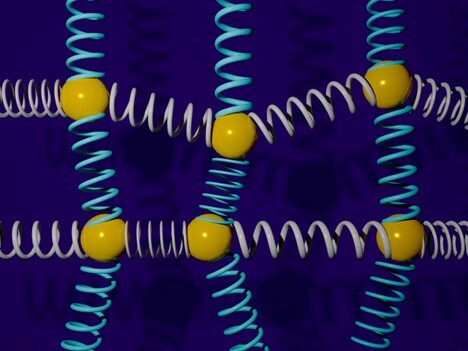
Quantum computers for simulation: Coupled oscillators are systems of coupled masses and springs. They’re important for describing a number of real-world phenomena, such as bridges. Researchers at the University of Toronto and DOE’s Pacific Northwest National Laboratory developed an algorithm for quantum computers that simulates these systems. This algorithm was able to simulate these systems much faster than classical algorithms on non-quantum computers. This approach could be useful for simulating a variety of real-world situations, including in engineering and chemistry. |
|
Four Years of the National Quantum Information Science Research Centers
|
|
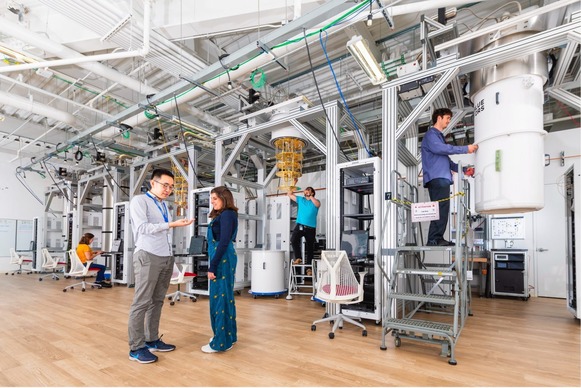
Happy anniversary to our five DOE National Quantum Information Science Research Centers! Over the past four years, these centers have been expanding the frontier of what’s possible in quantum computing, communication, sensing and materials. The 1,500 experts who participate in the centers are advancing basic science for energy, security, communication, and logistics. By training the next generation of quantum scientists and technicians as well as achieving breakthroughs, the centers have also strengthened the national quantum information science ecosystem. Learn more about the centers’ accomplishments and successes so far. |
|
Fermi Award Winners Announced
|
|
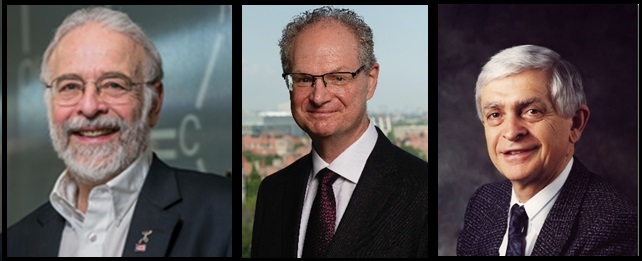
The Enrico Fermi Presidential Award is one of the highest honors in science and technology bestowed by the U.S. government. On December 19, the White House Office of Science and Technology Policy announced the newest Fermi Award recipients: Héctor D. Abruña, Paul Alivisatos, and John H. Nuckolls. Abruña was recognized for his contributions to batteries, fuel cells, and energy materials; Alivisatos was recognized for his work in nanocrystals and polymers; and Nuckolls was recognized for his leadership in inertial confinement fusion and high energy density physics. The awards ceremony is on January 10 and will be broadcast virtually. Please RSVP if you plan on attending. |
|
|
Research News Update provides a review of recent Office of Science Communications and Public Affairs stories and features. This is only a sample of our recent work promoting research done at universities, national labs, and user facilities throughout the country.
|
|
|
|
Please see the archive on Energy.gov for past issues.
No. 133: 6 January 2025
|
|
|
|