|
|
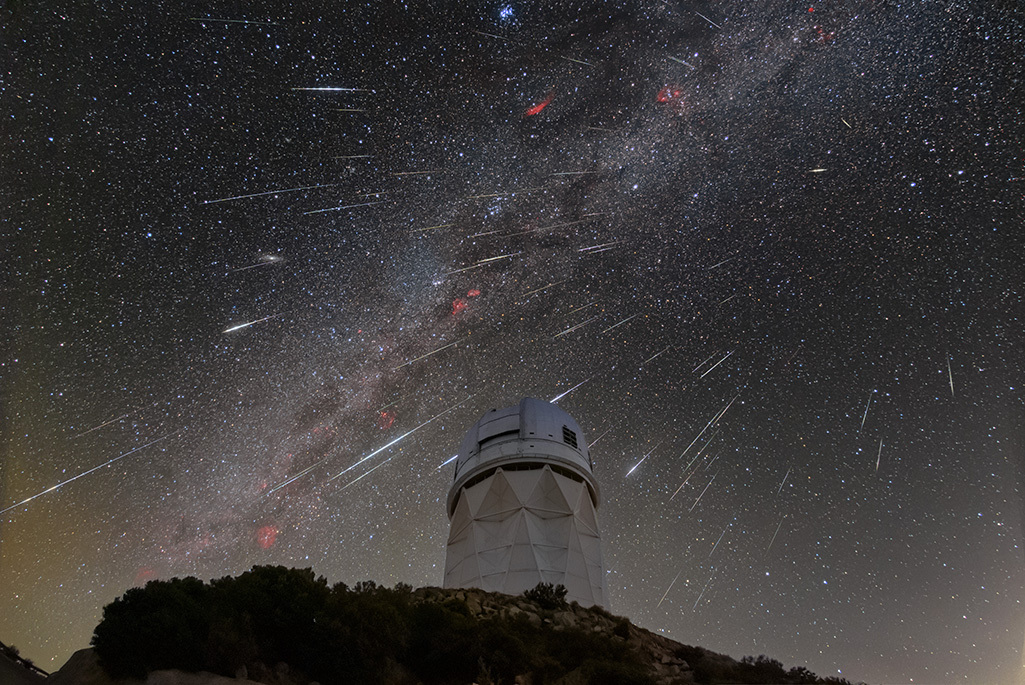
Gravity has shaped our cosmos. Its attractive influence turned tiny differences in the amount of matter present in the early universe into the sprawling strands of galaxies we see today. A new study using data from the Dark Energy Spectroscopic Instrument (DESI) has traced how this cosmic structure grew over the past 11 billion years, providing the most precise test to date of gravity at very large scales. DESI is an international collaboration of more than 900 researchers and is managed by the Department of Energy’s (DOE) Lawrence Berkeley National Laboratory (Berkeley Lab).
In their new study, DESI researchers found that gravity behaves as predicted by Einstein’s theory of general relativity. The result validates our leading model of the universe and limits possible theories of modified gravity. These theories have been proposed as alternative ways to explain unexpected observations – including the accelerating expansion of our universe that is typically attributed to dark energy.
Learn more about the new results and what they can tell us about how our universe works.
|
|
River microbes: A team of scientists has catalogued the microorganisms in a vast number of rivers, with data on 90 percent of the watersheds in the continental U.S. The team was led by researchers from Colorado State University and used data from a years-long participatory science effort led by DOE’s Pacific Northwest National Laboratory. The research suggests that microbes play a significant role in shaping the overall health of rivers. The information illustrates how microbes affect nutrient flows, energy flows, water quality, and river contaminants. |
Electrolytes: Electrolytes convert chemical energy to electrical energy. They’re essential for power sources, including fuel cells. Scientists are working to develop lighter electrolytes to enable longer lasting and more efficient fuel cells. Electrolytes based on polymers that form membranes could help solve that problem. Scientists from DOE’s Oak Ridge National Laboratory, Sandia National Laboratories, and Clemson University discovered a way to control the structure of these membranes. They used the High Flux Isotope Reactor and the National Energy Research Scientific Computing Center, both DOE Office of Science user facilities. |
|
Engineering plants: When scientists genetically engineer plants, they use a bacterium called Agrobacterium tumefaciens. In the wild, this bacterium causes tumors in plants. But its ability to put its own DNA into host plants makes it a useful tool for biotechnology. A team from the Innovative Genomics Institute at the University of California Berkeley and the Joint BioEnergy Institute showed that simple changes to this bacterium can significantly improve how efficiently scientists can introduce DNA into a genome. This technology can open up new opportunities to transform other crop plants and fungi. |
Electrons: Normally, electrons travel at high speeds. But at low densities and temperatures, they come to a standstill. This “electron ice” is called a Wigner crystal, named for the scientist who predicted it in the 1930s. Only a few years ago, a team from DOE’s Berkeley Lab and UC Berkeley provided direct evidence that these crystals exist. Now, scientists from that team have captured direct images of a new quantum phase of an electron solid. Called a Wigner molecular crystal, it has a highly ordered pattern of artificial “molecules” made of two or more electrons. |
|
Nuclear shapes: Scientists at DOE’s Brookhaven National Laboratory have demonstrated a new way to reveal subtle details about the shapes of atomic nuclei. High-energy particle smashups at the Relativistic Heavy Ion Collider — a DOE Office of Science user facility – can complement information from other techniques for determining nuclear structure. Nuclei make up the vast bulk of visible matter in the universe. Better understanding their shapes helps scientists gain insight into fission, element formation, and the early universe. |
Neutrons: Researchers working at the DOE’s Thomas Jefferson National Accelerator Facility have detected neutrons for the first time in a certain type of reaction. This result is providing new insights into the neutron’s internal structure and spin. It was made possible by the Central Neutron Detector, a specialized detector in Jefferson Lab’s Experimental Hall B that took more than a decade to develop and install. The study used the Continuous Electron Beam Accelerator Facility, a DOE Office of Science user facility. |
|
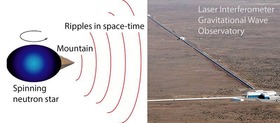
Neutron stars: Collapsed dead stars (neutron stars) are a trillion times denser than lead. A team of nuclear theorists from Indiana University considered similarities between these stars and surface features of moons and planets in our solar system. Some of these mechanisms suggest that neutron stars are likely to have mountains. Neutron star mountains would be so massive that the gravity just from them alone could produce small ripples in the fabric of space and time. The Laser Interferometer Gravitational Wave Observatory (LIGO) is now searching for the ripples these mountains would make. |
|
Projects at Office of Science User Facilities Nab Nominations for Gordon Bell Prize
|
|
|
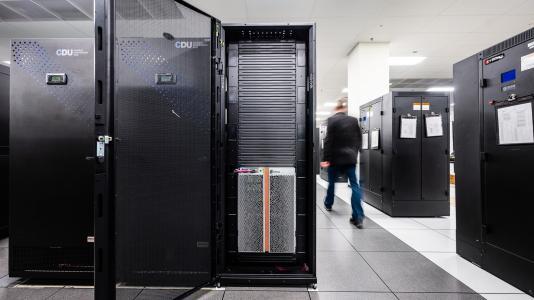
The Gordon Bell Prize is one of the highest honors in the field of supercomputing. Given by the Association for Computing Machinery, the award honors innovation in using high-performance computing to support applications in science, engineering, and large-scale data analytics. This year, multiple DOE national laboratories have participated in teams that have been selected as finalists.
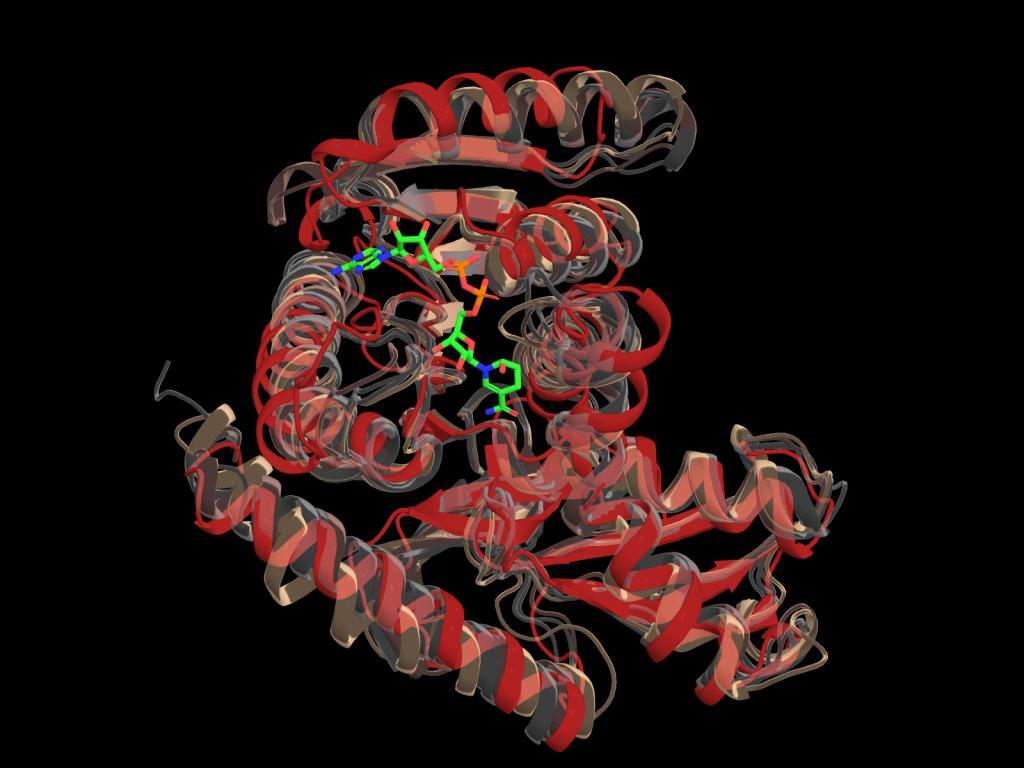
One of the nominations is for a program that the study’s senior author described as “a ChatGPT that designs proteins.” It is an artificial intelligence model that comes up with new designs for protein combinations likely to succeed in the laboratory. It could help scientists design antibodies, vaccines, cancer treatments and more. A team led by researchers from DOE’s Argonne National Laboratory used Frontier at the Oak Ridge Leadership Computing Facility (OLCF) and Aurora at the Argonne Leadership Computing Facility (ALCF) (both DOE Office of Science user facilities) as well as several other supercomputers for their work.
Another project at the OLCF is in the running for the Gordon Bell Prize for Climate Modeling. Researchers at DOE’s Oak Ridge National Laboratory used Frontier to train the world’s largest artificial intelligence model for weather prediction. The model could lead to a new era of fast, cheap, and accurate hyperlocal weather forecasts. It has the potential to predict weather up to 30 days in advance.
|
|
How Can Scientists Use Large Language Models for Research?
|
|
Artificial intelligence tools based on large language models such as ChatGPT are affecting everything from how people search for information to how we communicate with each other. Researchers from DOE’s national laboratories are leading efforts to use artificial intelligence – including large language models – to support scientific discovery. Find out how scientists are training AI and looking forward to using it in the article “Everything you always wanted to know about large language models for science (but were afraid to ask)” from Argonne National Laboratory. |
|
|
Research News Update provides a review of recent Office of Science Communications and Public Affairs stories and features. This is only a sample of our recent work promoting research done at universities, national labs, and user facilities throughout the country.
|
|
|
|
Please see the archive on Energy.gov for past issues.
No. 132: 10 December 2024
|
|
|
|