|
 30 September 2024
|
|
Better batteries: The amount of energy that batteries can store lessens over time. This is a particular problem for cobalt-free batteries that engineers are in the process of developing. Improving their capacity would improve electric vehicles and renewable energy storage. A team that includes researchers from the University of Colorado Boulder and DOE’s Argonne National Laboratory used the Advanced Photon Source (a DOE Office of Science user facility) to study the cause of this degradation. This research will help engineers develop solutions that can prevent the problem. |
Neutrino detection: Scientists working on the Short-Baseline Near Detector at DOE’s Fermilab National Accelerator Laboratory identified that the detector has captured its first interaction with a neutrino. Physicists will be using this detector to study different types of neutrinos and search for a potential fourth type. By combining this detector with an existing one, they will be able to measure how these strange fundamental particles change in much more precise, specific ways than before. These data will also inform the upcoming Deep Underground Neutrino Experiment project. |
|
Efficient computing: As electrical signals move around a computer chip, the amount of energy and information they can transfer decreases. To reduce these losses, chips must have amplifiers. But these amplifiers limit the chips’ performance. Through the REMIND Energy Frontier Research Center, researchers at Texas A&M University, Sandia National Laboratories, and Stanford University discovered a new class of materials that could help solve this problem. By spontaneously amplifying pulses, these materials work similarly to axons in the brain. They could enable far more efficient computers. |
Flooding: If unabated, future climate change will have drastic and destructive impacts across the country. Researchers at DOE’s Pacific Northwest National Laboratory studied climate change’s effects on flooding in the Delaware River Basin. This area is home to eight million people, including people in New York, New Jersey, and Pennsylvania. Using modeling, they analyzed flood events over the past 40 years. Future projections based on these climate scenarios suggest more intense flooding across the region as well as changes to the timing and risk level of floods. |
|
Transistors: Transistors are a fundamental component of computer microchips. There are new transistor materials that may be able to store a greater amount of electrical charge at lower voltages, which is the opposite of traditional materials. Researchers at DOE’s Lawrence Berkeley National Laboratory have mapped where this property comes from, down to the arrangements of specific atoms. They designed a new open-source 3D simulation framework for this research and ran it on the Perlmutter supercomputer at the National Energy Research Scientific Computing Center, a DOE Office of Science user facility. |
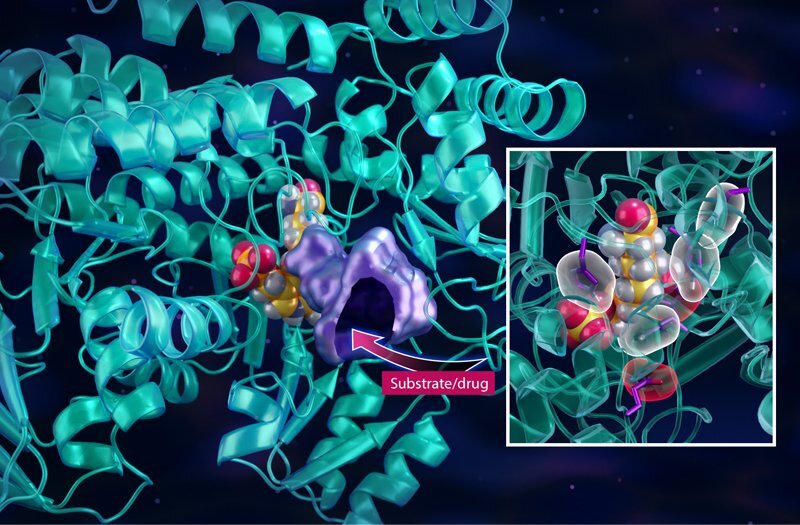
Fungal infections: There are more than 150 million severe fungal infections worldwide, with almost 1.7 million fatalities annually. There is also a scarcity of effective, non-toxic fungal drugs on the market. To help inform the development of antifungal treatments, scientists at DOE’s Oak Ridge National Laboratory used neutron scattering to reveal key information about fungus cell membranes. They used the Spallation Neutron Source and the High Flux Isotope Reactor, both DOE Office of Science user facilities. |
|
The Office of Science posted six new highlights between 9/16/24 and 9/29/24.
|
|
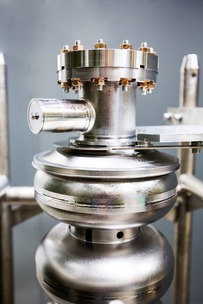
Improving SRF cavities: Advanced particle accelerators rely on superconducting radiofrequency (SRF) cavities to function. Current SRF cavities are made of niobium. Scientists have ways of further improving the cavities’ efficiency, but some of these enhanced cavities cannot stand up to high-power operations as well as current ones can. Accelerator scientists know that the cleanliness, shape, and roughness of these cavities’ inner surfaces affect their efficiency. Researchers at DOE’s Thomas Jefferson National Accelerator Facility studied the surface roughness of the enhanced cavities. They found that cavities with smoother inner surfaces were more efficient. Based on what they found, the scientists developed a toolkit to help scientists better monitor and control these cavities’ characteristics. It could also help engineers make better cavities for future accelerators. |
|
|
Science Friday: Physicists create heaviest antimatter nucleus yet
This piece describes a new finding by scientists at DOE’s Brookhaven National Laboratory at the Relativistic Heavy Ion Collider. They discovered the heaviest exotic antimatter nucleus observed to date.
|
|
Scientific Innovation Puts the Future in Focus
|
|
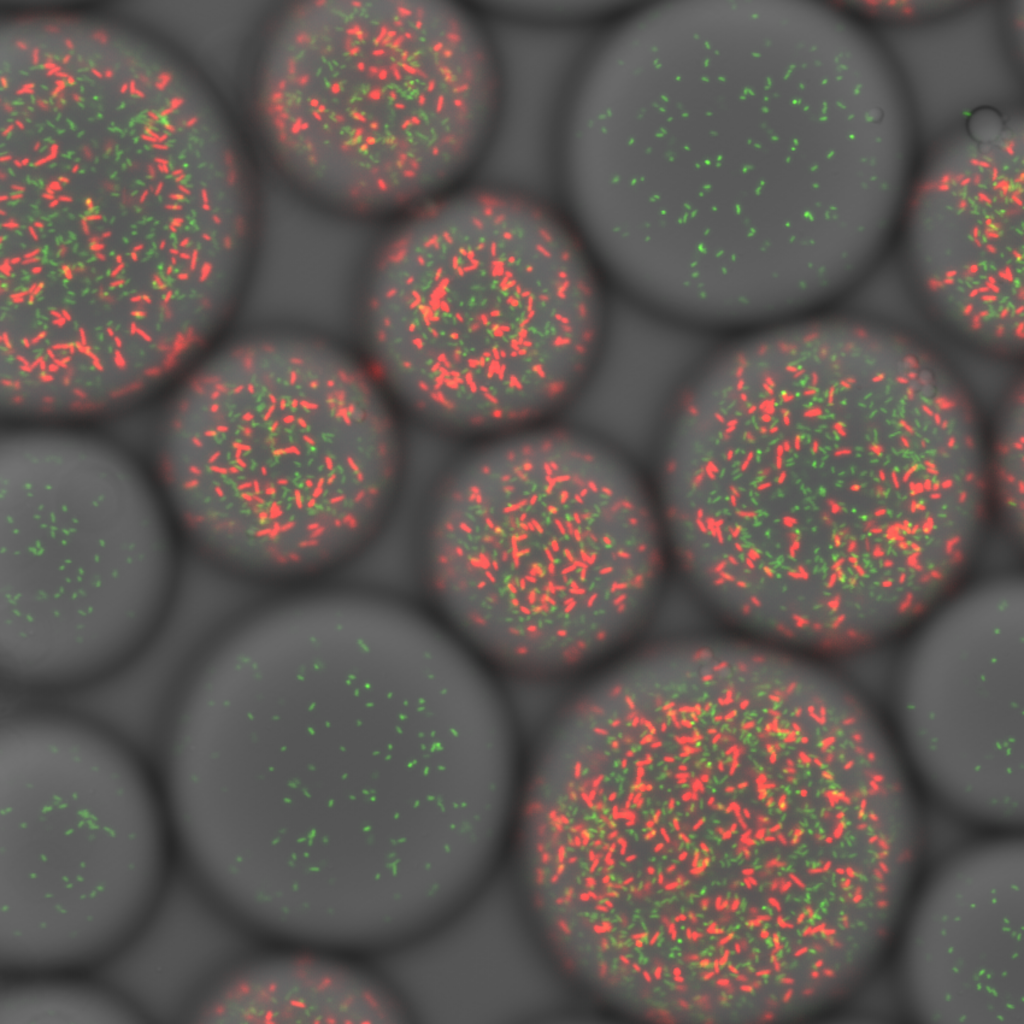
Our national laboratories are pursuing cutting-edge research to help solve some of our world’s biggest problems. Researchers at DOE’s Argonne National Laboratory are investigating artificial intelligence, energy storage, quantum information science, and synthetic biology. They are combining artificial intelligence with robot-assisted experimentation to allow scientists to focus on the most important aspects of research. Work on quantum information science is moving us towards a quantum internet while improved energy storage will help us transition to a grid powered by renewable energy. With synthetic biology, scientists are combining supercomputing, AI, and specialized genetic tools to create microbes that can reduce microplastics or nuclear waste. |
|
Building Bridges through Relationships and Research
|
|
|
In science, partnerships are essential. Friendships can become sparks for creativity and discovery. That’s why it meant so much when two long-time friends were able to work together on a research project after 30 years in their fields.
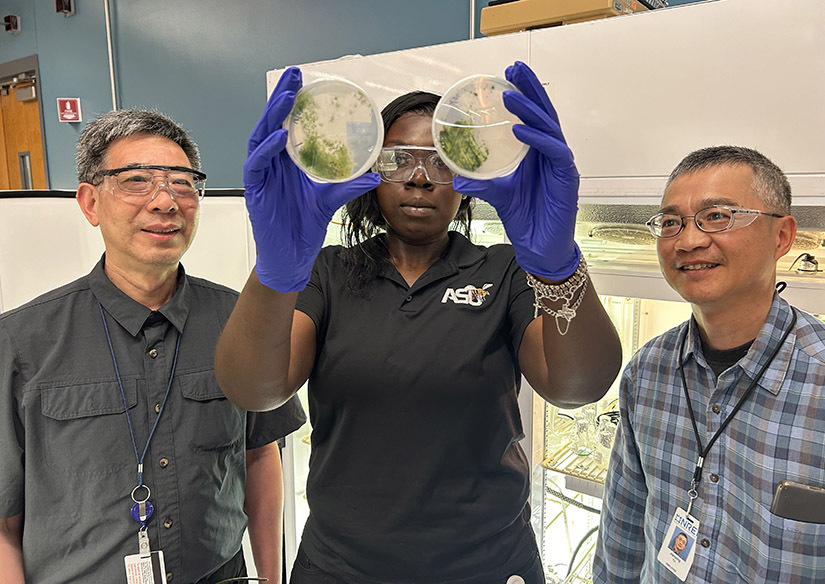
Harvey Hou is an Alabama State University chemistry professor and Jianping Yu is a molecular biology researcher at DOE’s National Renewable Energy Laboratory. They first met as postdoctoral researchers and kept in touch through the years. While they also wanted to work together on a research project to study photosynthesis, they never had the opportunity.
That recently changed when Hou was chosen for the DOE Office of Science’s Visiting Faculty Program. The program is designed to strengthen ties between institutions historically underrepresented in STEM research and DOE national laboratories. Hou finally had the chance to work alongside Yu and his team at NREL. Yu’s team studies how cyanobacteria (blue-green algae) regulate their cellular energy. This understanding can help support efforts to create low-carbon fertilizers or biofuels.
The collaboration has led to published papers, a DOE Science Foundations for Energy Earthshots award, a presentation at 79th Joint Meeting of Beta Kappa Chi and the National Institute of Science, and an internship for one of Hou’s students at NREL.
|
|
|
Research News Update provides a review of recent Office of Science Communications and Public Affairs stories and features. This is only a sample of our recent work promoting research done at universities, national labs, and user facilities throughout the country.
|
|
|
|
Please see the archive on Energy.gov for past issues.
No. 127: 30 September 2024
|
|
|
|