|
 3 September 2024
|
|
Antimatter: A team of scientists using the Relativistic Heavy Ion Collider (a DOE Office of Science user facility) has discovered a new type of antimatter nucleus. It’s made of four antimatter protons and is the heaviest of its kind ever detected. With this discovery, researchers expect to dig deeper into one of the major questions in physics - why there is far more matter than antimatter in the universe. |
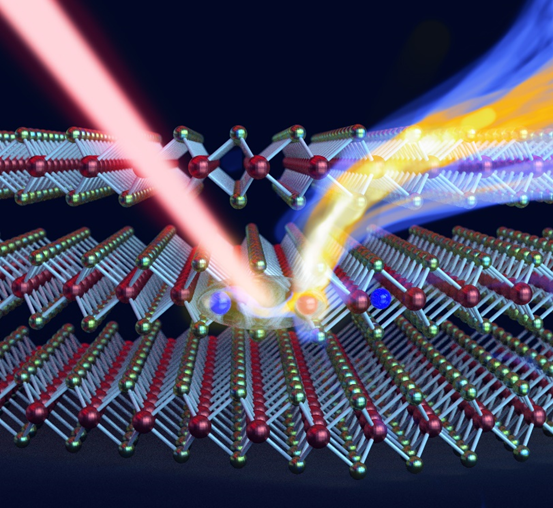
Excitons: Excitons are exotic particles that are key to a form of magnetism that occurs in ultrathin materials. Using the National Synchrotron Light Source-II Office of Science user facility, scientists from MIT and other universities have discovered the origin of these particles. They also demonstrated how to control these particles. These discoveries could be important for quantum computing. |
|
Superconductors: Superconductors allow electricity to flow through them with no energy loss. However, they only work at extremely low temperatures. A team led by researchers from DOE's SLAC National Accelerator Laboratory and Stanford University has observed a required phenomenon for superconductors – electron pairing – at much higher temperatures than scientists thought possible. The phenomenon also occurred in a surprising material. While the material did not have zero resistance, this finding brings us closer to engineering high-temperature superconductors. |
World record: The upgraded Advanced Photon Source DOE Office of Science user facility at Argonne National Laboratory recently achieved a world record. A new set of measurements shows that it has the best electron beam emittance of synchrotron X-ray facilities in the world. The emittance is a measurement of the size and angular spread of the electron beam. The lower the emittance, the more particles are packed into a smaller space and the brighter the X-ray beam. |
|
Genetic dark matter: Scientists from DOE’s Lawrence Berkeley National Laboratory have developed a new technique to analyze the genes in microbes. Scientists will be able to use this method to understand what traits or activities certain genes encode for. The technique will allow scientists to further investigate genetic dark matter, the vast amount of DNA that scientists can sequence but do not know the function of. |
Protecting tokamaks: To produce commercial fusion energy, scientists need to be able to protect the inside of the tokamak fusion device from the incredibly hot plasma generated. One potential method is to use evaporating liquid metal. Researchers at DOE’s Princeton Plasma Physics Laboratory used computer simulations to determine the best place to put a lithium vapor “cave” in a fusion device. |
|
The Office of Science posted six new highlights between 8/19/24 and 9/2/24.
|
|
Telecom: In today’s telecommunication systems, optical fibers carry long-distance internet communication. But where a data signal changes fibers, the system changes the signal from light to electricity. Shifting to electricity uses extra power. Researchers at the University of Maryland used tools at the Center for Functional Nanomaterials (a DOE Office of Science user facility) to investigate using a small number of photons of light to process information. This method could improve the speed and energy efficiency of telecommunications. The scientists demonstrated that a device made of three atomic layers of a specific semiconductor has a behavior that is necessary for developing this approach to telecommunications. |
|
Enabling Next-Generation Aircraft
|
|
Whisper Aero is a start-up in Tennessee that focuses on developing an advanced electric ducted fan for airplanes. These fans could potentially replace traditional fossil-fuel burning engines used on most aircraft. The engines could also be more efficient and quieter than current and competing technologies. The company partnered with the Oak Ridge Leadership Computing Facility (a DOE Office of Science user facility) to conduct simulations on the Summit supercomputer. These simulations are enabling the firm to accelerate their design of a unique integrated system for an airplane called the Whisper Jet. This proposed aircraft could fly without producing any emissions. |
|
|
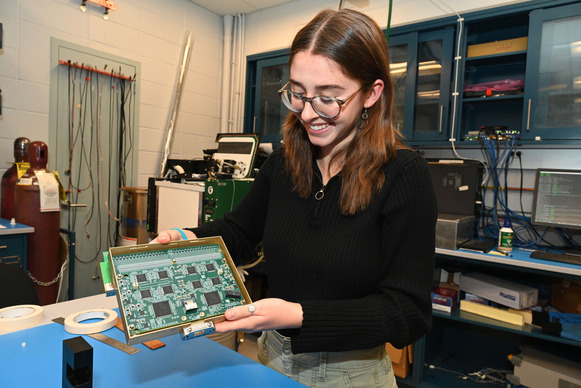
Neutrinos are tiny, mysterious subatomic particles that are one of the building blocks of matter. To better understand our universe, researchers at DOE’s Brookhaven National Laboratory study neutrinos, including collaborating on the massive LBNF-DUNE experiment in South Dakota. In a feature article, Nora Lowe (a summer science writing intern at DOE’s Brookhaven Lab) gives a terrific explanation of these strange particles and her experience learning about them from the lab’s scientists.
Editor’s Note: We apologize for an error in the last Research News Update that a reader pointed out to us. The link in the feature pointed to the wrong article. It should have pointed to this article: Breaking Barriers in Scientific Discovery.
|
|
|
Research News Update provides a review of recent Office of Science Communications and Public Affairs stories and features. This is only a sample of our recent work promoting research done at universities, national labs, and user facilities throughout the country.
|
|
|
|
Please see the archive on Energy.gov for past issues.
No. 125: 3 September 2024
|
|
|
|