|
 6 August 2024
|
|
|
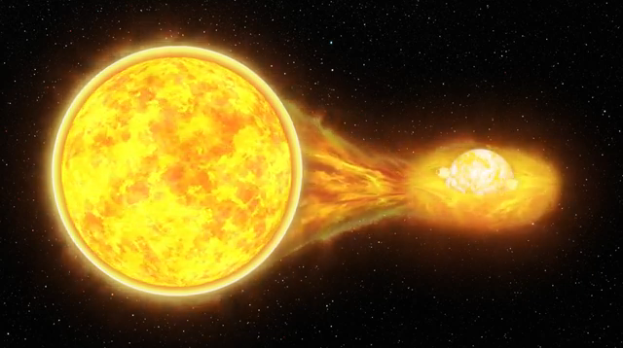
In space, some stars are known to feed off one another. As they suck energy from their neighbors, these stars trade chemical elements. By understanding the dynamics of these stellar reactions, we can learn more about the cosmic recipes in everything from planets and particles in space to life on Earth.
Scientists at the Department of Energy’s (DOE) Oak Ridge National Laboratory and Michigan State University have reproduced in a laboratory one of the specific reactions that occurs when a neutron star gobbles up mass from a nearby companion star. Neutron stars are super dense stars with a center that has a massive gravitational pull. The force is so powerful that it can siphon off enough hydrogen and helium from a nearby star to create an explosion on the neutron star’s surface. These explosions, fueled by the nuclear reactions, can create new versions of chemical elements.
Learn more about how researchers recreated these stellar reactions in the laboratory.
|
|
Changes in materials: The properties of materials in electronics change in response to voltage and current. Scientists have studied these changes at both the microscale and nanoscale. Researchers at DOE’s Argonne National Laboratory, Rice University, and Lawrence Berkeley National Laboratory used the Advanced Photon Source, a DOE Office of Science user facility, to study those changes at the mesoscale, the level between those two. This research helps scientists bridge those levels and have a bigger picture of overall atomic structure. |
Electric aircraft: Electric aircraft need high power for both takeoff and landing, but that can be difficult to access at the end of a flight. Researchers at the University of Michigan and the Molecular Foundry (a DOE Office of Science user facility) employed a technique usually used in biology to explore the interactions between electrodes and electrolytes in batteries. They found that damaging molecules form on the positive side of the battery, which reduced power delivery. By mixing salts into the electrolyte, they reduced the formation of damaging molecules. |
|
Cancer treatments: Isotopes of actinium are an important aspect of a very promising cancer treatment. However, actinium is incredibly difficult to study and only very small amounts exist. Most of the time, scientists study such rare elements by examining similar non-radioactive elements. But researchers from DOE’s Berkeley Lab found out that actinium acts differently than its lighter counterpart, lanthanum. Better understanding actinium’s chemistry and behavior could help scientists develop better pharmaceuticals. The team used the Advanced Light Source, a DOE Office of Science user facility, in the research. |
Poplar: A team led by researchers from Michigan State University and the Great Lakes Bioenergy Research Center has discovered a way to engineer poplar trees to produce valuable chemicals. One of these chemicals is commonly derived from shark livers. Using poplar as an alternative source could reduce destructive shark hunting. These chemicals could also provide an additional economic benefit to processing these trees, making biofuels from poplar more economically viable. The scientists are currently finding ways to produce other important compounds. |
|
Fusion devices: For a future fusion power plant to produce reliable energy, scientists need to be able to control and confine the superhot plasma inside of the device. Scientists thought that the particle beam that heats the plasma and causes it to rotate reduced the amount of turbulence, which always made the plasma easier to confine. However, recent simulations suggest otherwise. Researchers from General Atomics and the University of California San Diego used data from the D-IIID facility on computers at the Oak Ridge Leadership Computing Facility (both DOE Office of Science user facilities) to simulate turbulence near the device’s walls. They found that the rotation can sometimes reduce confinement rather than improve it. |
Solar panels: Solar cells that use carbon-based semiconductors could be cheaper than silicon-based ones and potentially be coated onto surfaces. However, most of them don’t convert light to electricity as well as silicon-based ones. Researchers at the University of Kansas investigated one type of carbon-based semiconductor that is very good at light conversion. They found a microscopic mechanism that enables its efficiency. They used the Advanced Photon Source DOE Office of Science user facility in the research. |
|
The Office of Science posted 14 highlights between 7/2/24 and 8/5/24.
|
|
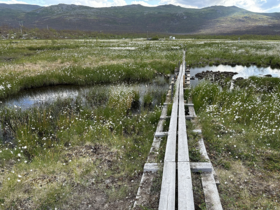
Peatland microbes: Peatlands in the Arctic store huge amounts of carbon. If the peatlands release this carbon, it could further accelerate climate change. Scientists want to understand the role of microorganisms in how carbon moves through these peatland ecosystems. Researchers at Colorado State University used the Joint Genome Institute and Environmental Molecular Sciences Laboratory (both DOE Office of Science user facilities) to analyze the genomics of peatland microbes. They found that microbes in wetlands use certain enzymes to break down a group of organic compounds that are often toxic to microbes. Scientists previously thought that microbes only used these enzymes in the presence of oxygen. The fact that they can break down this group of compounds both with and without oxygen suggests that there is a greater risk of peatlands releasing carbon into the atmosphere than previously thought. |
|
Empowering Urban Communities with Climate Data
|
|
|
The climate in urban environments varies from neighborhood to neighborhood. The built environment, including buildings and pavement, makes a big difference in the temperature and how much heat the land absorbs during the day. This diversity means that different parts of a city may need different approaches to reducing the effects of climate change.
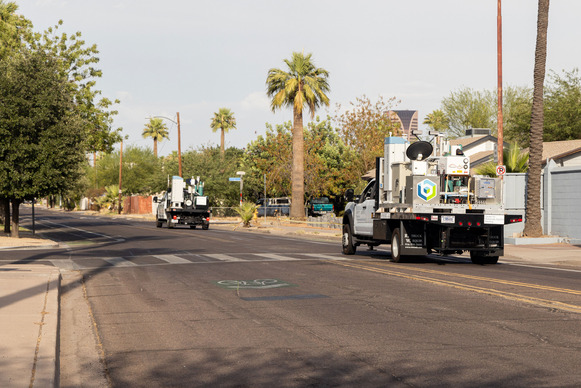
To measure these variations, researchers at DOE’s Brookhaven National Laboratory have designed and built two mobile atmospheric observatories. Most observatories consist of a set of stationary instruments. In contrast, these observatories are pickup trucks equipped with a suite of instruments. Having two of them allows scientists to take data from different locations simultaneously and compare it. In addition, the instruments on one of the two observatories can be removed and placed in other locations like a boat or a rooftop. The first mobile observatory has already taken a number of observations on the East Coast and in Houston, Texas.
Recently, both observatories moved to Arizona to take data as part of the Southwest Urban Corridor Integrated Field Laboratory. This integrated urban field laboratory is a collaborative project between Brookhaven, all three state universities in Arizona, and several other partners. The observatories are taking data in Tucson and Phoenix to better understand how extreme heat varies across these cities. In fact, the heat in these cities was so intense some days that it tested the limits of the instruments themselves. The researchers will analyze the results with local partners to help inform decision-making about the best ways to respond to climate change.
|
|
Fusion Summer Schools Prepare Students for the Future
|
|
|
Before fusion can become a reliable source of clean power, scientists need to solve a number of challenging problems. The next generation of scientists may provide some of those essential answers. Fusion summer schools supported by the DOE’s Office of Science are helping train those up-and-coming researchers.
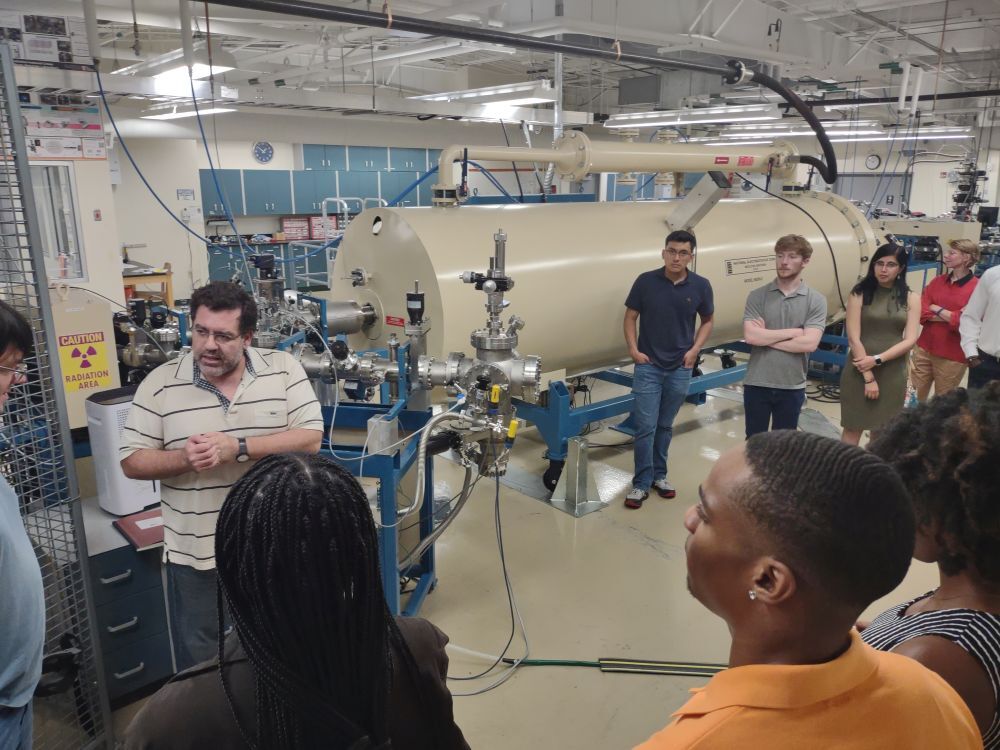
In May, the University of Tennessee Knoxville hosted the first University of Tennessee / Oak Ridge National Laboratory Fusion Summer School. This one-week class had four interns from minority serving institutions (Tennessee State University, Lane College, and Fisk University) as well as 12 interns from DOE's Oak Ridge National Laboratory. Participants enjoyed lectures, panel discussions, lab visits, and demonstrations. This program is part of the larger Reaching a New Energy Sciences Workforce (RENEW) program that builds foundations for Office of Science research at institutions that are historically unrepresented in the Office of Science portfolio.
In June, the data science program at William & Mary hosted the AI4Fusion Summer School. This two-week intensive course focused on using artificial intelligence and machine learning to better control fusion experiments. The course taught 14 undergraduate students through both lectures and hands-on work based on real datasets. The program is part of a larger project to use advanced algorithms to tackle high-priority research opportunities in fusion and plasma sciences.
Several other universities and laboratories are hosting similar programs, including DOE’s Princeton Plasma Physics Laboratory and the Massachusetts Institute of Technology.
|
|
|
Research News Update provides a review of recent Office of Science Communications and Public Affairs stories and features. This is only a sample of our recent work promoting research done at universities, national labs, and user facilities throughout the country.
|
|
|
|
Please see the archive on Energy.gov for past issues.
No. 123: 6 August 2024
|
|
|
|
|