|
 11 March 2024
|
|
Freeze-frame: Scientists have developed a way to watch an electron moving while stopping the motion of the much larger atom it orbits in liquid water. The method will provide new insights into the electronic structure of molecules in the liquid phase. In particular, it will help scientists better understand the effects of radiation exposure. The research is supported by the Interfacial Dynamics in Radioactive Environments and Materials Energy Frontier Research Center. It includes scientists from DOE’s Pacific Northwest National Laboratory, Argonne National Laboratory, SLAC National Accelerator Laboratory, and international and university partners. |
Heavy fermions: Heavy fermion compounds are a class of materials with electrons that are up to 1,000 times heavier than usual. Scientists think that the electrons’ interactions may play important roles in a number of quantum phenomena, including superconductivity. Researchers at Columbia University have successfully created the first 2D heavy fermion material. Because it is thinner than previous versions, it is easier to manipulate and combine with other materials. The team used the National Synchrotron Light Source II and Spallation Neutron Source, both DOE Office of Science user facilities. |
|
Unconventional superconductors: A team of scientists from DOE’s Ames National Laboratory and SLAC National Accelerator Laboratory has provided new insights into infinite-layer nickelates. This material is a recently discovered class of unconventional superconductors, which work at higher temperatures than conventional ones. The results will help scientists understand how these superconductors work and how they differ from other superconductors. |
Snowpack: A new Dartmouth University study provides evidence that seasonal snowpacks in most of the Northern Hemisphere have shrunk significantly over the past 40 years due to climate change. The sharpest reductions were in the Southwestern and Northeastern United States, as well as in Central and Eastern Europe. These losses ranged from 10 to 20 percent per decade. These changes will worsen a water crisis for hundreds of millions of people that depend on snowpack for water. |
|
The Office of Science posted five new highlights between 2/27/24 and 3/11/24.
|
|
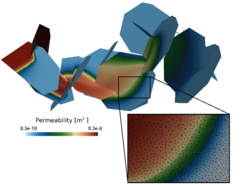
Fractures: Water and other fluids move through fractures in rocks below the Earth’s surface. As fluids move through the fractures, they react with minerals in the rocks. Because these processes occur slower in nature than in the lab, it’s hard for scientists to fully predict these chemical reactions. Researchers at DOE’s Los Alamos National Laboratory ran simulations of how minerals dissolve in these networks of fractures. Better understanding how rocks will react in a variety of situations can inform geothermal energy production, carbon dioxide storage, and other applications. |
|
Leveraging Supercomputers to Investigate Earthquake Hazards
|
|
|
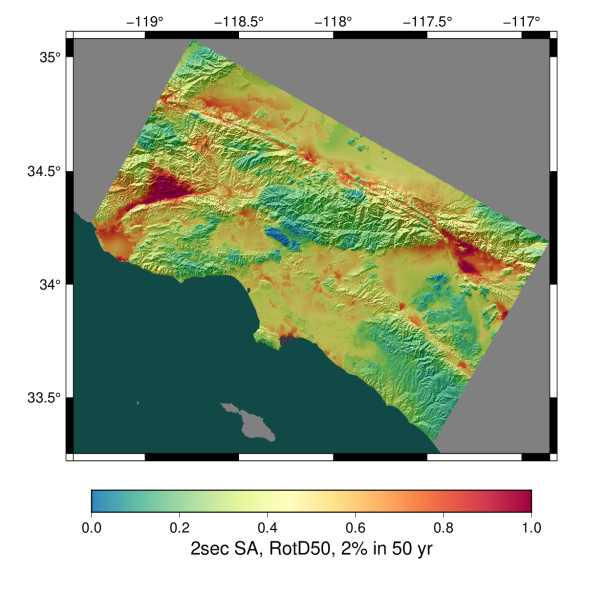
Severe earthquakes don’t happen very often in highly populated areas, but when they do, they can be devastating. DOE’s supercomputing resources are helping earthquake researchers better understand these events.
Scientists at the Statewide California Earthquake Center ran a new version of a computer model on the Summit supercomputer at the Oak Ridge Leadership Computing Facility, a DOE Office of Science user facility. The CyberShake Study 22.12 uses better simulations of the Earth’s structure and new computational methods to create more accurate representations of how the ground moves during earthquakes in California. Being able to better predict how long and severely the ground moves can help scientists improve their estimates of risks. In fact, policymakers (including the U.S. Geological Survey) have used past versions of the model to inform earthquake hazard prevention programs and new building codes.
|
|
Developing Both Future Quantum Technology and Future Quantum Scientists
|
|
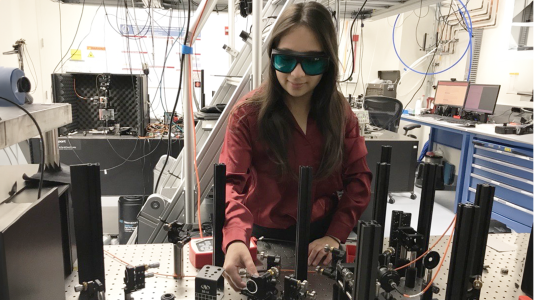
Quantum technology may be The Next Big Thing. But to move forward, it requires advances in both science and the people to carry out that research. Chloe Washabaugh is devoted to developing both. She’s a University of Chicago student pursuing a Ph.D. in quantum engineering. She’s also a collaborator with Q-NEXT, a DOE National Quantum Information Science Research Center led by DOE’s Argonne National Laboratory. In her research, Washabaugh works on building qubits that can carry quantum information. They serve as the heart of quantum computers. She focuses on qubits made out of custom molecules, which can be more flexible than other options. In addition to her research, Washabaugh conducts outreach to decision-makers and non-scientists to help them better understand the importance of quantum science. |
|
|
Research News Update provides a review of recent Office of Science Communications and Public Affairs stories and features. This is only a sample of our recent work promoting research done at universities, national labs, and user facilities throughout the country.
|
|
|
|
Please see the archive on Energy.gov for past issues.
No. 114: 11 March 2024
|
|
|
|