|
 12 February 2024
|
|
|
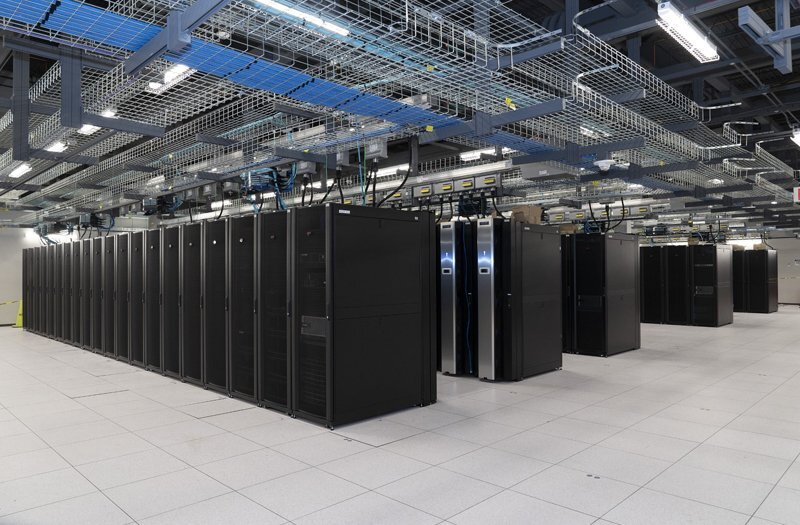
We’re all about finding new ways to save energy and money at the Department of Energy (DOE), especially when it comes to our facilities. But it’s not usually on such a large scale. DOE’s Brookhaven National Laboratory just completed a facility "repurposing" project. It turned a particle accelerator that hosted Nobel Prize-winning research into one of the largest storehouses of scientific data in the world. The 59,000 square feet of the former National Synchrotron Light Source (NSLS) facility had been unused after its successor, the NSLS-II, opened. Recently, the lab completely renovated it as the home for Brookhaven's Scientific Data and Computing Center.
Learn about how this project allowed the DOE Office of Science to support its sustainability goals while saving money.
|
|
Ink: A research team led by scientists from DOE’s Lawrence Berkeley National Laboratory has developed “supramolecular ink.” It is a new technology that can be used in OLED (organic light-emitting diode) displays or other electronic devices. Most smartphones and flat-screen panel TVs use OLEDs. Instead of costly scarce metals, the ink is made of inexpensive, Earth-abundant elements. This technology could lead to more affordable and sustainable versions of current electronic devices as well as new wearable ones. |
Fuel cells: To be more widely used, fuel cells need to be less expensive. Researchers have been investigating catalysts that use iron, carbon, and nitrogen but they are either not durable or are inefficient. A team led by scientists at the University of Buffalo found that adding hydrogen to the process of creating these catalysts can create strong and effective catalysts. These new catalysts are close to performing as well as existing platinum-based ones. The team used the Center for Nanophase Materials Sciences Office of Science user facility. |
|
Protons: Researchers at DOE’s Thomas Jefferson National Accelerator Facility are connecting theories about gravity to how the smallest particles of matter interact. They used this new method to capture the distribution of the strong force in the proton. It’s the sheer stress that the strong force may exert on the proton’s quarks. This is only the second of the proton’s mechanical properties that scientists have measured. The research used the Continuous Electron Beam Accelerator Facility Office of Science user facility. |
Giant viruses: Giant viruses are hundreds of times larger than regular ones. Researchers at the University of Massachusetts, Amherst found 16 new giant viruses in Harvard Forest. This discovery was particularly unusual because most giant viruses were previously discovered in aquatic habitats. The Joint Genome Institute, a DOE Office of Science user facility, conducted the genomic analysis. |
|
Twisted crystal: Researchers with DOE’s SLAC National Accelerator Laboratory, Stanford University, and Berkeley Lab grew a twisted multilayer crystal structure for the first time. They also measured the structure’s key properties, including a new version of a property that’s essential in transistors and LEDs. The twisted structure could help researchers develop next-generation materials for solar cells, quantum computers, lasers, and other devices. |
Plasma: A research team from the University of Maryland, DOE’s Princeton Plasma Physics Laboratory, DOE’s Oak Ridge National Laboratory and other partners has invented a new technology that can produce a uniform, ultra-high temperature plasma. The technology can be set up at a lab using relatively low electrical voltage – as low as 50 volts. The new technology could be useful for improving materials research. |
|
The Office of Science posted five new highlights between 1/30/24 and 2/12/24.
|
|
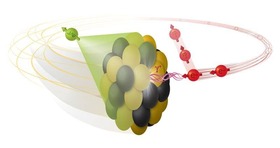
Atomic nuclei: Scientists from DOE’s Brookhaven National Laboratory, University of Jyvaskyla (in Sweden), and Wayne State University have developed a new way to study the shapes of atomic nuclei and their internal building blocks. With this method, the researchers found that certain collisions (ones that only produce a particle made of a quark and antiquark) can help us understand nuclei’s size and shape. In particular, this method provides information on how gluons (which hold together quarks) are distributed in nuclei. This research is important for work at the future Electron-Ion Collider, which will produce these types of collisions. |
|
Leveraging Light Sources for Clean Energy Research
|
|
|
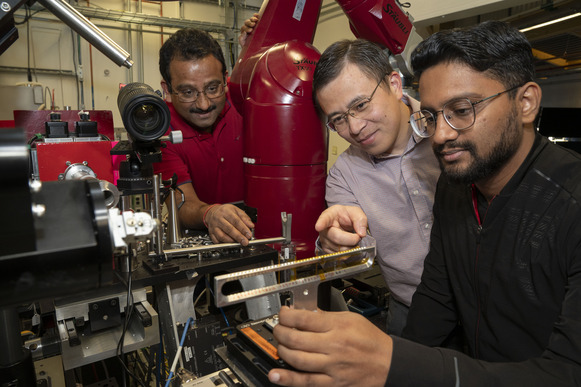
X-ray light sources can be powerful tools for understanding the new and existing materials we need to support the clean energy economy. Scientists are using the X-ray light source user facilities at DOE’s national labs to advance essential technologies, including solar panels and batteries.
At the Advanced Photon Source (APS) at DOE’s Argonne National Laboratory, scientists used the APS to study how ions move in perovskite crystals under ultraviolet radiation. Perovskites are a class of materials that have great potential for developing more efficient solar cells and LED displays. Researchers would like to improve the lifetime of the cells made from these materials. The scientists studied the material under ultraviolet radiation because UV light can reduce the solar cells’ performance over time.
Energy storage is also a key technology for reducing greenhouse gas emissions. Some work focuses on improving batteries’ charging rate or efficiency, while other work focuses on safety. Researchers at the National Synchrotron Light Source-II user facility at DOE’s Brookhaven National Laboratory used it to analyze a new approach to lithium metal batteries. Lithium metal batteries could have twice the energy density of today’s lithium-ion batteries but have issues with fast charging. This research will help improve these batteries’ functionality. At the Advanced Light Source at DOE’s Berkeley Lab, researchers investigated why thermal runaway can cause resting batteries to catch fire. They used the X-ray light source to capture 3D images in real-time of the state of the battery’s charge. The information they gathered and this technique could support the development of new safety protocols.
|
|
Marvelous Outreach on Quantum Physics
|
|
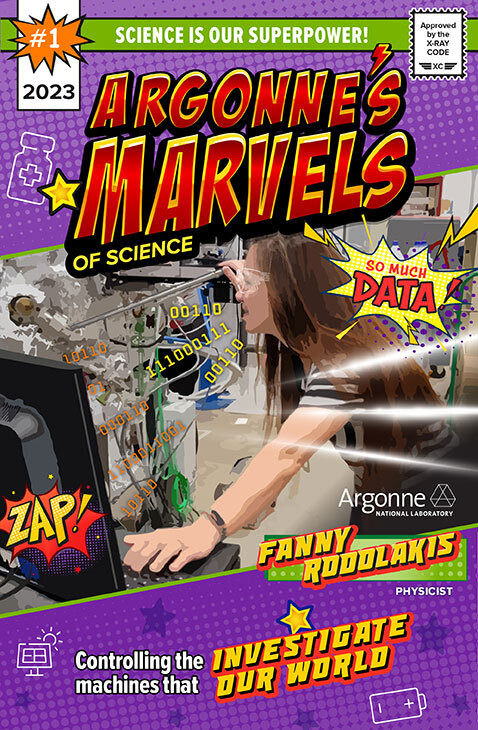
Science fiction movies often draw on scientific concepts, even they aren’t always the most accurate representation. Nonetheless, sci-fi can serve as a great jumping-off point to learn about real research and scientists. DOE’s Fermi and Argonne National Laboratories recently hosted an outreach event to help fans explore the science behind the new movie “The Marvels.” After a screening, they held a panel discussion with cosmologist Ana Botti of Fermilab, physicist and X-ray scientist Jessica McChesney of Argonne, and physicist and beamline controls specialist Fanny Rodolakis of Argonne. To continue the theme, Argonne also created six comic book covers highlighting researchers investigating science facts that can be stranger than fiction. |
|
|
Research News Update provides a review of recent Office of Science Communications and Public Affairs stories and features. This is only a sample of our recent work promoting research done at universities, national labs, and user facilities throughout the country.
|
|
|
|
Please see the archive on Energy.gov for past issues.
No. 112: 12 February 2024
|
|
|
|