|
 29 January 2024
|
|
|
The Early Career Research Program provides financial support that is foundational to early career investigators, enabling them to define and direct independent research in areas important to Department of Energy (DOE) missions. The Early Career Award Winner series provides awardees with an opportunity to explain the results of their research in their own words.
A wide range of technologies rely on semiconductor devices. These applications include solar cells and thermoelectrics for clean energy. Other applications include lasers and detectors for health and environmental monitoring as well as the Light Detection and Ranging (LIDAR) that can support autonomous vehicles.
Learn about how Joshua Zide used his Early Career award from the DOE’s Office of Science to develop a new approach to making materials for semiconductors.
|
|
Magnets for qubits: Scientists at the DOE’s Argonne National Laboratory, the University of Chicago, the University of Iowa, and Tohoku University in Japan have started to develop devices that connect qubits by sending signals through magnets. This quantum technology would use conventional materials to create the building blocks of quantum computers. This technique allows qubits to be further apart and for scientists to entangle two qubits without them interfering with others on a chip. |
Fools’ gold for geology: Geologists use deposits on the seafloor to understand ecological and environmental changes in the past. For decades, they’ve assumed that pyrite (fools’ gold) has accurately recorded conditions in the marine environment. They’ve used the abundance of different isotopes of sulfur in pyrite to understand microbial activity. But researchers at Washington University in St. Louis found that variations in these isotopes may not represent global processes. |
|
Black silicon: Black silicon is an important material used in solar cells, light sensors, antibacterial surfaces, and more. Black silicon is made when regular silicon is etched to produce pits on its surface. Researchers at DOE’s Princeton Plasma Physics Laboratory have developed a new theoretical model explaining one way to make black silicon that’s different from the typical process using plasma. |
Strange metals: Researchers at Rice University studied nanoscale wires of a quantum critical material. Its quantum entanglement creates a “strange” behavior that’s dependent on temperature in a way that’s different from normal metals. The researchers found that electricity seems to flow through these metals in a liquid-like form that can’t be explained by how scientists currently describe how charge moves. |
|
Barcoding bacteriophages: Bacteriophages are viruses that infect bacteria. Researchers at DOE’s Lawrence Berkeley National Laboratory have developed a way to develop gene labels for phages that act like barcodes. They will help scientists understand what parts of a phage’s genome are essential to its function. This discovery could support the development of biotechnology applications in agriculture and health. |
Chirality: A phenomenon called chirality-induced spin selectivity influences the activity of electrons in molecules that have a specific “handedness.” Chirality (handedness) means that an object or molecule cannot exactly match its mirror image even if you move or rotate it. This phenomenon could be very useful for understanding how electrons behave and move. Scientists at Northwestern University have revealed new information about its underlying processes. |
|
The Office of Science posted six new highlights between 1/17/24 and 1/29/24.
|
|
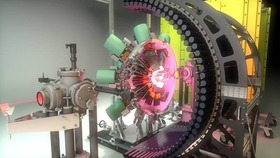
Nuclei shape: When a nucleus has the shells that surround it completely filled with protons or neutrons and is in its lowest energy configuration, scientists expect it to be shaped like a sphere. But as these nuclei gain energy, they can change shape. In exotic nuclei, these shapes can replace the spherical state as the state the nuclei takes at its lowest energy configuration. Researchers at several national laboratories and universities used the Facility for Rare Isotope Beams (a DOE Office of Science user facility) to study radioactive sodium-32 (32Na). It has generally been hard to observe high-energy spherical states. But the scientists found that 32Na has an excited state that is unusually long-lived. This property could be a result of this shape dynamic. |
|
Producing Medical Isotopes for Cancer Treatments and Imaging
|
|
|
Medical isotopes are increasingly important for cancer treatments and imaging for cancer diagnosis. Through our Isotope Program, DOE’s Office of Science has made long-term investments in these technologies. Both recently completed work and upcoming resources are making radioisotopes more available to doctors and patients.
One of the Office of Science’s major accomplishments in 2023 was making record levels of actinium-225 (Ac-225). Ac-225 is a high-priority radioisotope within the medical research community, particularly to treat metastasized cancers. The Ac-225 Tri-Lab Research Effort—a collaboration of DOE’s Los Alamos National Laboratory, Oak Ridge National Laboratory, and Brookhaven National Laboratory scientists—produced over 100 millicuries of Ac-225 in a single experimental run or batch. This achievement demonstrates that DOE Isotope Program production sites can produce enough Ac-225 to support clinical trials. This achievement was possible in part because of the recent completion of the all-purpose hot cells at Brookhaven National Laboratory.
In addition, DOE’s Argonne National Laboratory and Oak Ridge National Laboratory are also upgrading their radioisotope production facilities. Argonne is replacing systems based on technologies used since the 1940s with computer-driven robotic technology. By being able to manipulate samples from across the room, researchers can handle samples that are up to 10 times more radioactive than with current similar techniques. These upgrades will increase the lab’s ability to produce these valuable isotopes while also improving safety, reproducibility, and cost-effectiveness. At Oak Ridge National Laboratory, the High Flux Isotope Reactor (a DOE Office of Science user facility) has a number of upgrades that are currently in development. This user facility is an exclusive provider of many medical isotopes.
|
|
High Schoolers Discover Mathematical Pattern in Dragonfly Wings
|
|
|
Scientists from all over the world conduct research at our user facilities. But usually, they’re not in high school. Two high school students (Keene Lu and Samson Shen) participating in DOE’s Brookhaven National Laboratory’s High School Research Program led a team that found a new example of math in nature. With the help of researchers and resources at the National Synchrotron Light Source-II (NSLS-II), they discovered the “golden angle” exists in the vein pattern of dragonfly wings. The “golden angle” is 137.5 degrees. It’s found in many places in the natural world, especially plant structures.
The research builds on an ongoing project by one of the NSLS-II researchers, Xiaojing Huang. Huang first worked with Lu to process and analyze 50 images of dragonfly wings. He then supervised Shen’s work to create a model to explain the data. The research was eventually published in Scientific Reports, a major scientific journal. After his participation in high school, Keene also participated in a Science Undergraduate Laboratory Internship at the lab during the summer of 2023.
|
|
|
Research News Update provides a review of recent Office of Science Communications and Public Affairs stories and features. This is only a sample of our recent work promoting research done at universities, national labs, and user facilities throughout the country.
|
|
|
|
Please see the archive on Energy.gov for past issues.
No. 119: 29 January 2024
|
|
|
|