|
 16 January 2024
|
|
Trapping electrons: While electrons usually move through conducting materials in an uncoordinated way, they behave as one when they’re trapped. When they act in this coordinated way, they show unusual properties that could be useful in technologies like quantum computing and electronics. Physicists at MIT trapped electrons in a pure crystal. It’s the first time scientists have achieved this coordinated state in a 3D material. They used the Advanced Light Source and Advanced Photon Source, both DOE Office of Science user facilities. |
Brain development: Mice usually live two years, while monkeys live 25. Surprisingly, the brains of both appear to develop their synapses at the same time, according to research by scientists at DOE’s Argonne National Laboratory and the University of Chicago. Previously, scientists assumed brain development happened faster in mammals with much shorter lifespans. This discovery has major implications for studies on brain development. The team used the Argonne Leadership Computing Facility, a DOE Office of Science user facility, to analyze the datasets. |
|
Conducting heat: In solid materials, electrons and atomic vibrations known as phonons are the major carriers of energy, including heat. But researchers at Vanderbilt University and DOE’s Oak Ridge National Laboratory have found an alternative channel for how heat moves in thin films and nanowires of polar crystals. This discovery could be useful in developing cooling devices for electronics. |
Algae memory: Plants and green algae adjust their photosynthetic systems in response to changes in sunlight. A rudimentary form of memory helps organisms adjust to these changes faster than they would otherwise. Researchers from DOE’s Lawrence Berkeley National Laboratory and the University of California, Berkeley developed a detailed understanding of this process in algae. It could help scientists develop crops with higher yields. |
|
Plants’ coping strategies: Researchers at the Michigan State University (MSU)-DOE Plant Research Laboratory have found that plants have multiple systems to deal with the varying length of days. Depending on the amount of daylight, plants change how they use their energy. During shorter days, they increase their rate of photosynthesis and invest more energy in their shoots. This research could be helpful in developing new crop varieties. |
Quantum spin liquids: Quantum spin liquids are states of matter that are controlled by entangled magnetic atoms. They can stabilize quantum mechanical activity in materials that have a triangular lattice structure. Researchers from several national laboratories and universities, including DOE’s Oak Ridge National Laboratory, Berkeley Lab, and SLAC National Accelerator Laboratory have confirmed quantum spin liquids in a new material with this structure. It could be useful for developing superconductors and quantum computers. |
|
The Office of Science posted nine new highlights between 12/19/23 and 1/16/24.
|
|
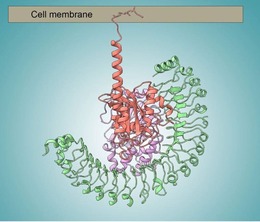
Targets for cancer treatments: A series of molecular signals that move between proteins triggers cells to replicate. But something going wrong with these signals can cause cancerous tumors to develop. Scientists are researching anticancer drugs that block these signals. Researchers at Genentech, Inc. and Berkeley Lab used DOE Office of Science user facility light sources to study a key step in the signaling pathway. A better understanding of this three-protein complex could help improve drugs for lung, colorectal, pancreatic, and other cancers. |
|
|
Popular Science: These 10 scientists are on the cusp of changing the world
The “Brilliant 10” includes Ronald Garcia Ruiz, a scientist at MIT conducting research at the Facility for Rare Isotope Beams, a DOE Office of Science user facility. He studies rare radioactive substances to help answer major questions in physics.
|
|
|
Science Magazine: 2023 breakthrough of the year
The launch of Frontier at DOE’s Oak Ridge Leadership Computing Facility that heralded the dawn of exascale computing was one of the runners-up in Science’s breakthrough of the year.
|
|
Materials Discovery with PNNL and Microsoft
|
|
|
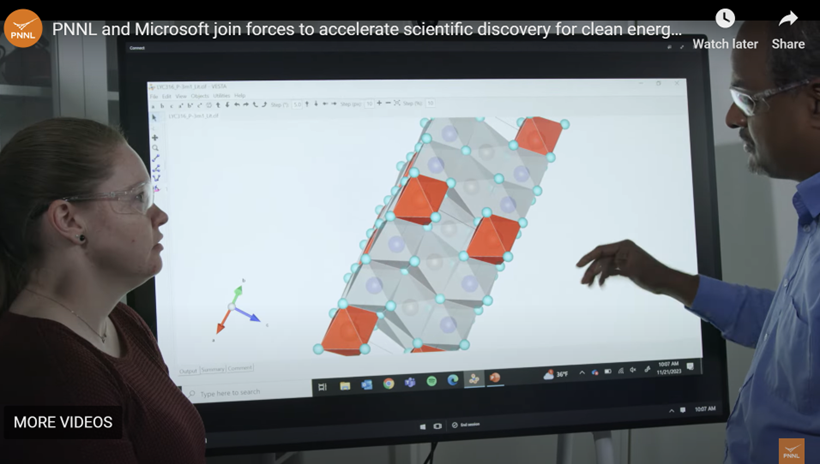
DOE’s Pacific Northwest National Laboratory (PNNL) and Microsoft are collaborating to accelerate research using artificial intelligence, cloud computing, and high-performance computing. It will make supercomputing resources available to a much larger array of scientists. The project is initially focusing on chemistry and materials science. These two areas are key to improving clean energy technologies to address climate change.
The institutions have announced one of the first results from this partnership. Microsoft used its AI platform to sort through millions of potential battery materials in about 2 weeks. Based on this analysis, PNNL developed a prototype battery that uses one of the most promising materials. This material could result in batteries that use far less lithium than today’s lithium-ion batteries. The entire process took less than 9 months. Scientists at the laboratory are continuing to optimize the battery and study the material’s properties.
|
|
Driving Innovation and Discovery: 2023 Year in Review
|
|
|
Research News Update provides a review of recent Office of Science Communications and Public Affairs stories and features. This is only a sample of our recent work promoting research done at universities, national labs, and user facilities throughout the country.
|
|
|
|
Please see the archive on Energy.gov for past issues.
No. 118: 16 January 2024
|
|
|
|