|
 18 December 2023
|
|
|
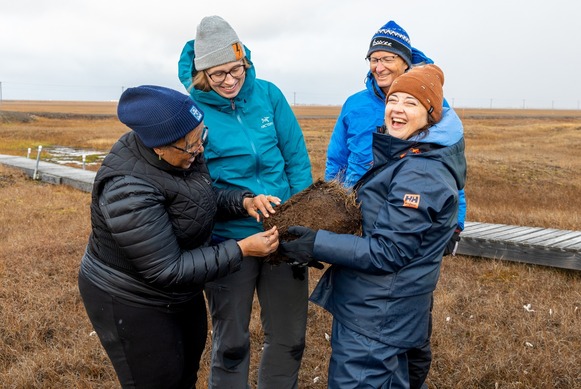
The Department of Energy’s (DOE) Office of Science Director Asmeret Asefaw Berhe recently shared her experiences seeing the Office of Science’s research first-hand.
When I joined the DOE Office of Science as the Director in 2022, I was the first climate scientist to hold this position. As a premier funder of long-term, large-scale climate science, the Office of Science was an ideal place for me to help support key research and highlight the wonderful work DOE-funded scientists are doing. During the 2023 Climate Week, I traveled to Minnesota and Alaska to learn more about the Office of Science’s investments in cutting-edge studies of climate.
Learn more about Director Berhe’s trip and the innovative field experiments and observational studies that she visited.
|
|
Protein function: A team of scientists from Cornell University and DOE’s Brookhaven National Laboratory has revealed an unexpected function of a transport protein and the role it plays in plants. Using the National Synchrotron Light Source-II DOE Office of Science user facility, they investigated how plants move iron around. Their research could help scientists pack more micronutrients into the edible parts of plants and reduce human mineral deficiencies. |
Rechargeable batteries: Researchers from Texas A&M University and DOE’s Pacific Northwest National Laboratory have discovered how a specific type of layer that forms on electrodes affects batteries’ performance. This layer is called the solid-electrolyte interphase. Understanding how its structure relates to its properties can help engineers design better lithium-ion batteries. The study used the Environmental Molecular Sciences Laboratory and the Molecular Foundry, both DOE Office of Science user facilities. |
|
Stretching diamonds: A team of researchers from DOE’s Argonne National Laboratory, the University of Chicago, and Cambridge University has made a major advancement in quantum network engineering. By “stretching” thin films of diamond, they created quantum bits, also called qubits. These bits can operate in ways that are easier to control, cheaper, and use much less equipment than other qubits. |
Flexible electronics: Researchers at Florida State University have developed soft and stretchable electronic components for health monitoring devices. With these components, devices would be more accurate, hold a charge longer, and be more comfortable than current ones. The researchers used the Center for Functional Nanomaterials DOE Office of Science user facility. |
|
Air into fertilizer: Scientists from Stanford University and DOE’s Oak Ridge National Laboratory are laying the foundation to be able to turn air into fertilizer with a minimal carbon footprint. With the use of the Spallation Neutron Source DOE Office of Science user facility, they studied an electrochemical process for producing ammonia. This information could be used to develop a process where farmers could convert nitrogen from our atmosphere into fertilizer. |
Magnetic properties: Certain semimetals only display magnetic properties if they’re cooled to a few degrees above absolute zero. But researchers at MIT have found a way for these semimetals to show magnetic properties at higher temperatures. They discovered that how the electrons in these semimetals are arranged can affect the magnetic moments in the material. This finding could expand the number of possible applications for these materials. |
|
The Office of Science posted five new highlights between 12/5/23 and 12/18/23.
|
|
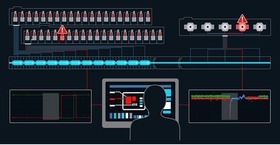
AI for particle accelerators: Particle accelerators are immense, complex machines. They need to be continually monitored to spot problems and minimize downtime. Researchers at DOE’s SLAC National Accelerator Laboratory developed an artificial intelligence algorithm that assists human operators. It alerts operators when there is a dip in performance and identifies which subsystem has an issue. Manufacturing plants and the electric grid could potentially use similar monitoring systems. |
|
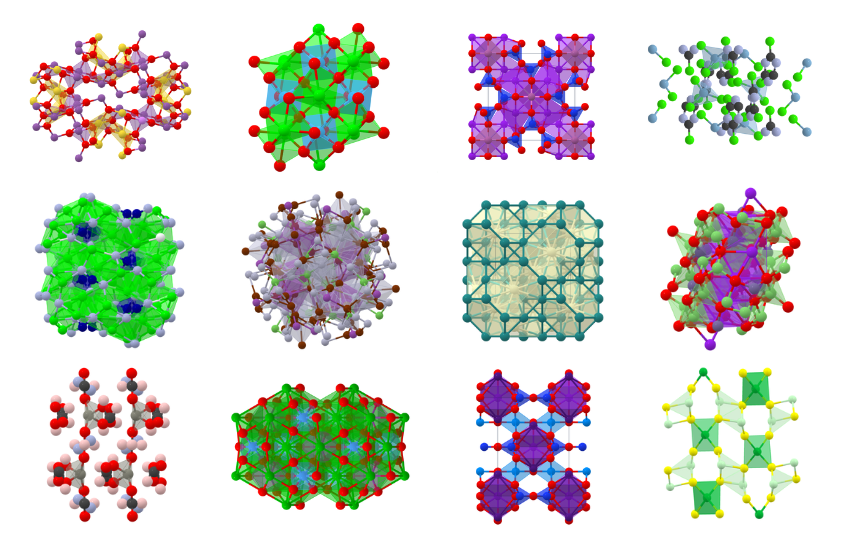
Google DeepMind Adds Nearly 400,000 New Compounds to Berkeley Lab’s Materials Project
|
|
|
Open access data can enable tremendous innovation. The Materials Project, run by DOE’s Lawrence Berkeley National Laboratory, is an open-access database that provides information on properties of both known and predicted materials. Recently, Google’s artificial intelligence laboratory used the Materials Project – including workflows and data – to train their own AI. Based on this information, the Graph Networks for Materials Exploration (GNoME) produced data on 2.2 million new compounds and their properties. Of this set, it predicts that 380,000 materials are stable and could be potentially useful in technologies.
Berkeley Lab tested data from both the Materials Project and GNoME in its A-Lab. In the A-Lab, AI guides robots making new materials. The lab produced 41 new compounds in 17 days. In the past, it may have taken a human experimenter months to produce even a single new material. Such materials may be extremely helpful for developing better batteries, solar panels, and more.
|
|
Beverly Marzec Reflects on her 59-year Career at Argonne
|
|
The scientific enterprise needs people in a huge variety of roles, from administration to technical support. In her 59-year career at DOE’s Argonne National Laboratory, Beverly Marzec held many of them. She was only 19 years old when she started at the lab as a secretary at the Zero Gradient Synchrotron, a proton accelerator facility. After she obtained a bachelors’ degree while working full-time, she moved to the Intense Pulsed Neutron Source. Eventually, her hard work led to her becoming assistant director of the source. Despite the fact that she planned to retire in 2012, she ended up becoming the assistant division director for the lab’s Materials Sciences division instead. She recently retired this past June. We appreciate Marzec’s work and all of the people like her who keep the DOE national labs running every day! |
|
|
Research News Update provides a review of recent Office of Science Communications and Public Affairs stories and features. This is only a sample of our recent work promoting research done at universities, national labs, and user facilities throughout the country.
|
|
|
|
Please see the archive on Energy.gov for past issues.
No. 117: 18 December 2023
|
|
|
|