|
 4 December 2023
|
|
|
Sometimes, science is all about turning existing information on its head to get a new perspective. A “strange” perspective, in some cases.
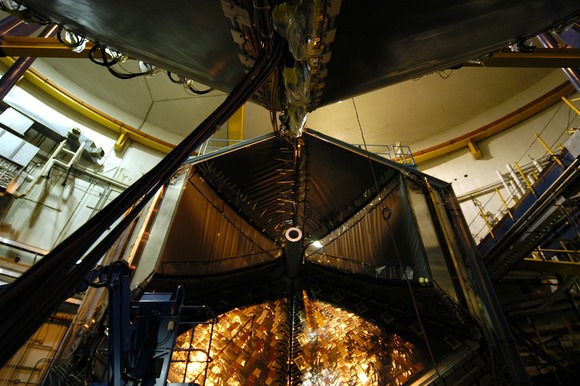
As a PhD student working with nuclear physicists at the Department of Energy’s (DOE) Argonne National Laboratory, Lamiaa El Fassi used data from a 2004 experiment at the Continuous Electron Beam Accelerator Facility (CEBAF). A DOE Office of Science user facility, CEBAF is a huge particle accelerator at DOE’s Thomas Jefferson National Accelerator Facility. CEBAF speeds up beams of electrons, which then smash into different targets. By looking at the electron beams bouncing off the targets and the particles these collisions produce, nuclear scientists can better understand the insides of the nuclei in atoms.
Years later, El Fassi returned to that dataset with a new mission. As an assistant professor at Mississippi State University, she started sorting through the data to find evidence of how a specific process can produce “strange matter.”
Learn more about what El Fassi found and what it means for nuclear physics.
|
|
Wastewater treatment: Phosphorus in wastewater has the potential to harm wildlife, livestock, and even humans. To remove phosphorus, wastewater treatment plants rely on techniques that are energy-intensive and use strong chemicals. Researchers from DOE’s National Renewable Energy Laboratory and their partners found that certain strains of algae take up phosphorus better than others. They’re now developing a wastewater treatment system that leverages this ability. |
Quantum eraser: Quantum computers tend to be much more prone to errors than classical ones. Usually, the act of looking for errors causes more errors to occur. A group of researchers led by scientists from Caltech are the first to demonstrate a type of quantum eraser. It pinpoints and corrects for mistakes in quantum computing systems known as “erasure” errors. |
|
Self-assembling nanosheets: Researchers at DOE’s Lawrence Berkeley National Laboratory have developed a self-assembling nanosheet. It forms a high-performance coating material that could lead to improvements in electronics, energy storage, and more. In particular, it could extend the shelf life of consumer products and reduce single-use packaging. The researchers used the Spallation Neutron Source, the Advanced Photon Source, and the Molecular Foundry, all DOE Office of Science user facilities. |
|
More efficient particle colliders: Running a particle collider takes a similar amount of energy as keeping tens of millions of lightbulbs on. Researchers from DOE’s SLAC National Accelerator Laboratory and Stanford University have developed ways to make a proposed collider more energy efficient. They considered how the collider would be built, where it’s built, and how it’s operated. |
Microstructures: To study microstructures in 3D printed materials, scientists often examine them with X-rays after the materials are finished printing. Researchers from Cornell University instead bombarded a 3D printed metal alloy with X-rays as it was printing. This technique allowed them to see how certain phenomena like bending and fragmentation happened in real time. It will help inform how to produce custom materials. |
|
The Office of Science posted five new highlights between 11/21/23 and 12/4/23.
|
|
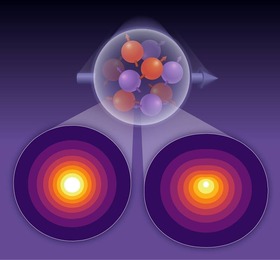
A view of quarks: Quarks and gluons are the building blocks of the protons and neutrons that make up matter all around us. Scientists want to understand how different quarks determine protons’ overall properties, particularly spin. Protons contain two up quarks and one down quark. Calculations made by scientists at Argonne National Laboratory, Temple University, Adam Mickiewicz University of Poland, and the University of Bonn, Germany, revealed key differences between the up and down quarks. They show that the up quarks are more symmetrically distributed and spread over a smaller distance within the proton than the down quark. The results imply that these two types of quarks contribute differently to protons’ properties. |
|
What Scientists Learned from Firefighters in Training
|
|
Heat stress can be life-threatening, especially for people who wear large amounts of protective equipment, like firefighters. Scientists at DOE’s Pacific Northwest National Laboratory worked with members of the Los Angeles County Fire Department to study what happens when the body undergoes intense physical exercise. Using the Environmental Molecular Sciences Laboratory (a DOE Office of Science user facility), they analyzed more than 4,700 molecules from each of the firefighters. The team detected hundreds of molecular changes. The research will help us better understand the effects of exercise on people’s immune systems. |
|
Seeing Life-Saving Cancer Treatment in Action
|
|
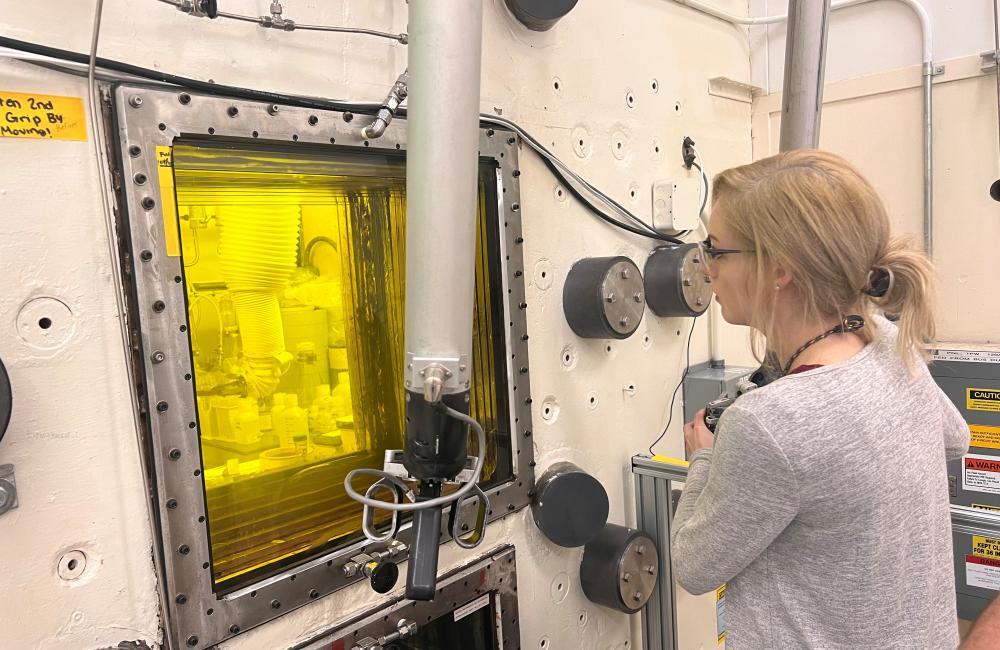
Scientists and technicians all have different paths to their work. They’re often motivated by wanting to help people or solve challenges that we face in society. But Raina Setzer wasn’t motivated by just a textbook understanding of a problem. She came to DOE’s Oak Ridge National Laboratory (ORNL) because she saw the potential impact of her work with her own two eyes. Before coming to ORNL, she worked as a radiochemist at the Washington University School of Medicine in St. Louis. Among her tasks working in a nuclear pharmacy was synthesizing and labeling the radiopharmaceutical Ac-225 DOTA-TATE. It contained Ac-225 that came from ORNL. She saw how quick and effective the cancer treatment was and wanted to be part of the team that makes it possible. Find out how she’s making this treatment available for more cancer patients through ORNL’s work on radioisotopes. |
|
|
Research News Update provides a review of recent Office of Science Communications and Public Affairs stories and features. This is only a sample of our recent work promoting research done at universities, national labs, and user facilities throughout the country.
|
|
|
|
Please see the archive on Energy.gov for past issues.
No. 116: 4 December 2023
|
|
|
|