|
 10 October 2023
|
|
Runaway electrons: Runaway electrons can reduce the efficiency of tokamak reactors used for fusion. Scientists would like to trim the number of runaways to help bring fusion energy closer to reality. Researchers from DOE’s Princeton Plasma Physics Laboratory, General Atomics, and Columbia University discovered a strange circular process where runaway electrons create instabilities that reduce damage from runaways overall. Scientists may be able to design devices that take advantage of this process. |
Quantum repeaters: Researchers from Princeton University developed a new way to connect quantum devices over long distances. They described a new approach towards building quantum repeaters. Quantum repeaters are a key tool for connecting quantum computers in future communication networks. |
|
Dinosaur feathers: Past research suggested dinosaurs’ feathers had a different protein composition from modern bird feathers, making them less stiff. But research done by scientists at the University College Cork and partner institutions at DOE’s SLAC National Accelerator Laboratory found the opposite. They found the protein composition was similar, which suggests that modern feathers evolved earlier than scientists had estimated. |
Capturing carbon: Conventional agriculture releases carbon from the soil into the atmosphere as carbon dioxide. Applying ground-up silicate rock to Midwestern farm fields can capture significant amounts of that carbon dioxide. Researchers at the University of Illinois Urbana-Champaign associated with DOE’s Center for Advanced Bioenergy and Bioproducts Innovation quantified these climate benefits for the first time. |
|
Qubits: Quantum computers use qubits that are based on quantum states that exist for very short periods of time. To improve qubits’ stability, researchers at DOE’s Oak Ridge National Laboratory are working on new materials to create them. They coupled a superconductor (which electricity can move through without losing energy to heat) and a topological insulator (where the surface can conduct electricity but the interior can’t). |
Biological pathways: Cells in plants, animals, and fungi all have “self-destruct” mechanisms that can switch on under stress. These mechanisms can either help or hurt the organism, depending on the situation. Researchers at Michigan State University mapped the genes and proteins that make up one of the signaling pathways to one of these mechanisms in plant cells. |
|
The Office of Science posted five new highlights between 9/26/23 and 10/10/23.
|
|
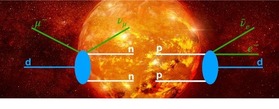
Muon capture: Sometimes studying one interaction that is possible to capture in the lab can lead to insights about a different one that’s not. Two protons fusing together to form a deuteron (a proton and neutron) is a crucial step in how stars produce energy. But we can’t do laboratory studies of this process. Instead, scientists study how muons (a particle similar to the electron but much heavier) bind with deuterons. This process provides helpful insights into the proton-proton fusion process. Researchers at Washington University in St. Louis, the University of Pisa and INFN in Italy, and DOE’s Thomas Jefferson National Accelerator Facility used advanced models to study the muon capture rate. |
|
|
Popular Science: Why astronomers want to put a telescope on the dark side of the moon
LuSEE-Night is a project to put an observation station on the far side of the moon, which could help astrophysicists better understand the time when plasma began forming protons and electrons. The project includes DOE’s Lawrence Berkeley National Laboratory, NASA, and the University of Minnesota.
|
|
Making Semiconductor Manufacturing More Sustainable
|
|
Semiconductors are essential to nearly every electronic device. But the manufacturing process takes a lot of energy, especially converting sand into the relevant materials. Researchers from DOE’s Lawrence Berkeley National Laboratory and the University of California, Berkeley have created a new material for semiconductors that could make this process much more energy-efficient and sustainable. Called multi-element ink, it’s the first of a specific type of semiconductor that can be processed at low or room temperatures. The team used the Advanced Light Source, an Office of Science user facility, to conduct some of the research. |
|
Repurposing Magnets for the Electron Ion Collider
|
|
|
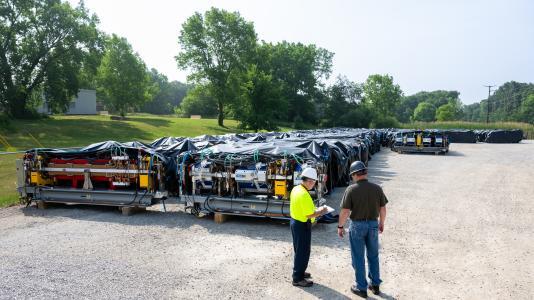
Remember the Reduce – Reuse – Recycle triangle? DOE’s national laboratories take it very seriously, even extending it to their laboratory equipment. The giant magnets used in physics experiments are very expensive and difficult to make. When possible, the laboratories reuse them in new experiments.
DOE’s Argonne National Laboratory is repurposing magnets from its Advanced Photon Source user facility for use in the Electron Ion Collider Office of Science future user facility. DOE’s Brookhaven National Laboratory and Thomas Jefferson National Accelerator Facility are building the Electron-Ion Collider in New York. While the original magnets from the Advanced Photon Source are being replaced with more state-of-the-art technology, they still function perfectly well. Reusing these magnets saves about $10 million for the project. It also helps the project avoid delays due to supply chain issues.
Once it’s finished, the Electron-Ion Collider will smash electrons into protons and ions to help scientists better understand the fundamental structure of matter. In addition to contributing the magnets, staff at Argonne are also providing key expertise on accelerator technology.
|
|
|
Research News Update provides a review of recent Office of Science Communications and Public Affairs stories and features. This is only a sample of our recent work promoting research done at universities, national labs, and user facilities throughout the country.
|
|
|
|
Please see the archive on Energy.gov for past issues.
No. 112: 10 October 2023
|
|
|
|