|
 10 July 2023
|
|
|
The Early Career Research Program provides financial support that is foundational to early career investigators, enabling them to define and direct independent research in areas important to Department of Energy (DOE) missions. The Early Career Award Winner series provides awardees with an opportunity to explain the results of their research in their own words.
Why is there something instead of nothing?
What is the origin of mass in the universe?
These are the questions I studied with my support from the Department of Energy 2012 Early Career Research Program.
Precision measurement of rare particle interactions provides a unique test of our most delicate physical theories. In particular, my work focused on interactions that produce multiple vector bosons (the particles responsible for nuclear decay and how atomic nuclei lose energy).
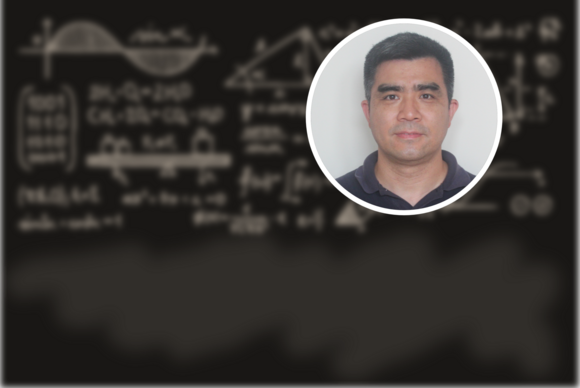
Read about how Junjie Zhu used his Early Career award to find evidence for rare but important processes in physics.
|
|
Gluon spin: Physicists at the Relativistic Heavy Ion Collider user facility at DOE’s Brookhaven National Laboratory have discovered more information about gluons’ spin. They found that gluons’ spins are aligned in the same direction as the spin of the proton they are within. This information will help scientists resolve the ongoing question of what contributes to protons’ spin. |
Water: For decades, chemists and physicists assumed that the bonds in atoms and molecules (like metallic bonds) give all types of solid matter their character. But research from Columbia University supports the idea that water actually creates the character of many biological materials. Despite remaining a liquid, water enables these materials to be solids and defines those solids’ properties. |
|
Copper delivery: Some rare genetic disorders make the body unable to absorb copper. These disorders are often deadly and there are currently no effective drugs to treat them. Researchers at Texas A&M University led work at the Advanced Photon Source user facility at DOE’s Argonne National Laboratory to investigate how a promising drug for treating copper deficiency may work. |
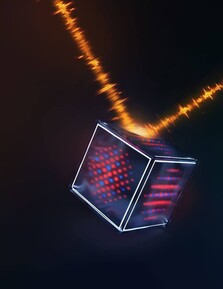
Quantum computing: Researchers at IBM Quantum, the University of California, Berkeley and DOE’s Lawrence Berkeley National Laboratory pitted a 127-qubit quantum computer against a supercomputer. For at least one type of calculation, the quantum computer bested the classical one. The test shows that there are ways to compensate for errors in quantum computers that could make them useful today. |
|
Disparities in heat stress: Heat and its stressful effects can vary greatly within a city. New research from DOE’s Pacific Northwest National Laboratory found that the average Black resident is exposed to air that is warmer by 0.28 degrees C relative to the city average, while the average white urban resident lives where air temperature is cooler by 0.22 degrees C relative to the same average. |
Cobalt-free batteries: Scientists at the University of California, Irvine have developed a long-lasting battery that uses nickel instead of cobalt. Cobalt is expensive and mining it often involves human rights abuses. To conduct the research, the scientists used user facilities at both DOE’s Brookhaven National Laboratory and Argonne National Laboratory. |
|
The Office of Science posted six new highlights between 6/27/23 and 7/10/23.
|
|
Quantum error correction: The very nature of quantum computing makes quantum computers unstable compared to conventional ones. Quantum systems shift from being explainable by quantum laws of physics to being explained by classical laws of physics. This process often happens because of stray radiation or other outside factors. When it happens, the tools scientists use to harness quantum laws no longer work as designed. For example, qubits in a quantum computer change their states and lose the information they were storing. To resolve this problem, scientists use quantum error correction. In the past, quantum systems lost information faster than the correction tools could keep up. Researchers at Yale University supported by the Co-design Center for Quantum Advantage improved their quantum error correction enough that it could exceed the information loss. |
|
Direct air capture technology licensed to Knoxville-based Holocene
|
|
|
An innovative and sustainable chemistry developed at DOE’s Oak Ridge National Laboratory (ORNL) for capturing carbon dioxide from air has been licensed to Holocene. Holocene is a startup based in Knoxville that focuses on designing and building plants that remove carbon dioxide from the atmosphere. Direct air capture collects carbon dioxide from the atmosphere rather than at the source, such as a power plant. The carbon dioxide can then be released and stored deep underground.
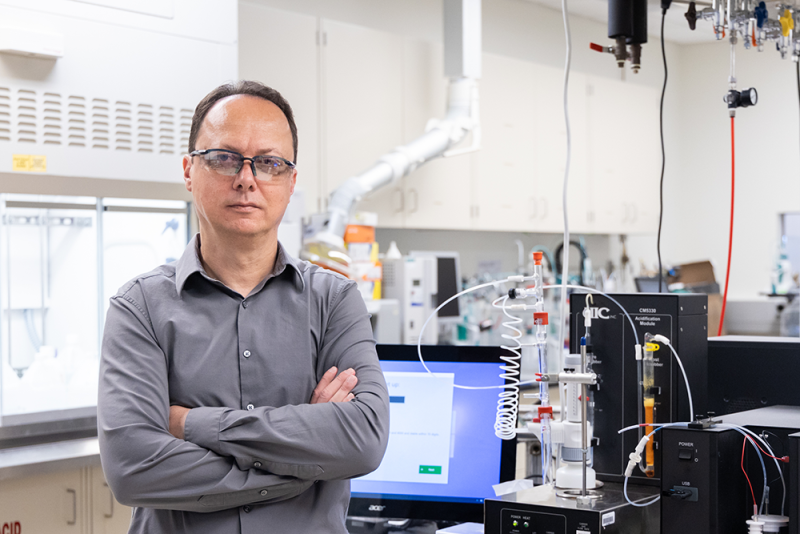
ORNL researcher Radu Custelcean developed the new technology. Through research supported by the DOE Office of Science Basic Energy Sciences program, he developed a thorough understanding of the chemical reactions and processes. That foundation enabled him to develop the current technology.
|
|
Morgan Styer: A lifetime tinkerer finds a career at PPPL as a welding engineer and tech shop supervisor
|
|
|
Technical and mechanical experts are just as essential to our science as researchers. They build and maintain our world-class user facilities as well as the everyday tools of research.
Morgan Styer is a tech shop supervisor and welding engineer at DOE’s Princeton Plasma Physics Laboratory (PPPL). She supervises technicians in the welding and carpentry shops as well as mechanical technicians. At PPPL, welding is essential to building large machines and creating effective vacuum seals for tools. Styer’s work supports fusion experiments that the lab is involved in all over the world. Read more about Styer’s work, including heading the PPPL Pride Employee Resource Group, in this feature from PPPL.
|
|
|
CommUnique provides a review of recent Office of Science Communications and Public Affairs stories and features. This is only a sample of our recent work promoting research done at universities, national labs, and user facilities throughout the country.
|
|
|
|
|