|
 17 April 2023
|
|
|
The Early Career Research Program provides financial support that is foundational to early career investigators, enabling them to define and direct independent research in areas important to Department of Energy (DOE) missions. The Early Career Award Winner series provides awardees with an opportunity to explain the results of their research in their own words.
Materials scientists have achieved improvements in renewable and sustainable energy technologies like photovoltaics, solid-state lighting, and power electronics. This comes from our ability to make and layer together new crystalline semiconductors with highly advantageous properties.
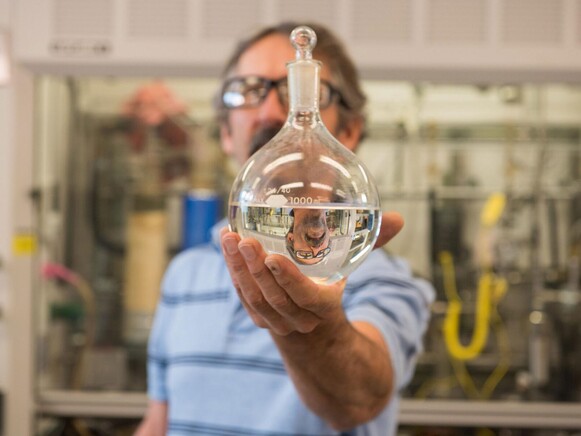
Learn about how Kirsten Alberi used her Early Career award to research better ways to synthesize semiconductors.
|
|
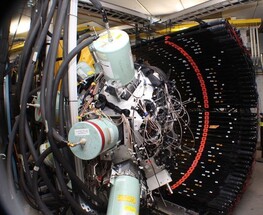
Proton mass: Nuclear physicists may have finally pinpointed where in the proton a large fraction of its mass resides. A recent experiment carried out at DOE’s Thomas Jefferson National Accelerator Facility has revealed the radius of the proton’s mass. The mass is generated by the strong force as it glues together the quarks that act as the proton’s building blocks. Researchers from DOE’s Argonne National Laboratory also played a major role. |
MXenes: Materials known as MXenes have great promise for new applications, including high-tech electronics and energy storage. They are made of several extremely thin layers of metal, between which scientists can slip different ions for various purposes. A new discovery by scientists with the University of Chicago shows how to make these MXenes far more quickly and easily with fewer toxic byproducts than before. |
|
Doppler effect for plasma: Scientists at DOE’s Princeton Plasma Physics Laboratory used a common weather forecasting technique to gain insight into how powerful lasers produce plasma. Plasmas are soups of electrically charged particles. Researchers used the Doppler effect to measure the dense cloud of plasma produced by a laser striking a solid target. Using this technique in a new context could help researchers make important measurements in inertial confinement fusion devices. This is one concept being explored as a way to harness fusion energy. |
Anaerobic fungi: Lignin is one of the most abundant land-based polymers on Earth. It surrounds plant fibers and molecules that would be useful for biofuels and other chemicals if we could break it down. That process already occurs in the guts of large herbivores through anaerobic microbes. Researchers at UC Santa Barbara, DOE’s Joint Genome Institute user facility, Lawrence Berkeley National Laboratory, Joint BioEnergy Institute, and Great Lakes Bioenergy Research Center showed that a group of anaerobic fungi (fungi that do not need oxygen) is capable of breaking down lignin. |
|
Spintronics: Microelectronics are based on the ability to allow and stop the flow of electrons through a material. Spin electronics (or spintronics) is based on the spin of electrons, and the fact that the electron spin along with the electric charge creates a magnetic field. A team including researchers at DOE’s Argonne National Laboratory discovered surprising properties in a magnetic material of iron, germanium, and tellurium. The team is the first to observe two types of specific magnetic fields coexisting at the same time in a thin film at low temperature. |
|
Y-Balls: A team of scientists, including those at Rutgers University, recently investigated a compound called “Y-ball.” This compound belongs to a mysterious class of “strange metals” viewed as centrally important to next-generation quantum materials. By finding new ways to probe and understand Y-Ball’s behavior, researchers could describe details of electron motion that provide new insight into its unusual electrical properties.
|
|
|
The Office of Science posted six new highlights between 4/4/23 and 4/17/23.
|
|
FRIB first results: A multi-institutional team of researchers from 10 different universities and national laboratories has published the results of the first experiment at the Facility for Rare Isotope Beams (FRIB), a brand-new DOE Office of Science user facility. The experiment studied the decay of isotopes so unstable that they only exist for fractions of a second. These measurements are among the most fundamental properties that researchers can observe about short-lived particles. The experiment reached some of the most neutron-rich isotopes of phosphorus, silicon, aluminum, and magnesium studied to date. |
|
The Flightpath from a Groundbreaking Catalyst to Jets that Soar on Renewable Fuel from Waste
|
|
|
A team of researchers from DOE’s Pacific Northwest National Laboratory (PNNL) and LanzaTech was awarded the 2023 American Chemical Society’s Award for Affordable Clean Chemistry. They received the award for their development of a clean and sustainable alcohol-to-jet-fuel catalytic process. This process holds promise for helping the nation achieve net-zero emissions by 2050.
This discovery was made possible due to LanzaTech’s carbon recycling process. It first converts industrial waste gases to ethanol. The ethanol then undergoes an innovative catalytic process developed at PNNL to upgrade it to fuel for commercial aviation.
PNNL’s sustainable jet fuel journey was decades in the making. Early fundamental research, sponsored by DOE’s Office of Basic Energy Sciences, laid the groundwork for understanding the chemistry functions. The lab began building its catalysis capability in the 1980s. In the 2000s, it established the Institute for Interfacial Catalysis (now called the Institute for Integrated Catalysis). The institute grew to become the largest non-industrial catalysis research and development effort in the U.S. Currently, it focuses on developing catalysts that can efficiently make fuels from alternative feedstocks, store electrical energy in chemical bonds, and increase fuel efficiency and cut emissions at the same time. Learn more about how PNNL brought fundamental research to the market in this feature from the lab.
|
|
Podcast: EMSL’s Bonding Over Science
|
|
On the Bonding Over Science podcast, join the Environmental Molecular Sciences Laboratory (EMSL) DOE Office of Science user facility for a monthly conversation around scientific questions affecting our daily lives. Bonding Over Science host Dawn Stringer sits down with researchers to unpack the molecular processes involved in climate change, plant growth, biofuels production, and more. The latest episode discusses the depiction of fungi in "The Last of Us," and if the organism is our friend or our foe. |
|
|
CommUnique provides a review of recent Office of Science Communications and Public Affairs stories and features. This is only a sample of our recent work promoting research done at universities, national labs, and user facilities throughout the country.
|
|
|
|
|