EM Wins Five Sustainability Awards at Three Sites: Second Story in Two-Part Series
WASHINGTON, D.C. – In this second part of a two-part series, EM Update focuses on three of five DOE 2013 Sustainability Awards EM received for its efforts in comprehensive greenhouse gas emissions management, waste reduction, pollution prevention, and fleet management at the Portsmouth, Oak Ridge, and Savannah River (SRS) sites.
The annual awards program highlights DOE achievements that saved taxpayer money by reducing the Department’s use of energy, water, and paper while improving the energy efficiency of government buildings and vehicles. All of EM’s award-winning projects cut hundreds of thousands of tons of carbon emissions, lowered energy use, diverted thousands of metric tons of construction and demolition debris, allowed for more efficient fleets, and provided cost savings. These efforts helped EM exceed sustainability commitments and improve its operations.
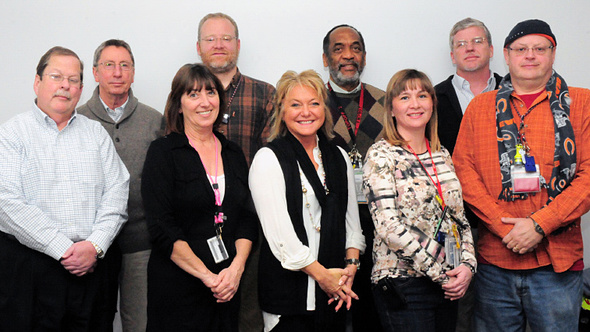
Pictured are members of the Portsmouth Site Sustainability Team, including, left to right, Joe Moore, Bob Anderson, Stephanie Puckett, Matt Vick, Lisa Burns, Vince Adams, Stephanie McLaughlin, Frank Johnston, and Ron Shelato. Team members Roger Steckel, Russell McCallister, Roger Coats, Jeff Stone, and Mandy Mayo are not shown.
The Portsmouth site achieved a 29-percent reduction in greenhouse gas emissions in fiscal year 2012 by creating a culture of energy saving and sustainability now incorporated into how the site performs daily activities. This reduction exceeded DOE’s Strategic Sustainability Performance Plan target to reduce greenhouse gas emissions by 28 percent by fiscal year 2020.
Specific actions taken to drive Portsmouth’s success include the creation of a site-wide sustainability team; training and awareness; comprehensive energy audits; implementation of energy conservation measures; reduction of electric-use intensity by 41 percent; procurement of 12,500 megawatt hours of green power from biomass, a plant-based material that serves as a renewable energy source; and replacement of vehicles that use petroleum with alternative-fueled vehicles.
Additionally, replacing a 1950s-era, coal-fired boiler with a new natural gas fired boiler was one of the most significant actions to reduce greenhouse gas emissions. The new boiler’s projected annual cost savings are $2.2 million. It reduces carbon dioxide emissions by about 61 percent.
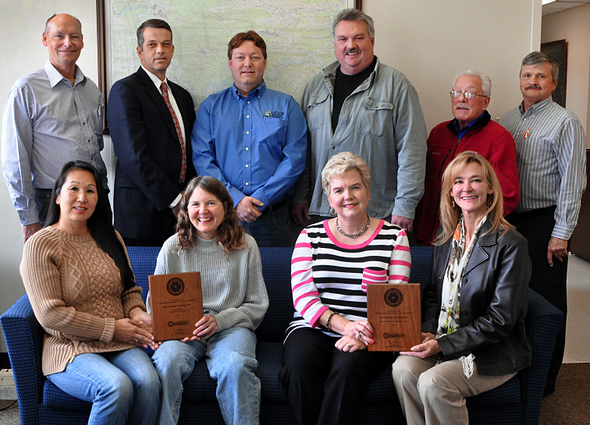
Oak Ridge's East Tennessee Technology Park award team is shown, front row, left to right, Veronica Hoffman, Betsy Brucken, Sherree Shaw, and Traci Hempen-Potter; back row, left to right, Jim McCague, Mark Whitney, Chuck Oldham, Moose Erickson, Leo Sain and Richard Frounfelker.
The Oak Ridge Environmental Management System program promotes opportunities to minimize waste, energy use, and greenhouse gases. The program also makes environmentally preferable purchases and finds opportunities to divert waste.
By integrating pollution-prevention practices into work procedures and processes, Oak Ridge’s East Tennessee Technology Park successfully diverted about 8,100 metric tons metric tons of construction and demolition waste in fiscal year 2012. Reuse of rubble saved landfill space and diverted about 7,200 metric tons from disposal.
Oak Ridge’s Waste Disposition Operations Project reused 2,900 concrete shielding blocks from the transuranic (TRU) waste storage facility as shielding at the TRU Waste Processing Center. This resulted in the diversion of over 84,000 pounds of material from disposal. Diversion solves a waste disposition problem for one project while saving time and money for another. Waste reuse at Oak Ridge has resulted in project efficiency and cost savings.
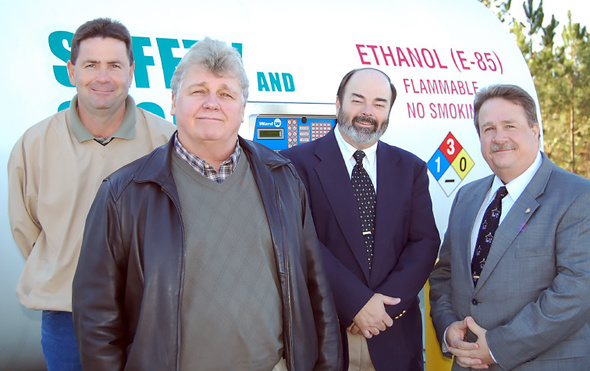
Pictured are members of the SRS Green Fleet Team, including, left to right, Kevin Heath, Tim Armstrong, Chris Goodman, and Dave Hepner. Team member Pete Ladomirak is not shown.
The SRS green fleet management program supports sustainability goals by using alternative fuels and reducing petroleum use. Approximately 77 percent of vehicles in the light duty fleet, which includes vehicles that transport employees, use an ethanol fuel blend or are gasoline hybrids. SRS reduced its fleet petroleum use by approximately 19 percent and is on track to meet the overall goal requirement of 30 percent by fiscal year 2020.
Savannah River Nuclear Solutions, the site management and operations contractor, cut its fleet by 201 vehicles, exceeding its goal of a 35-percent reduction in three years. SRS’s Green Fleet Program’s efforts to ensure sustainable, effective site transportation services were worthy of recognition.
Last month’s issue of the newsletter reported on EM’s overall sustainability progress and highlighted individuals at Oak Ridge and SRS who were honored with DOE 2013 Sustainability Awards.
Nevada National Security Site Groundwater Program Welcomes Peer Review Team
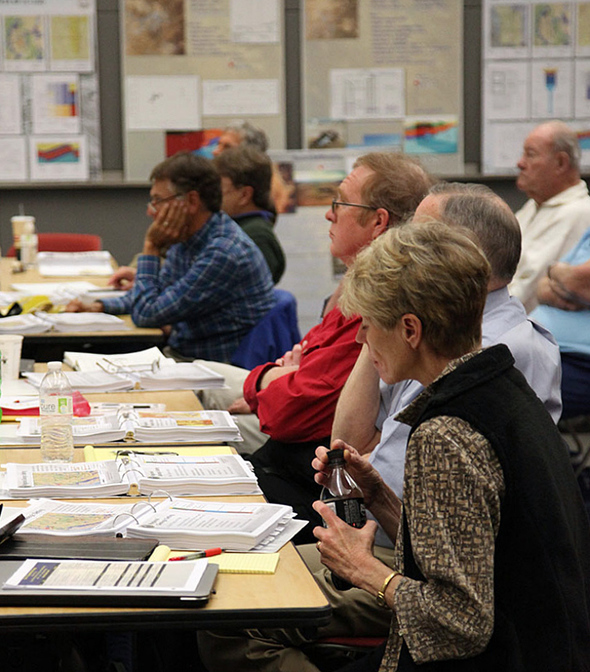
Peer reviewers gathered at the Frank Rogers Building in Las Vegas for technical discussions.
LAS VEGAS – Recently, an independent peer review team was invited to assess the groundwater characterization program at the Nevada National Security Site (NNSS). This nationally recognized group of experts, from various external organizations, will examine the computer modeling approach developed to better understand how historic underground nuclear testing in Yucca Flat affected the groundwater.
In early April, five peer reviewers joined the NNSS groundwater team in Las Vegas to participate in technical briefings, working sessions, and a tour of Yucca Flat, which was the site of hundreds of underground nuclear tests from 1951 to 1992. To ensure transparency, two members of the public who are with the Nevada Site Specific Advisory Board also attended and observed the peer review process.
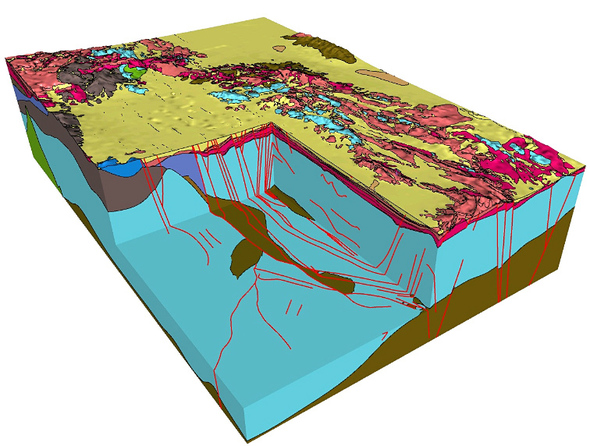
Under review is what’s called the Yucca Flat Flow and Transport Model, a set of representations, including complex subsurface geologic models and mathematical models of groundwater flow and contaminant transport. Years of intensive drilling and data collection went into making the model. NNSS scientists use such models to analyze the movement of radioactive contaminants in groundwater.
In this model example, each geologic unit is represented by a different color. The red lines represent faults.
Peer reviewers representing the fields of geochemistry, radiochemistry, hydrology, hydrogeology and computer modeling are charged with determining the viability of the Yucca Flat model.
“We’re asking the panel to consider these questions,” NNSS Underground Test Area Task Manager Bill Wilborn said. “Does the model adequately account for uncertainty in the natural system and how contamination may be transported within it? Is it a useful tool to aid in regulatory decision making? Is the model sufficient to move forward to the next stage of our negotiated regulatory process, which is continued model evaluation to build confidence that the model is sufficient? And does the model provide a solid basis for long-term monitoring of the natural system and contaminants?”
The peer reviewers will spend the next few weeks exploring these questions and coming up with recommendations. Their report will be completed in the next few months.
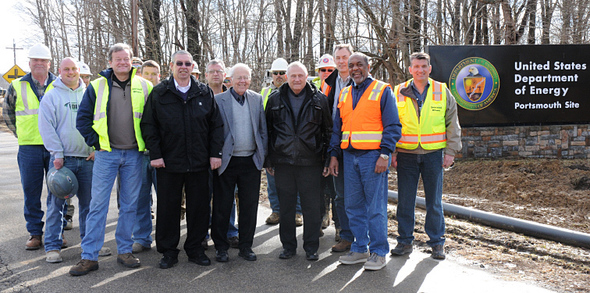
The Pike County Commissioners recently toured the construction site of the county’s new sewer line extension being installed. Shown with team members from contractors FOILL Construction, Stantec, and Fluor-B&W Portsmouth in the background are, front row, left to right, Dennis Carr of Fluor-B&W Portsmouth; Commissioners Teddy West, Blaine Beekman, and Harry Rider; EM Site Lead Joel Bradburne; EM Site Director Dr. Vince Adams; and Rick Ginther of Fluor-B&W Portsmouth.
PIKETON, Ohio – Crews are installing a sewer line in the Portsmouth site to connect EM’s sewer treatment facility to the Pike County Manufacturing Center, which is being developed.
The project is the result of an agreement EM signed with the Pike County Commissioners in 2010 allowing EM to provide sewer services to the county in support of economic development in the area. Because the Portsmouth site is no longer in gaseous diffusion enrichment operation, the sewer facility is not operating at capacity, allowing EM to extend the offer for the services.
“The Department is working in partnership with our Pike County leaders to take advantage of the excess capacity that can be used to attract development in the community,” EM Site Director Dr. Vince Adams said. “We appreciate the hard work the commissioners are doing to further this development for future generations.”
Fluor-B&W Portsmouth, EM’s primary cleanup contractor at the former uranium enrichment facilities, is assisting with site integration and coordination of construction activities for the sewer line, which is expected to be completed this summer.
Dennis Carr, site project director with Fluor-B&W, said the partnership is a win-win situation.
“Any time you can make use of excess capacity in a utility situation like sewer treatment, you’re benefiting everyone involved,” Carr said. “Having appropriate sewer services in place will support the nearby manufacturing center. This is just good stewardship of the resources at our site."
Paducah Site Exceeds 2.5 Million Hours Without Lost Workdays
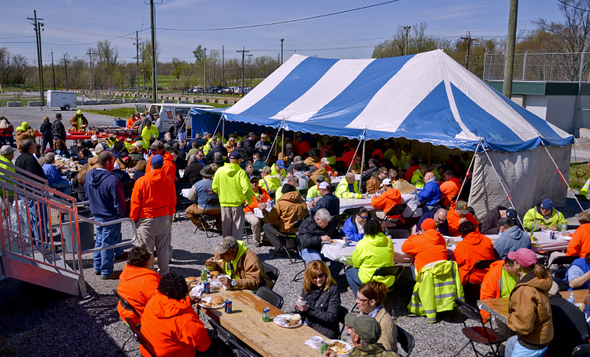
Employees celebrate surpassing 2.5 million hours without lost workday cases over the past 3½ years.
PADUCAH, Ky. – This month, EM’s cleanup contractor at the Paducah site celebrated surpassing 2.5 million work hours without lost workdays resulting from job-related injury or illness.
The milestone 2.5 million hours without lost workday cases as defined by the Occupational Safety and Health Administration were recorded during 3½ years of facility demolition and environmental cleanup.
“This is a significant accomplishment because much of the project work involves complex operations and handling of hazardous materials,” said Rachel Blumenfeld of EM’s Paducah Site Office.
“We could not have achieved this most auspicious milestone without having the steadfast commitment to safety by our workforce,” said LATA Kentucky Environment, Safety, and Health Manager Dave Kent. “Our employees carefully plan and execute the work. And for doing so, they receive the ultimate payoff, being able to go home to their families the same way they arrived — free of occupational injury and illness.”
LATA Kentucky Project Manager Mark Duff commends workers for their safety-first attitude.
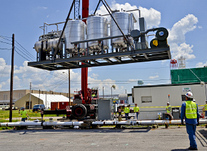
Employees lower a carbon treatment system into place to remove groundwater contamination from near an equipment cleaning building in the middle of the Paducah site.
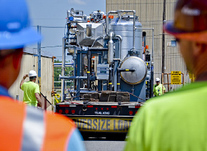
Employees position the carbon treatment system on the ground.
Cleanup of hazardous materials at the site is performed by members of United Steelworkers (USW) Union Local 550. Highly skilled USW workers perform work safely and efficiently by strictly adhering to procedures.
“Our success has been tied to the questioning attitude of our workers, a trait that is inherent to an organization with a strong safety culture,” said Mark Duff, LATA Kentucky project manager.
Key accomplishments during the past 3½ years include:
Razing the eastern third of an inactive facility where workers once produced uranium hexafluoride. The rest of the building is currently undergoing demolition.
Demolishing a seven-story inactive facility — the tallest building at the plant — formerly used to manufacture uranium metal.
Building and operating a system to remove the degreasing agent trichloroethene from the ground near an equipment cleaning building that is the plant’s leading source of groundwater contamination.
Drilling and testing for contamination within one of the plant’s old burial grounds as part of determining a cleanup remedy.
Savannah River National Laboratory Celebrates More Than 60 Years of Innovation
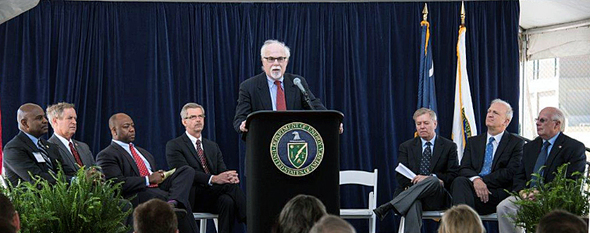
DOE Deputy Under Secretary for Management and Performance David Klaus, center, speaks during the SRNL 10th anniversary ceremony. Seated behind Klaus, left to right, are Savannah River Nuclear Solutions President and CEO Dwayne Wilson, U.S. Rep. Joe Wilson, U.S. Sen. Tim Scott, SRNL Director Dr. Terry Michalske, U.S. Sen. Lindsey Graham, EM Acting Assistant Secretary Dave Huizenga, and Savannah River Operations Office Manager Dr. Dave Moody.
AIKEN, S.C. – EM’s Savannah River National Laboratory (SRNL) is celebrating its first 10 years as a national laboratory and over 60 years of dedicated service to the country.
More than 900 employees and special guests gathered on the grounds of SRNL this month to mark the important milestone, including DOE Deputy Under Secretary for Management and Performance David Klaus and EM Acting Assistant Secretary Dave Huizenga.
SRNL began as the Savannah River Laboratory, designed to lead the Savannah River Site’s part in the nuclear defense program. The laboratory now has three main areas of focus: national security, environmental stewardship, and clean energy. SRNL is DOE’s only designated EM laboratory, touching more than 50 foreign countries, engaged with over 90 private companies and universities, and supporting more than 20 different federal agencies.
“SRNL has made the transition from a site-specific resource to a true National Laboratory,” Klaus said. “The lab is instrumental is helping manage the challenges of nuclear waste cleanup efficiently and effectively, while also advancing technologies that enable us to compete in a global economy.”
With SRNL research ranging from hydrogen-fueled vehicles to security of our nation’s electric grid, SRNL is making an impact on more than just South Carolina.
“SRNL innovations in technology will have a much broader impact as the U.S. moves to be the technology competitor of the world,” Klaus said. “SRNL is vital in addressing not only the nation’s waste challenges, but in developing technology for the rest of the world. This is how we will be competitive in a global economy.”
Innovations developed at SRNL in the past five years have provided more than $5 billion in complex-wide savings for the EM program.
“The laboratory’s research has been integral to the advancement of EM’s mission in radioactive waste treatment and the cleanup of groundwater and soils,” Huizenga said.
SRNL External Advisory Board member and former laboratory director Dr. Susan Wood said the caliber of people who are willing to invest their time and energy to focus on SRNL’s success speaks volumes about how the laboratory is regarded at the national level.
“The External Advisory Board’s assessment is that SRNL’s science and technology contributions have been and continue to be important to this region, more broadly to the nation and have also been successfully applied internationally. They have an outstanding record of solving very real and difficult technical problems.”
SRNL Laboratory Director Dr. Terry Michalske said, “This is a time to appreciate our history, celebrate who we are today, and perhaps most importantly, look forward to our future as a vital asset in the network of national laboratories. I am genuinely excited by the new initiatives that this laboratory is leading and by the increasingly important role it is playing for the nation.”
SRNL is a multi-program applied research and development laboratory for DOE. SRNL applies state-of-the-art science and engineering to provide practical, high-value, cost-effective solutions for our nation’s environmental cleanup, nuclear security, and clean energy challenges. For more information, click here.
Construction Workers Achieve Safety Milestone at Savannah River Site
AIKEN, S.C. – A portion of the construction workforce at the Savannah River Site (SRS) has worked more than 26 million hours without injury or illness resulting in missed work days.
June 1998 marked the last missed day of work due to a work-related injury or illness for construction employees of current liquid waste contractor Savannah River Remediation (SRR) and former SRS contractor Washington Savannah River Company/Bechtel Savannah River Inc. The contractors shared a recording process for the site’s liquid waste operations. SRR built on the hours of the previous contractor to achieve the milestone.
The accomplishment represents more than 15 years of work without a days-away case. The average construction organization has 191 days-away cases in a span of 26 million hours, according to U.S. Bureau of Labor statistics.
“You have done a tremendous job. You continue to earn recognition and I applaud that. Your milestone of 26 million safe hours is worth recognition. Keep it up,” DOE Savannah River Operations Office Manager Dr. David Moody said.
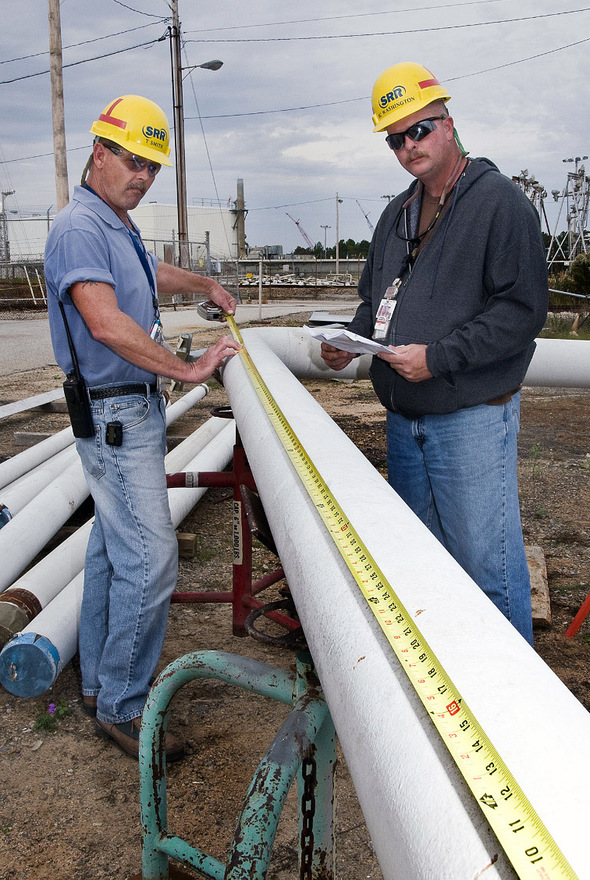
Savannah River Remediation construction employees worked more than 26 million hours without work-related injury or illness resulting in missed work days.
SRR President and Project Manager Ken Rueter congratulated SRR construction employees for their accomplishment and noted all work at SRS begins and ends with safety.
“SRR’s construction employees are continuing an impressive record of work without a days-away injury. I am pleased to see them continue to keep the focus on what’s most important in their daily job performance of high-hazard work,” Rueter said.
SRR Director of Projects, Design and Construction Kim Cassara praised construction workers and supervisors for their dedication to a safe workplace.
“Our construction project employees continue to demonstrate they are the best in the business,” Cassara said. “By any comparison, this is world-class safety performance and a rare construction industry achievement that exemplifies our unrelenting commitment to the highest standards of workplace safety.”
EM Contractors’ Donations Support 4-Year Engineering Degree at USC Aiken
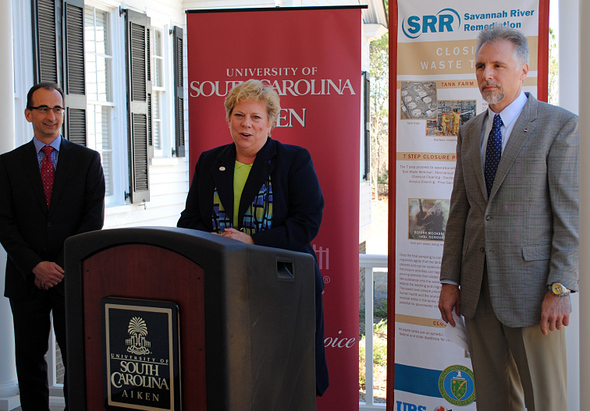
Officials announce financial support for a new engineering program at the University of South Carolina Aiken. Pictured, left to right, are URS Global Management and Operations Services General Manager James Taylor, USC Aiken Chancellor Sandra Jordan, and SRR President and Project Manager Ken Rueter.
AIKEN, S.C. – EM contractors URS and Savannah River Remediation (SRR) pledged to contribute $400,000 over several years to help fund a proposed four-year engineering degree at the University of South Carolina Aiken (USC Aiken).
“SRR’s commitment to promote degrees in science, technology, engineering and math has been substantial over the years and I have witnessed its success,” said DOE Savannah River Operations Office Manager Dr. David Moody. “This donation to fund a four-year engineering program at USC Aiken is another example of that exemplary commitment.”
URS, a 25-year partner and supporter of USC Aiken, was pleased to offer its financial support to the proposed Bachelor of Science Degree in Industrial Process Engineering.
“Both URS and our limited liability company, Savannah River Remediation, recognize there is a significant demand for engineering degree opportunities for students at the Aiken campus,” URS Global Management and Operations Services General Manager James Taylor said.
SRR is the liquid waste contractor supporting the EM program at the Savannah River Site in Aiken.
There is a significant demand for engineering degrees among non-traditional students employed in the Central Savannah River Area. USC Aiken has offered evening engineering courses, but students must travel to the Columbia campus to complete the degree program. Some students do not pursue the degree because they are unable to relocate to Columbia, which is about 55 miles away.
“Given the short- and long-term needs of the regional business community, and in the science, technology, engineering, and math areas, there is a need to attract students to an engineering program in our region,” Taylor said. “URS believes that it is important to provide students with the option to attend a regional university to attain a four-year engineering degree and, with the growth of the nuclear industry in the university’s 60-mile region, the timing is right for this degree.”
USC Aiken officials believe students educated in Aiken are more likely to stay there for engineering careers, benefiting the community’s business and government sectors.
USC Aiken Chancellor Dr. Sandra Jordan said the school is thrilled by the URS and SRR investment.
“By funding this proposal, they are making a tremendous difference in engineering education opportunities for students from the Aiken region and building a pipeline for future employees,” she said.
Carlsbad Field Office Nominated for Employer Support Freedom Award
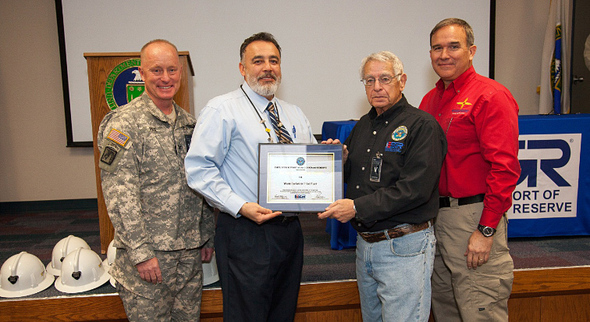
CBFO’s Joe Franco, second from left, receives the New Mexico Patriotic Employer Award from the N.M. ESGR in January at WIPP. Others pictured, from left to right, include Col. Tim Paul, Joint Forces Headquarters, N.M. National Guard; N.M. ESGR Chair Ray Battaglini; and New Mexico Department of Veterans’ Services Secretary Timothy Hale.
The New Mexico Employer Support of the Guard and Reserve (N.M. ESGR) nominated CBFO as one of three finalists for the Freedom Award, the highest recognition given by the U.S. government to employers for their outstanding support of employees serving in the Guard and Reserve. In June, five winners will be selected from nominations nationwide from multiple categories in the national competition. CBFO was nominated for the public-sector category.
ESGR seeks to promote a culture in which U.S. employers support and value the military service of their employees. Its mission encourages employment of Guard members and Reservists.
“(CBFO) is one of the best of the best in New Mexico,” said N.M. ESGR State Chairman Raymond Battaglini. A volunteer member of the N.M. ESGR, CBFO Manager Joe Franco has been active in the New Mexico Committee’s initiatives to provide outreach for Guard and Reserve Forces throughout the state and nation. CBFO has responsibility for the Waste Isolation Pilot Plant (WIPP) and the National Transuranic Program.
In January 2014, the N.M. ESGR held its annual meeting, training and signing of a Statement of Support for the Guard and Reserve at WIPP. More than 40 participants visited and pledged support.
“New Mexico can take pride in that it has the highest employment among the states for Guard members and Reservists, and I’m pleased to support our employees who are members of the military,” said Franco. “As a veteran and a former member of the U.S. Navy, I recognize the nation’s need for — and the important support provided by — the Guard and Reserve.”
The Freedom Award was instituted in 1996 through ESGR to recognize exceptional support from the employer community. In the years since, 190 employers have been honored with the award. Recipients of the 2014 Freedom Award will be recognized in a ceremony this fall in Washington, D.C.
“As the military continuously evolves to meet ever-changing national security challenges, the flexibility and efficiency provided by Guard and Reserve members will take on an even more critical role,” said ESGR National Chair Paul Mock. “The Freedom Award provides an opportunity to acknowledge exceptional employers that support Guard and Reserve members as they serve our nation.”
Established in 1972, ESGR advocates initiatives, recognizes outstanding support, increases awareness of applicable laws, and resolves conflict between service members and employers. ESGR operates through a network of more than 4,900 volunteers.
WIPP Recovery Continues
In recent weeks, WIPP recovery teams have been working to identify the cause and location of the Feb. 14 radiological event. Employees are examining all available information and will determine the activities necessary to locate the cause of the release. Once this phase of the investigation is completed, teams will work to eliminate the source of contamination and implement a plan to decontaminate the mine.