Former Assistant Secretary Shares Experiences Leading EM: ‘Highlight of My Profession’
WASHINGTON, D.C. – In an occasional EM Update series, we feature interviews with former EM Assistant Secretaries to reflect on their achievements and challenges in the world’s largest nuclear cleanup and to discuss endeavors in life after EM. Former EM Assistant Secretaries interviewed for the series include Leo Duffy, Thomas P. Grumbly, Dr. Carolyn L. Huntoon, Jessie Roberson and Dr. Inés Triay. The last in the series is the following interview with James Rispoli.
Rispoli began his career in the military and transferred to the Civil Engineer Corps of the Navy in 1974. He was assigned to various facilities and environmental positions in the U.S. and overseas. In the early 1990s, he directed the Navy’s Environmental Cleanup Program. After retiring from the Navy, he served as president of M&E Pacific and managing principal of Dames & Moore — both engineering and environmental services companies in Hawaii. He then joined DOE as a career executive in 1999. From 2005 through 2008, Rispoli led EM as Assistant Secretary. He is a professional engineer licensed in five states and an American Academy of Environmental Engineers and Scientists Board Certified Environmental Engineer.
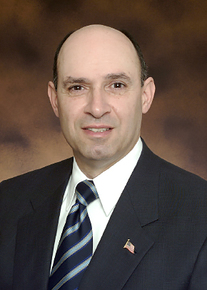
James Rispoli served as EM Assistant Secretary from 2005 to 2008.
What are you doing currently for your professional work?
In January last year, I transitioned from being the president of Project Time & Cost, LLC for three years to a new lifestyle as a part-time executive advisor. Project Time & Cost, LLC is an engineering company that services a number of clients, among them DOE, and included in that is the EM program. I am also a professor of practice at North Carolina State University’s Center for Nuclear Facilities and Structures, so I am enjoying a relatively new lifestyle where I am part time with a company and part time with the university. The company is a project management and construction management company, having provided support to DOE for over 20 years. In my company role, we provide services to DOE and EM in the area of project management, which includes cleanup and construction projects. At the university, I teach project management and construction management, with a focus on nuclear projects. What I do supporting DOE in PT&C and as a professor are actually closely aligned in area of expertise.
Where do you live now?
I live in Raleigh, N.C.
How do you view your term as the EM Assistant Secretary?
I think I was blessed in my life with having fantastic jobs, but I would have to say that being the Assistant Secretary had to be the highlight of my profession. It was a great job with an important mission and great people, both the federal employees and contractor teams that we work closely with. I view it with great satisfaction. This position was something really special.
What was your greatest achievement as EM Assistant Secretary?
I actually have two. Obtaining and maintaining a very good safety record for the benefit of the workers, which is No. 1. No. 2 is that when I first became the Assistant Secretary, we had 103 projects and a very low percentage of them were on cost and on schedule. We put a strong focus on improving the way we manage those 103 projects. Over time, we were able to get our ratio of success to above the 90-percent level so that 90 percent of our projects were on cost and on schedule. That was a pretty significant accomplishment and it didn’t happen overnight. But it took a lot of people working very hard for a couple of years to get to the improvement level that we obtained. We maintained that level for the last several months before the end of my term.
What were your biggest challenges?
The biggest challenge is that it is a very complex program. What the EM program is trying to do is protect the United States public, protect the environment and certainly protect the workers that are in the cleanup program. I think the challenge is that we are doing probably some of the most hazardous work that can be done and yet we do it safely. Thanks to a lot of great support from the DOE staff at headquarters and the field and our contractor community, we attained a level of safety that protected the workers performing this hazardous work. I must mention that I have seen the current numbers, and that persists today. This is a very noble mission and safety is integral to it.
What differences do you see in EM now and when you were the EM Assistant Secretary?
I see a good constant, which are the many dedicated, good people that are working hard to do a very difficult job. My favorite saying back then was, ‘Our only asset is our people.’ It’s true. You’re doing this very difficult work because you have very dedicated people throughout the complex. This has been a constant and there are still many of the same very dedicated people working here. Some changes that I have seen are that a number of projects that we had under way during my time have been finished.
What misperceptions do people generally have about the program and about the EM Assistant Secretary?
One misperception that we had to deal with would be the establishment of target dates to finish projects. Many people would think that there is no risk to that. But we have to realize that because of the complexity of what EM does, a lot of these proposed target dates are at risk because you are not sure if you have the technology and future years’ funding. We always work to do better, but one of the misperceptions is that when you give a date, that date becomes a date certain and that’s never the case because anything could happen. You never sacrifice the safety of the worker to make a date.
How has your experience as the EM Assistant Secretary helped you in subsequent endeavors?
What has helped me the most has been to better understand the nuclear aspects of doing construction, cleanup and deactivation of facilities. The nuclear aspect was something that I was unfamiliar with. That has greatly helped me with my work subsequent to working for the DOE because now I am a professor in the Center for Nuclear Energy Facilities and Structures at North Carolina State and I wouldn’t have been there if I didn’t know something about nuclear facilities.
Did you take any interesting trips while you were EM Assistant Secretary?
I took many interesting trips, visiting all of our EM sites where you could see DOE employees and contractors doing tremendous work. The most rewarding ones were where we would have a public ceremony to celebrate an actual completion of a major project of the sites. The public would be invited in and they would get to enjoy the success as well that resulted from so many people working hard to complete the project. There were several that were particularly memorable, but one would be going out to Rocky Flats. It had been an entire industrial, nuclear city that is now a wildlife refuge. Everything is gone. To go out there when that was finished was a major transformation. Fernald in Ohio was also another similar cleanup effort. Both of these cleanups were awarded the Project Management Institute’s Project of the Year Award.
Do you have any personal accomplishments that you would like to talk about?
I just had a great career and enjoyed every phase of it. Beginning in the U.S. Navy, this took young people and turned them into better leaders. In the private sector, I had some great jobs, including the job that I am still with. But the EM job topped all of it. I would say that I was blessed with some really great opportunities.
EM Finds Success with Fixed-Priced Hybrid Contract Approach Benefitting Taxpayers
WASHINGTON, D.C. – EM plans to complete more fixed-priced procurements in the future, and some may involve a new combination of contracting strategies proven successful at the Hanford site.
The Hanford success story marked EM’s latest use of a hybrid fixed-price contract. The estimated $99 million contract went to HPM Corp., a certified minority- and woman-owned small business, to provide occupational medical services. More than a year has passed since HPM was awarded the contract, and EM’s Richland Operations Office at Hanford reports the contract is working well and that the contractor’s performance is acceptable.
“Applying this contract type reduces the government’s risk and protects the interest of taxpayers, demonstrating a strong commitment and top leadership support for improving contract management,” EM Deputy Assistant Secretary for Acquisition and Project Management Jack Surash said.
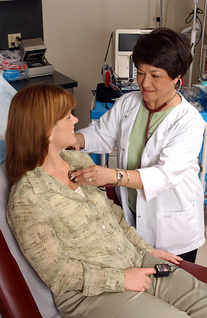
A registered nurse with EM contractor HPM Corporation checks a patient’s vital signs at the Hanford Occupational Medical Services Clinic.
The winning combination strategy used at Hanford comprises three parts. One is the use of a firm-fixed-price contract. Under this contract type, EM identified the work scope and HPM submitted a firm price, including its profit and overhead costs.
DOE believes firm-fixed-price contracts align with taxpayer interests. The Department asks contracting officers to consider awarding this type of contract before others, such as cost reimbursement contracts. Firm-fixed-price contracts are most appropriate for services objectively defined in a statement of work, and the risks involved can be estimated with an acceptable degree of certainty. They are also appropriate for construction contracts when design is completed prior to contract award. Use of these contracts benefits the Department by providing greater budget stability. These contracts also motivate contractors to identify improved methods of performance to increase profits.
The Hanford hybrid contract cost is about 2.5 percent less than the previous contract for occupational medical services. Under the previous contract, EM reimbursed the contractor for all costs allocable under the contract, allowable under federal acquisition regulations and reasonable using sound business judgment.
The second part of the hybrid contract is a cost reimbursement component to account for unpredictable costs, such as employee pensions and x-rays and laboratory tests that cannot be completed onsite. The contractor is not allowed to earn a fee under this arrangement.
The third part of Hanford’s hybrid contract, called indefinite quantity, addresses the potential for paying overtime or hiring additional workers if needed.
Fewer government resources were used to award the hybrid contract compared to cost reimbursement contracts, which require extensive cost evaluations and audits that often take several months. Post-award, contract management and administration requires fewer DOE resources because business system reviews and additional audits are not required.
EM’s drive to use firm-fixed-price contracts is one of several key reforms instituted to continuously improve contract management. Other reforms include the implementation of policies requiring more front-end planning; ensuring federal project directors and contracting officers have access to relevant training; and more frequent project reviews by peers and experts in contract and project management to make sure issues are identified early and lessons learned are applied in real time.
“We remain focused on sustained process improvements with the goal of improving our results,” Surash said. “As I’ve said before, acquisition and project reform is a journey, not a destination.”
Portsmouth Educational Outreach Seeks to Transform Lives of Area Students
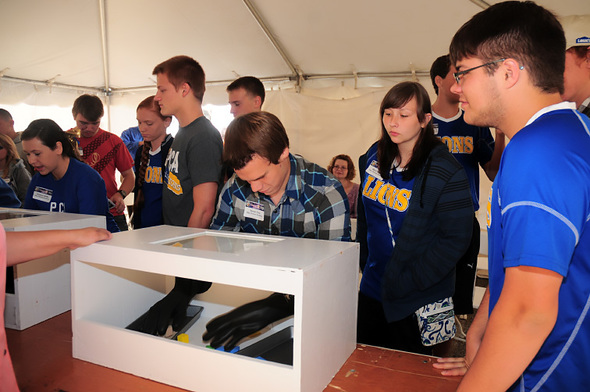
Students participating in the Science Alliance enjoyed hands-on exhibits and discussions with scientists, engineers and specialists in a range of fields.
PIKETON, Ohio – Educational outreach efforts at the Portsmouth Gaseous Diffusion Plant in southern Ohio are making a positive and significant impact on youth in the area surrounding the site.
The 3,700-acre reservation rests in Ohio’s Appalachian region in Pike County, where the unemployment rate is among the state’s highest. In a region where educational attainment and the median income lag well behind state and national averages, outreach efforts at Portsmouth are paramount.
“We believe the work we are doing here is changing the lives of young people,” said Greg Simonton, who heads EM public outreach initiatives at Portsmouth. “These are not programs that are simply good public relations or photo ops. These are dynamic efforts that make our area’s high school students understand what is possible in their lives. These experiences become kitchen table discussion topics, therefore the impacts are immeasurable.”
The site received statewide recognition from the Ohio School Boards Association (OSBA) in 2012 when Portsmouth Site Director Dr. Vincent Adams received the prestigious OSBA President’s Award — that body’s highest distinction for contributions to education — for the site’s extensive outreach program.
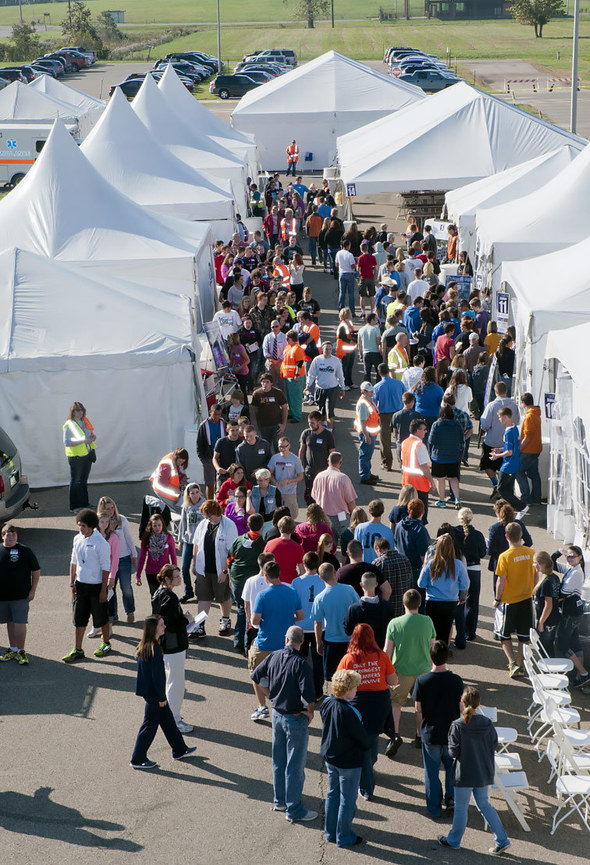
The staple of Portsmouth’s educational outreach is the annual Science Alliance, a three-day science fair that brings government, education, regulators and private entities together in a science, technology, engineering and math (STEM)-focused program that allows students to interact with various professionals. The popularity of the event has grown, as evidenced by a steady increase in student participation, with the 2013 version drawing about 1,200 students and educators from 23 high schools.
More than a thousand students from 23 area schools attended the three-day Science Alliance Oct. 1-3 at the Portsmouth site.
Interactive demonstration stations allow students to learn about topics such as biology, groundwater monitoring, recycling, innovation, geology and emergency management. Simonton said it allows students to become educated on plant history and the role it played during the Cold War. Students also learn how to turn STEM-related topics into careers.
Kyle Exline, an educator at Wellston High School in Wellston said the event was an eye-opening experience for his students.
“One of my favorite things was that nearly every station discussed careers and the diverse employment opportunities available. Many of our students are never exposed to life outside of their town and what they see around them. Many of them have no desire to leave this area due to family connections or they believe they will never have the financial means to move,” he said. “It was so great for them to see that there are current careers and likely future opportunities for them in their own backyard. So many times, kids get caught up in what they know — doctor, lawyer, secretary, cashier, nurse, teacher — that they don't even realize the plethora of careers available to them in today's workforce.”
Simonton, a Pike County native who understands the challenges some of the region’s students have to face, said that giving students new perspectives is what the Science Alliance is all about.
“The students who come through our gates go from one end of the socioeconomic spectrum to the other. Going to college seems like a world away to some of our kids, but we change their paradigms. We show them the STEM-related fields that might be of interest to them, we show them the careers that can be associated, we show them the educational tools they need and we give them information on the regional universities that offer those programs,” said Simonton, who added the event is often the students’ first visit to the site that is so prevalent in the region’s economy. “These kids receive advice from professionals in the field and that leads to opportunities as well as paving the way for a more informed group of future stakeholders. We try to show them the path to a successful future and it also helps meet the nation’s need for more scientists and engineers.”
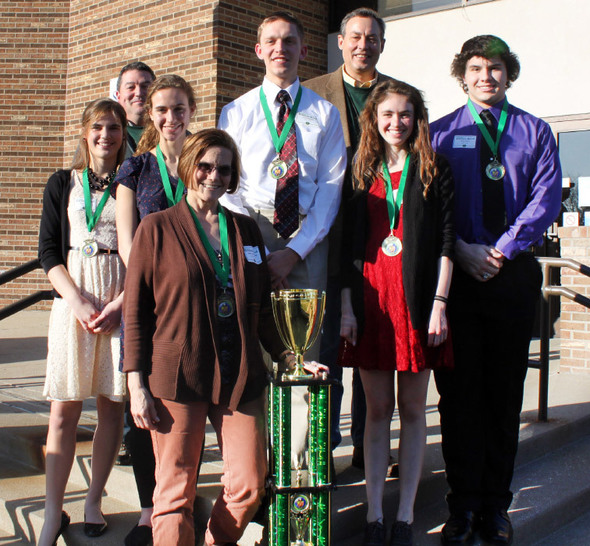
Zane Trace High School claimed the trophy and an all-expense paid trip to the National Science Bowl in Washington, D.C. Team members standing behind coach Nancy Robertson are, from left, Emily Joosse, Jessica Proehl, Tyler Moore, Kasandra Dalton, and Beau Bilek. The team is pictured with Greg Simonton (back left), South Central Ohio Regional Coordinator for EM, and Joel Bradburne (back right), Portsmouth Site Lead for EM.
Simonton credits the Portsmouth/Paducah Project Office (PPPO) leadership’s support of the program for its growing success.
“Bill Murphie (PPPO Manager), Dr. Adams and Joel Bradburne (Portsmouth Site Lead) have been instrumental in the success of our educational outreach program,” Simonton said. “They understand the importance of these efforts and recognize the impacts of these events. What we do would simply not be possible without their support.”
Besides the Science Alliance, Portsmouth is also a regional Science Bowl host, conducting the inaugural South Central Ohio Regional Science Bowl in March 2012. By establishing Portsmouth as a regional host, Simonton said some of the region’s brightest students now have an opportunity to compete on the national stage.
Simonton chaperoned the winning team from Zane Trace High School in 2012, with some of the team members taking their first flight and seeing the nation’s capital for the first time. DOE created the National Science Bowl in 1991 and more than 200,000 students nationwide have participated in the competition in its 23-year history. It is the nation’s largest science competition.
“These kids had the experience of a lifetime,” Simonton said. “It was the first time being in an airplane for a couple of our students. They got to see national landmarks and had a first-rate educational experience. This is the untold story about the Science Bowl, that it can broaden horizons for young people.”
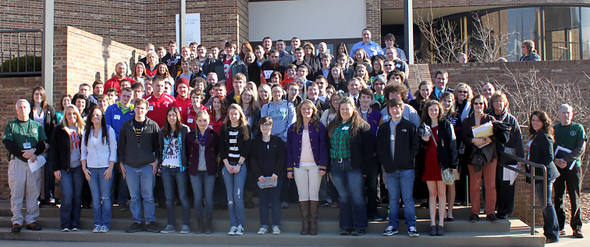
Coaches, students and volunteers paused for a group photo outside Clark Memorial Library before the Science Bowl competition began. More than 100 students from 13 area high schools converged on the campus of Shawnee State University in Portsmouth for the inaugural event hosted by DOE.
DOE also partners with regional universities and high schools on Portsmouth projects related to environmental management, future land use, business development and cultural resources. Among those efforts is a program in which regional high school students work with Ohio University to take the Portsmouth Annual Site Environmental Report and compile a summary, complete with their artwork and distribute it to the community. DOE representatives also make routine visits to universities and high schools to inform students on plant activities and other developments.
As with their sister Portsmouth Gaseous Diffusion Plant, employees and contractors at the Paducah site will also support their local students at the West Kentucky Regional Science Bowl in February. Over the next two months, more than 9,500 high school students and 4,500 middle school students nationwide will compete in 70 high school and 50 middle school regional tournaments for a spot in the National Science Bowl in Washington, D.C., April 24 to 28. More information is available here.
DOE’s emphasis on community engagement has fostered a culture of openness and trust between DOE and the community, Dr. Adams said.
“That does not happen by accident,” Dr. Adams said. “Good public outreach is difficult, but Bill Murphie has devoted the necessary resources for us to enjoy a quality public outreach program. We are now seeing the benefits of this public engagement and we are seeing how it makes a difference in the community we serve.”
PADUCAH, Ky. – After more than doubling production in fiscal year 2013, the Depleted Uranium Hexafluoride (DUF6) Conversion Project is moving from start-up mode to full production mode.
Operated for DOE by Babcock & Wilcox Conversion Services LLC (BWCS), the DUF6 project’s mission is to convert the nation’s approximately 800,000-metric-ton inventory of DUF6 to more benign forms for sale, long-term storage or ultimate disposal. BWCS took responsibility for plant operations in 2011.
Production in fiscal year 2013 at the Paducah and Portsmouth plants totaled 13,679 metric tons, more than double the production of 6,170 metric tons converted in fiscal year 2012 and surpassing the year’s target of 12,685 metric tons by 9 percent.
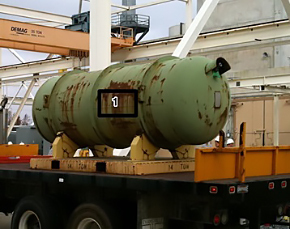
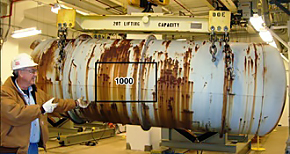
In January, each plant announced it finished processing 1,000 cylinders. There are currently some 45,000 cylinders awaiting conversion at Paducah and 20,000 cylinders awaiting conversion at Portsmouth.
The target for fiscal year 2014 is 22,700 metric tons, a near doubling of fiscal year 2013 production.
“BWCS is continuing to pursue operating and maintenance plans to achieve maximum safe performance,” said Jack Zimmerman, federal project manager at EM’s Portsmouth/Paducah Project Office.
The Paducah plant processed this DUF6 cylinder, its first, in 2011.
Shown here, earlier this month, is the 1000th cylinder the Paducah plant processed.
“We think the target for this year is achievable,” said BWCS President George E. Dials. “That’s an increase of 66 percent but it’s consistent with our ongoing ramp-up operating strategy. For the past 30 months we have been ramping up production and adjusting and modifying the plants and equipment to achieve the rate that can be safely sustained in continuous operations.”
The Portsmouth plant reached five years of operations without a lost-time accident in November, and the Paducah plant marked one year without a lost-time accident the same month.
“Our goal all along has been safe, sustainable operations,” Dials said. “Safety is first, and the sustainability of operations over the long-term supersedes any immediate aggressive action to achieve what would ultimately be unsustainable production.”
He continued, “In this fiscal year, we’ll be looking at ways to increase sustainable operations and will be adjusting systems to increase reliability and availability, which will account for the increased production we’re targeting.”
In the first quarter of fiscal year 2014, both plants processed 1,000 metric tons in a single month for the first time. Total production for that three-month period was nearly the total of the entire production for fiscal year 2012.
The two DUF6 plants — each employing approximately 200 people — are expected to take up to 30 years to convert the extensive inventory of DUF6 generated by six decades of uranium enrichment at the Portsmouth and Paducah gaseous diffusion plants.
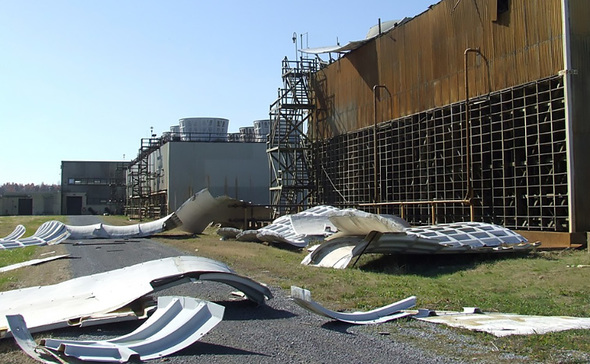
A cooling tower adjacent to a process building sustained damage when a tornado struck the Paducah Gaseous Diffusion Plant site Nov. 17.
PADUCAH, Ky. – Emergency management is a systematic, integrated effort at the Paducah Gaseous Diffusion Plant (PGDP) site, a sprawling complex with more than 500 facilities and multiple work organizations.
Components of the PGDP Emergency Response Organization include the crisis manager and the Emergency Operations Center (EOC) cadre, an incident commander, the Emergency Squad and the Joint Public Information Center. USEC, the PGDP plant operator, also maintains a fully staffed fire department along with protective force officers and a medical facility.
DOE, USEC, and DOE’s various contractors have separate emergency response procedures that they practice during training exercises to bolster their ability to work together. Those preparations were put to a real-life test on the afternoon of Sunday, Nov. 17, when a tornado struck the plant site.
With wind speeds upward of 115 mph, the tornado carved a substantial path of destruction through western Kentucky and southern Illinois. The PGDP plant shift superintendent previously had directed all personnel to take cover when the National Weather Service issued a tornado warning for the immediate area earlier that day. As part of its lease agreement with DOE, USEC coordinates emergency response at PGDP.
After the suspected presence of a tornado and resulting damage was confirmed, the superintendent declared an emergency according to established procedure and activated the Emergency Response Organization (ERO). The EOC, with its staff of about 60 people representing USEC, DOE and its prime contractors, was activated. The EOC was deactivated four hours later after the ERO had completed an assessment, dealt with potential damage, and established a detailed recovery plan.
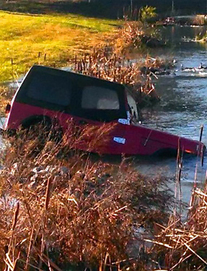
The Nov. 17 tornado forced a Jeep owned by an employee of DUF6 plant operator Babcock & Wilcox Conversion Services into a stormwater runoff ditch at the Paducah Gaseous Diffusion Plant site.
No one at the plant was injured during the storm, and all safety systems functioned as designed. No production systems were affected and there were no releases or off-site impacts.
Damage to DOE facilities involved the non-structural exterior of one of the four enrichment process buildings, the adjacent cooling towers and an electrical switchyard. Some power poles, wiring and electrical circuitry around the site perimeter were also damaged. Although the tornado passed near the Depleted Uranium Hexafluoride (DUF6) conversion building and its adjacent inventory of DUF6 cylinder containers, it did no damage to either. However, the twister did damage some of the other DUF6 buildings and site equipment and moved a Jeep from the employee parking lot into a rainfall runoff ditch.
“Despite the harsh weather, the limited damage and intermittent electrical power outages, the DUF6 conversion plant was undamaged and operations continued safely without interruption, as it was designed to do,” said Jack Zimmerman, DUF6 Federal Project Manager at EM's Portsmouth/Paducah Project Office in Lexington, Ky.
“In spite of widespread damage throughout the area, response to the plant’s emergency callout was outstanding,” said USEC Interim General Manager Mike Buckner, who served as assistant crisis manager for the tornado incident. “The EOC was staffed very quickly and provided excellent support to the shift organization already onsite. We had all the resources needed to ensure a safe, thorough and well-coordinated response in the wake of the storm.”
A critique was held Nov. 20 to discuss the emergency response, catalog what worked well and collect lessons learned for future improvements. USEC emergency management specialist April Tilford said the overall sentiment was that all of the organizations at the site worked well together during the emergency to identify damage and resolve issues. Several of the responders specifically noted that their emergency response training and previous drills and exercises prepared them well for a real event.
DOE, USEC, cleanup contractor LATA Kentucky, and Swift & Staley, DOE’s infrastructure contractor, coordinated well during the tornado response and recovery efforts, said Jeff Snook, who was DOE site lead in the plant EOC during the incident.
“They (USEC) defined the problem, prioritized the issues, addressed immediate needs, coordinated resources, ensured everybody was safe and accounted for, and then stood down from the alert once it was determined the plant was in a safe condition for continued operations,” Snook said. “We had some lessons learned to improve our response in the future, but overall the response was quite good.”
Hanford Site Shares Lessons Learned in Retrieving Highly Radioactive Material
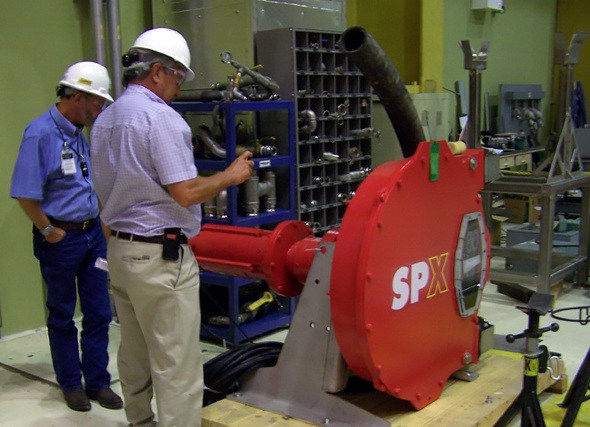
A team from the Oak Ridge Office of Environmental Management observes equipment that will be used to retrieve highly radioactive sludge at the Hanford site. This pump was modified to fit the underwater environment where the sludge is stored.
RICHLAND, Wash. – EM’s Richland Operations Office (Richland) and its contractor, CH2M HILL Plateau Remediation Company (CH2M HILL), welcomed staff from the Oak Ridge Office of Environmental Management Transuranic (TRU) waste processing team in Tennessee to the Hanford site recently to share lessons learned in the retrieval and processing of highly radioactive material, called sludge.
“This was a good exchange for the Hanford site,” Richland Federal Project Director Roger Quintero said. “It gave us an opportunity to share our experiences, and we learned from our colleagues at the Oak Ridge site. These partnerships are productive for the Department and its contractors.”
Just 400 yards from the Columbia River, which flows through Hanford, approximately 30 cubic meters of the sludge is stored underwater in an aging, water-filled reactor basin. That amount is roughly equivalent to the size of a 20-foot cargo shipping container.
EM and CH2M HILL have been working together to develop a better understanding of the sludge and to develop and test the best engineered approach to remove, treat and package the sludge for interim storage and final disposition in the future. Much of this process is in final demonstration testing.
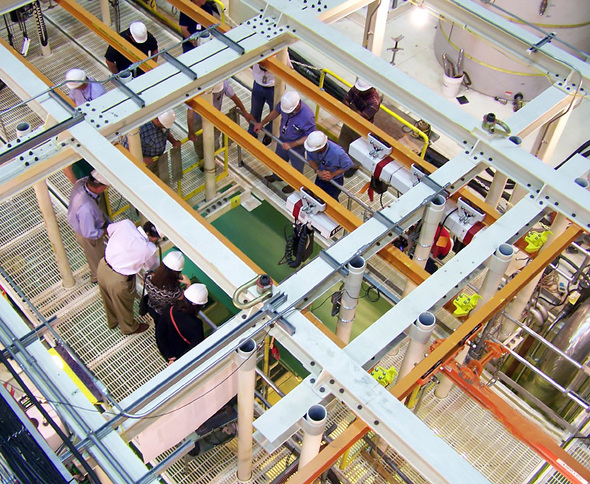
Representatives from the Oak Ridge Office of Environmental Management observe a mock-up reactor basin at the Hanford site where the Richland and CH2M HILL are testing equipment to be used to retrieve highly radioactive sludge.
The Oak Ridge team selected Hanford because it is leading the way by developing technology to solve the complex challenge of retrieving the sludge. Personnel from Oak Ridge visited Hanford to find potential solutions because both groups are dealing with similar problems.
The team visited Hanford’s Maintenance and Storage Facility, where workers constructed a full-scale replica of the reactor basin that contains the sludge. Workers at the facility design, develop, test and train for sludge retrieval, mastering the retrieval tools, processes and techniques for sludge retrieval in a safe, radiologically clean environment. The Oak Ridge team met with CH2M HILL workers who are designing, building, and training on the equipment and systems that will be used in the basin to retrieve sludge.
Laura Wilkerson, portfolio federal project director for Y-12 Projects and TRU Waste Processing and Disposition at Oak Ridge, wrote Richland’s Quintero a thank you note after the visit by the Oak Ridge team.
“The extensive knowledge and command of the subject by all (feds and contractors alike) was impressive,” Wilkerson wrote. “I am confident that the lessons learned shared by you, Tom (Teynor), and your team will be beneficial as we embark on our sludge processing work.”
“Nuclear sites like Hanford and Oak Ridge were once part of a similar mission and now have similarly challenging wastes,” CH2M HILL Decommissioning, Waste, Fuels and Remediation Services Vice President Ty Blackford said. “The consistency of waste streams like sludge may be somewhat unique to the sites, but many of the solutions we have used, and are planning to use, can be of benefit to other sites. We are glad to share our lessons learned and best practices across the DOE complex to help further the overall cleanup mission.”
Savannah River Site Saves $10 Million with Innovative Commercial Procurement Practices
AIKEN, S.C. – The management and operations contractor for the EM program at the Savannah River Site (SRS) created more than $10 million in cost savings in fiscal year 2013 by adopting successful purchasing practices used by America’s top companies.
Prior to that year, Savannah River Nuclear Solutions (SRNS) benefited from high-volume purchasing at the company level. The SRNS supply chain management has since teamed up with contractors at several DOE sites across the complex to greatly increase the company’s overall buying power.
“We looked at several other best business practices used by this group of DOE sites to further increase our savings,” said Helena Tirone, SRNS director of supply chain management.
"The support that SRNS has provided for the use of Supply Chain Management Center (SCMS) tools provided by EM has been exceptional," said Ralph Holland, deputy director of the Environmental Management Consolidated Business Center in Cincinnati. "The tangible savings that SRNS's efforts have provided is a tribute to the determination and commitment of those involved, and delivers value to the taxpayer."
One of the procurement methods implemented by SRNS provides supply vendors with an online, timed monetary bidding process. The low bid wins in the SRNS process.
The effort and resources dedicated to this project paid off. Working with the DOE procurement team known as the SCMC, SRNS personnel quickly achieved their initial goal of $1.67 million in cost savings. And through the use of multiple savings initiatives beyond those tools provided by the center, the overall savings achieved for fiscal year 2013 reached $10.2 million. The center uses new technologies and pooled purchasing power to drive efficiencies, resulting in lower costs.
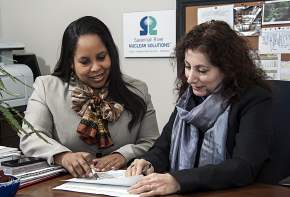
Sabrina Elam (left) and Lorri Wright, who work in procurement for SRNS, review the savings the company achieved.
“The primary value of this extraordinary team effort is a significant savings for our nation’s taxpayers,” SRNS President and CEO Dwayne Wilson said. “We’re now using several highly effective procurement strategic sourcing and acquisition savings tools with the result being a highly cost-efficient process for the purchase of both products and services. This is an impressive example of where governmental procurement has learned and benefitted from our counterparts in corporate America.”
EM asked SRS to be the EM pilot site for the new procurement program and to mentor 18 EM contractors new to the concept at sites such as Paducah in Kentucky and Hanford in Washington state.
“We readily agreed to share our newly developed expertise with a variety of companies under contract to DOE around the nation,” Tirone said. “Everyone in our group was honored by the request.”
Examples of items being purchased through this cooperative effort include commercial software, laundry services, travel card services, laboratory supplies, ammunition and safety glasses.
“Just to give you an idea of the volume we’re talking about, through the combined purchasing power of multiple DOE sites, it would not be surprising for us to order 1,000 lab coats, 2,000 pairs of safety glasses or 5,000 recordable DVD discs,” Tirone said.
Thousands of goods and services are being purchased through this successful enterprise.
EM’s Laboratory Supports Testing Wireless Technology in Secure Environment
AIKEN, S.C. – Wireless networks have become commonplace in homes, restaurants and retail environments. But up to now, they have not been suitable for secure environments.
That may change. The National Nuclear Security Administration (NNSA) Savannah River Tritium Enterprise (SRTE) has begun a year-long test using secure wireless technology in a tritium air monitoring system. The test is an important step in demonstrating the ability to reap the benefits of wireless technology in a secure environment, with potential for applications across NNSA, other federal agencies and critical manufacturing facilities.
EM’s Savannah River National Laboratory (SRNL) — which is part of DOE's network of national laboratories across the U.S. — designed and fabricated a prototype wireless Tritium Air Monitoring (TAM) cart, funded by SRTE’s Plant-Directed Research and Development program for innovative research, development and demonstration projects relevant to SRTE’s support for NNSA. The project also includes a control room computer display for the monitoring results along with related software.
“Secure wireless technology offers a lot of advantages to help achieve our goals of improving reliability, reducing complexity and providing deployment flexibility for our TAM systems,” said Lee Schifer, director of tritium operations for Savannah River Nuclear Solutions, which manages SRTE and SRNL. The company is the management and operations contractor for the EM program at the Savannah River Site.
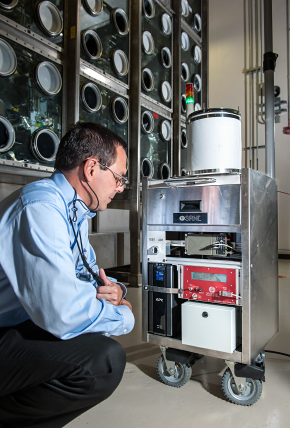
Joe Cordaro of SRNL observes the secure wireless TAM cart.
“This is the type of technology that places SRNL at the forefront in innovation,” SRNL Laboratory Director Dr. Terry Michalske said. “Not only does this solve a very expensive issue here at the Savannah River Site, this technology can be used across many industries to help keep information secure. At a time when citizens wonder if their valuable information is protected, SRNL is working to help make sure this most critical information remains secure.”
NNSA and its sites around the country could benefit greatly from the ability to use this wireless technology for radiation monitoring in nuclear facilities, where monitoring is essential for operating the equipment safely and protecting personnel. With the cost of running cable into a radioactive process room as high as $2,000 per foot, a wireless system could save millions in construction or upgrade of new nuclear facilities. Wireless air monitoring is also expected to be more reliable than its wired equivalent because it reduces the number of components in the air monitoring system.
Another key advantage is the freedom of movement that comes when equipment is not restricted by wires and cables. The sensors can be placed directly in the area of concern, instead of pumping air to the sensors’ location.
The TAM cart houses robust tritium monitoring equipment, a secure wireless transmitter, alarms and a backup power source. SRNL contracted with General Dynamics to develop components for the ultra-secure short range wireless network. During the demonstration, network reliability is being monitored by an independent computer. So far, the system has demonstrated 100 percent reliability.
DOE Awards Savannah River Remediation VPP Star of Excellence for Safety Performance
SRR President and Project Manager Ken Rueter (left), SRR Director of Environmental, Safety, Health and Quality and Contractor Assurance Patricia Allen and SRR VPP Chair Donletta Watts (right) accept DOE’s VPP Star of Excellence award.
AIKEN, S.C. – EM liquid waste contractor Savannah River Remediation (SRR) recently received the DOE Voluntary Protection Program (VPP) Star of Excellence award for its commitment to ensure the safety of employees.
This is the 12th such award presented to the Savannah River Site (SRS) liquid waste operations group and the fourth for SRR, which became the SRS liquid waste contractor July 1, 2009.
Dave Moody, DOE-Savannah River Operations Manager, recognizes the exemplary effects of SRR’s safety and wellness practices on the company's workers and other SRS contractors.
“SRR has demonstrated a commitment to ensuring a safe and healthy work environment for their workforce and establishing a legacy of excellence,” said Moody. “I thank them for their dedicated efforts to promote VPP, both at home and nationwide.”
SRR President and Project Manager Ken Rueter said the award is also given based on SRR's outreach services to other contractors striving to achieve VPP recognition.
“I’m proud of SRR’s demonstrated, outstanding level of performance towards safety and health goals needed to receive this award,” Rueter said. “Additionally, I’m honored SRR has provided service to the community by reaching out to other organizations and facilitating continuous improvement of the SRS safety program.”
SRR employees accepted the award during the annual National Voluntary Protection Programs Participants’ Association Conference held in Nashville, Tenn., in August 2013.
CARLSBAD, N.M. – EM’s Waste Isolation Pilot Plant (WIPP) was in the spotlight with two international organizations at meetings held in Europe late last year.
Dr. Abe Van Luik, EM Carlsbad Field Office (CBFO) International Programs and Policy Advisor, participated in the Executive Group and Management Board of the Nuclear Energy Agency Thermochemical Database (TDB) Project in Paris in November 2013. Also in November, Van Luik was a key participant in the International Atomic Energy Agency’s (IAEA) Underground Research Facility (URF) Forum meeting in Vienna.
“It’s important that CBFO engage in international venues to share our knowledge with other nations and gain from their experiences,” said CBFO Manager Joe Franco. “As America’s only operating deep geologic repository for the permanent disposal of radioactive waste, WIPP is a global model for other countries.” CBFO has responsibility for WIPP and the National Transuranic Program.
At the TDB meeting, the group began an important phase of its work to include a task suggested by the WIPP team representation that may further the scientific credibility of WIPP as a repository for the permanent disposal of waste. The team includes Los Alamos National Laboratory-Carlsbad Operations and CBFO.
The proposed project involves creating a report on the use of data in Pitzer equations. Pitzer equations are used at WIPP for estimating the solubility of actinides in brines and are part of the scientific basis for certifying WIPP’s ability to protect people and the environment from exposure to radionuclide releases for 10,000 years.
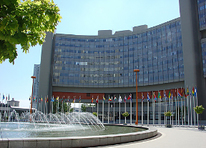
Discussions during the Underground Research Facility Forum meeting were conducted at the Vienna International Centre (VIC). The United Nations Offices in Vienna and the IAEA are located in the VIC (Photo courtesy of United Nations Information Service Vienna).
Van Luik was part of the URF Forum’s work that enables information from the development and operation of WIPP to be shared with other IAEA member nations worldwide to develop their repository programs. At the meeting, the WIPP team, which included representation from Sandia National Laboratories and CBFO, renewed an ongoing agreement with IAEA by offering to plan, conduct and support one course in the U.S. every other year.
A date and location will be determined for the next planned course, which will include subject experts from Sandia who will provide information on the generic safety cases for repositories situated in different rock types. As a highly successful repository with rock salt as its host rock, WIPP demonstrates the benefits of salt in nuclear waste management. Other rock types currently being studied in the U.S. include granite and other crystalline rocks and clay shale.
“The Underground Research Facility Forum was organized in 2001 and is the oldest of the IAEA network groups,” said Van Luik. “WIPP, which has participated in the educational activities of the URF since its inception, is the example for other countries that want to develop their own safe, long-term repository programs.”
Nevada National Security Site Groundwater Program Prepares for Peer Review
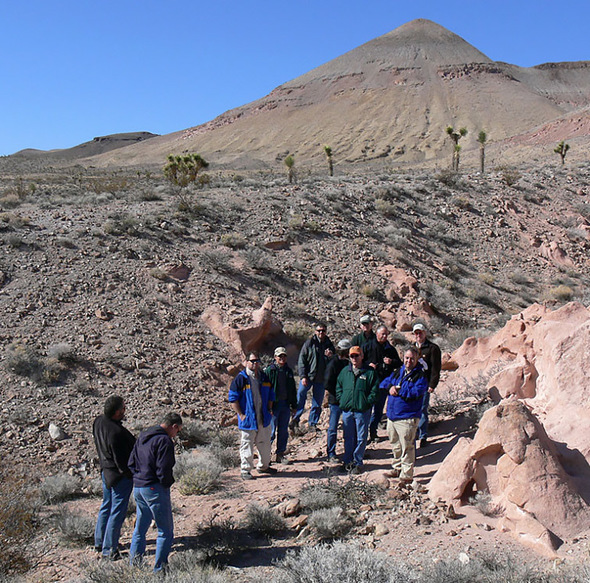
In March 2010, NNSS groundwater specialists toured the site in preparation for an independent peer review of the historic underground test area, Frenchman Flat. In August 2010, the peer review panel found model projections to be sound and recommended moving on to the next phase.
Nevada National Security Site Groundwater Program Prepares for Peer Review
LAS VEGAS – The historic underground test area known as Yucca Flat is the focus of an upcoming independent peer review. In preparation, groundwater specialists working for the Nevada National Security Site (NNSS) groundwater program have scheduled a week-long dry run in February.
Dry run organizers believe the exercise will strengthen the official peer review scheduled to begin April 7.
“This week-long practice session will bring all of the participating experts together so that we can prepare for questions and ensure we are including the appropriate level of technical detail,” said Bill Wilborn of DOE’s National Nuclear Security Administration, Nevada Field Office.
April’s peer review panel will consist of experts in geology, geochemistry, hydrology and modeling. “These independent panelists will be looking at how we have implemented our characterization strategy at Yucca Flat and whether our results meet the requirements within the strategy,” said Wilborn. “They’ll determine whether our process is sufficient enough to move us forward to our next phase, which involves additional data collection, analysis and an evaluation of our computer model’s performance.”
Situated on the northeastern portion of the NNSS, the Yucca Flat basin was the location of more than 700 underground nuclear detonations (a testing moratorium has been in effect since 1992). Scientists are now performing extensive work at Yucca Flat and four other former test areas to better determine groundwater flow paths and the transport of radionuclides resulting from past testing.
The Nevada Field Office plans independent peer reviews for each of the five former underground test areas.