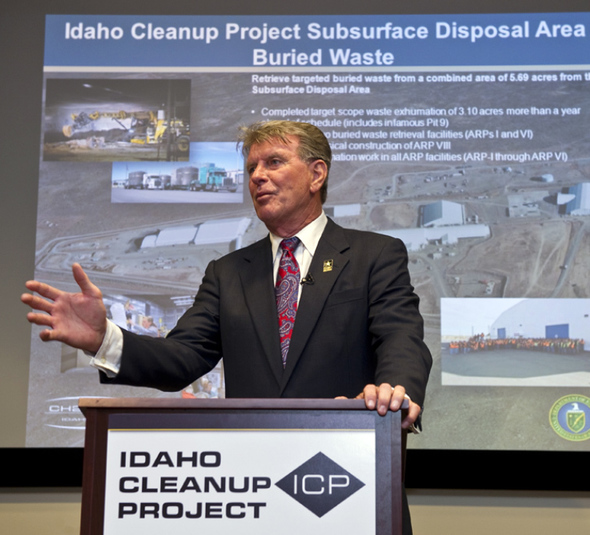
Idaho Governor C.L. “Butch” Otter discusses the importance of completing the cleanup mission at the Idaho site.
EM and CWI worked to identify efficiencies across all environmental cleanup projects ranging from productivity improvements to implementation of innovative solutions and energy savings. The resulting cost savings of approximately $8 million will fund the restart of the buried waste exhumation project. In this project, workers retrieve radioactive and hazardous waste from a decades-old Cold War landfill. The project was suspended last year due to budgetary challenges.
Since 2005, crews had been digging up plutonium and uranium-contaminated filters, plutonium-contaminated sludges, organic solvent sludges and oxidized, or depleted, uranium from the 97-acre landfill and shipping the waste for permanent disposal to the Waste Isolation Pilot Plant in New Mexico. The waste was generated during nuclear weapons production at the Rocky Flats Plant near Denver and was buried from 1954 to 1970.
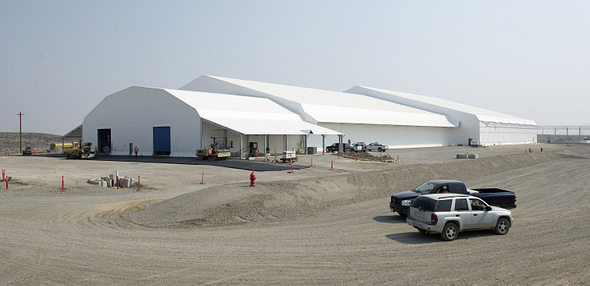
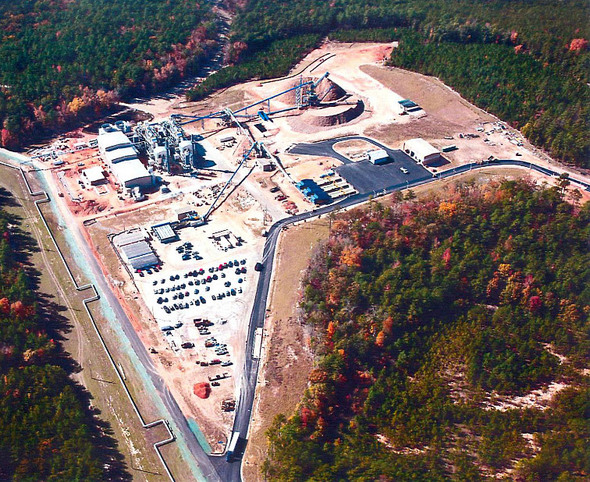
An exterior view of the recently constructed Accelerated Retrieval Project-VIII facility.
To date, 3.11 acres of targeted waste has been exhumed of the 5.69 acres required under a 2008 Record of Decision with the DOE, state of Idaho, and U.S. Environmental Protection Agency. The buried waste exhumation project had been as much as one year ahead of schedule before stoppage last year.
“I appreciate the DOE’s cooperation and the cleanup contractor’s diligence in completing these milestones on time and under budget,” Otter said. “While we still have some outstanding cleanup issues, this process demonstrates that our relationship with the Department of Energy is improving and we can be more confident that — with continued vigilance — promises will be kept and our concerns will be addressed.”
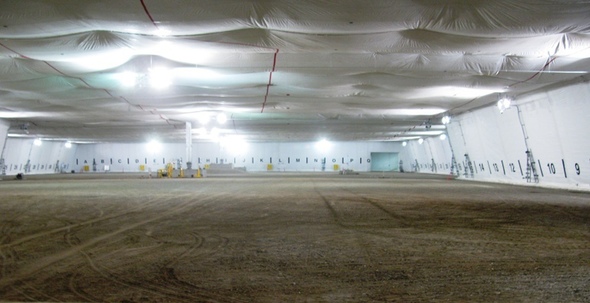
The Accelerated Retrieval Project-VIII building spans a 1.72-acre footprint. More than 2 million pounds of structural steel went into building. The eastern and largest portion of the structure is 250 feet long by 290 feet wide and 70 feet tall. The one-of-a-kind design consists of a center column-supported space frame connecting each side of the facility’s roof trusses.
CWI will hire approximately 65 members of the Steel Workers Union to complete this work scope. The overall buried waste project will cost approximately $1.3 billion and is expected to continue until the next decade.
“The success of the cleanup project is truly a team effort. The resumption of buried waste retrievals is a direct result of the Department of Energy, our cleanup contractor, CWI, and the state working together to identify funding and setting in place plans to restart the ARP (Accelerated Retrieval Project) work this year,” said Jim Cooper, deputy manager of EM for the Idaho Operations Office. “We greatly appreciate the support of the governor and we commend him for his continued support of the Idaho Cleanup Project and the Idaho National Laboratory.”
Former Assistant Secretary Shares Experiences Leading EM: ‘Best Job I Ever Had’
WASHINGTON, D.C. – In an occasional EM Update series, we feature interviews with former EM Assistant Secretaries to reflect on their achievements and challenges in the world’s largest nuclear cleanup and to discuss endeavors in life after EM.
Thomas P. Grumbly has more than 30 years of experience serving as a federal employee and government contractor. In 1993, he began serving as EM’s Assistant Secretary and went on to become the Under Secretary of Energy. Later, he joined Lockheed Martin’s Washington Operations.
Thomas P. Grumbly considers his role as EM Assistant Secretary the best job he ever had. He served in the position from 1993 to 1996.
What are you doing currently for your professional work?
I serve as the vice president for civil government programs at Lockheed Martin’s Washington Operations. In this position, I am responsible for maintaining all of the outreach to Congress and Executive Branch senior levels for all of the agencies that we do business with other than the Department of Defense and the intelligence world.
Where do you live?
I live in Vienna, Va.
How do you view your term as the EM Assistant Secretary?
The best job I ever had! I was fortunate to come in after EM had been fully formed at the beginning of the Clinton administration. It was a very exciting time to try to take an organization that had been put together and to start making it really work and work on all cylinders. It was a very exciting opportunity that also gave me access to the Secretary, White House and Congress. I found it very stimulating and rewarding, but difficult.
How has your experience as the EM Assistant Secretary helped you in subsequent endeavors?
I went on to become the Under Secretary, so it helped me climb the ladder. It also helped me establish my reputation, which I hope still continues as someone who can work pretty much with anyone and who is respected for being able to translate technical issues into things that ordinary people can understand. That has helped me a lot in my endeavors. It’s not a flashy job though. You don’t get invited to many fancy cocktail parties. It’s not for anyone who wants to be a show horse. It’s a job for someone who wants to be a work horse.
Did you take any interesting trips while you were EM Assistant Secretary?
The first time you go to the Hanford site and you see the initial reactor that Enrico Fermi put together, that is awfully impressive and it kind of gives you the chills because that was the beginning of the nuclear age. When you see all of the reactors stretched along the banks of the Columbia River in Washington state for the first time, and just recognize the enormity of the efforts that the U.S. undertook during World War II, you just can’t help but be impressed by the magnitude of the endeavor and the amount of work that these tens of thousands of people did in a very short period of time when they thought the state of the country was at stake.
Do you have any personal accomplishments that you would like to talk about?
I am very proud of the fact that I won, after I left office, the Secretary of State Distinguished Honor Award for the work that I did in returning nuclear material to the U.S.
“It was striking to see the tremendous progress that has been made in the cleanup. The changes at the site and in the local communities are undeniable and impressive,” Secretary Moniz said. “While there is much more to be accomplished, there is clearly a dedicated federal and contractor workforce, engaged community partners, and committed elected officials that are focused on the mission.”
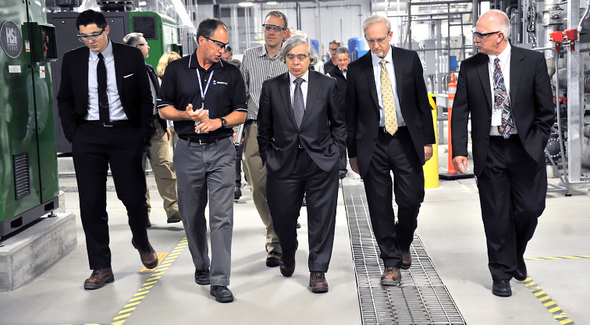
Energy Secretary Ernest Moniz tours the 200 West Pump and Treat System, which treats chemical and radionuclide contamination in Hanford’s groundwater. Pictured, left to right, are Special Assistant to the Secretary Mark Appleton, Bob Popielarczyk of CH2M HILL Plateau Remediation Company, Special Assistant to the Secretary T.J. Augustine, Secretary Ernest Moniz, EM Senior Advisor Dave Huizenga and DOE Richland Operations Office Deputy Manager Doug Shoop.
Secretary Moniz met with leaders from the Confederated Tribes and Bands of the Yakama Nation, the Confederated Tribes of the Umatilla Indian Reservation, the Nez Perce Tribe and the Wanapum people. These groups have strong cultural ties to the area, and several of them have treaty rights at the site. Tribal leaders have provided guidance to the Department on Hanford’s cleanup mission for decades, including the importance of protecting natural, biological, and cultural resources they have used throughout the Pacific Northwest for generations.
Click here to view photos of the Secretary’s visit.
Since beginning operations in 1996, workers supporting the Richland Operations Office have disposed of 15 million tons of contaminated material in the facility, a volume of soil and debris that would fill Seattle’s Safeco Field ballpark to its roof about 4 times over.
ERDF is operated by EM-funded contractor, Washington Closure Hanford, as part of the River Corridor Closure Project, DOE’s largest environmental cleanup closure project. The landfill accepts contaminated soil, demolition debris and solid waste from cleanup across the 586-square-mile Hanford site in southeast Washington state.
Matt McCormick, manager of Richland Operations Office, said disposing of 15 million tons of waste reflects the tremendous amount of cleanup accomplished over the past 24 years at Hanford.
“ERDF is a critical part of the Hanford cleanup mission,” McCormick said. “It provides a safe and compliant location to dispose of a variety of waste material, allowing us to accomplish our highest priority goal of preventing contaminants from reaching the Columbia River.”
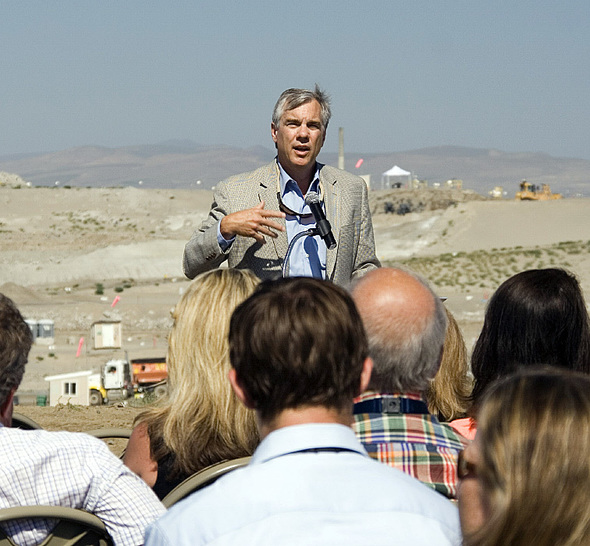
Matt McCormick, manager of the Richland Operations Office, commends a large group of Hanford workers for the 15-million-ton milestone at a public event at the Environmental Restoration Disposal Facility.
Hanford was established by the U.S. government in 1943 as part of the Manhattan Project. Its mission was to manufacture weapons-grade plutonium for America’s defense program during World War II and throughout the Cold War.
ERDF, located in central Hanford, is the largest disposal facility in the EM complex. It covers 107 acres at the base of the disposal trench — roughly the same area as 52 football fields — and has a capacity of 18 million tons. In addition to contaminated soil and building debris, ERDF accepts other hazardous materials such as mercury, asbestos, beryllium, chromium and lead that can be treated onsite before disposal.
The majority of waste material disposed at ERDF — about 13.5 million tons — was generated in a section on Hanford’s River Corridor, a 220-square-mile stretch of land that runs along the Columbia River. The River Corridor was home to Hanford’s nine plutonium production reactors, fuel development facilities and hundreds of support structures.
McCormick and Washington Closure President Carol Johnson praised a large group of Hanford workers.
“We have an exceptional workforce committed to safely and efficiently handling and disposing a variety of waste material,” Johnson said. “Everybody involved in the cleanup process, whether they are working to decontaminate and demolish buildings, dig up waste sites and burial grounds, or are involved in the disposal process, has contributed to this remarkable achievement.”
Dennis Faulk, Hanford’s program manager for the U.S. Environmental Protection Agency, said, “Without ERDF, Hanford cleanup would look nothing like it does today.”
ERDF is made up of disposal areas called cells, most of which were constructed two at a time. Each pair of cells is 70 feet deep, 500 feet wide and 1,000 feet long at the base — large enough to hold about three million tons of material. As each pair of cells reaches capacity, an interim cover is installed to prevent the infiltration of water. A permanent cap will be placed over the facility when Hanford cleanup is completed.
In February 2011, EM and Washington Closure completed the fourth and largest expansion of the facility since it opened. The $100 million project, supported with funding provided by the American Recovery and Reinvestment Act, increased the facility’s capacity by 50 percent. Recovery Act dollars also were used to construct three maintenance buildings and an operations center, and for new equipment to support disposal operations.
ERDF was designed to be expanded as needed. McCormick said the facility most likely will undergo its next expansion in 2018 and 2019.
CARLSBAD, N.M. – The Waste Isolation Pilot Plant’s (WIPP) two mine rescue teams recently led the field of 13 groups competing in the Southwest Regional Mine Rescue Contest.
The challenge was one of many Mine Safety and Health Administration-sponsored regional and national events in which these professionals compete and train to hone their skills.
“Our two teams did an outstanding job,” said EM Carlsbad Field Office (CBFO) Manager Joe Franco. “Mine safety is critical to our mission and I appreciate their skill and dedication to providing extremely well-trained emergency response for our workers, facility, community and entire industry.” CBFO has responsibility for WIPP and the National Transuranic (TRU) Program.
The volunteer team members are employees of Nuclear Waste Partnership (NWP), the WIPP management and operating contractor. They work at WIPP, America’s only operating deep-geologic repository for the permanent disposal of radioactive waste nearly one-half mile underground.
At the May 2013 competition in Taos, N.M., WIPP’s Blue and Red teams took first and second place overall, respectively, and placed first in every category. The Blue Team took first place in the field trial and third place in the first aid contest, while members of the Red Team won the first aid and team technician competitions. The WIPP team trainer placed first in the trainer contest.
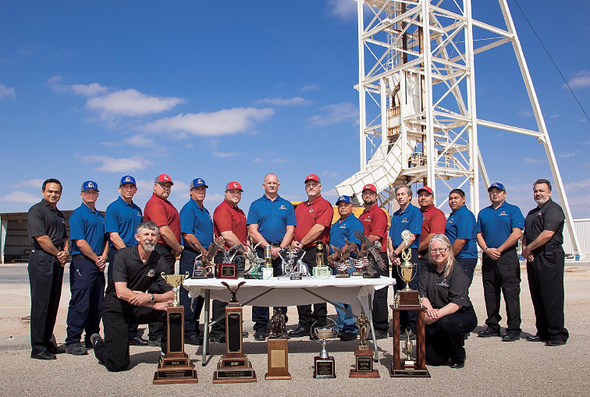
WIPP’s mine rescue team members, back row from left, are NWP President and Project Manager Farok Sharif; Heath Fowler; Manny Marquez; Mat Ridgway; Gary Kessler; Curtis Sanders, III; Jim Pierce; Tony Mihelic; Joe Baca; Justin Bailey; Ty Zimmerly; Fabian Carrasco; Chauncey Ortega; Nico Dominguez; and CBFO Manager Joe Franco. In front are Richard West, team trainer; and Ann Strait, of NWP emergency management. Not pictured is Doug Pitzer, a Red Team member.
The field competition obstacle course simulates conditions rescuers would encounter in an underground disaster, such as gases, fires and mine instability. Teams were evaluated as they moved through the course to locate, treat and move staged victims to the surface. The role of the benchman was to troubleshoot breathing apparatuses and stage fresh air stations — critical to survival and rescue in contaminated air. The competition also included technical and written tests.
The competitions are designed to sharpen skills and test the knowledge of miners who may respond to real mine emergencies. Coal mine disasters in the early 1900s led to the creation of mine-safety railcars, and later, rescue trucks outfitted with first aid equipment for emergency dispatch to mine fires or explosions. The difference between life and death for trapped miners was often the heroic efforts of fellow miners. Today, highly skilled mine rescue teams, such as WIPP’s experts, stand ready to render aid in an underground emergency.
Members of WIPP’s mine rescue teams pose by recently won trophies from the 2013 Southwest Regional Mine Rescue Competition. Shown with the team members is CBFO Mine Operations Project Manager Don Galbraith, second from right, who represented CBFO at the competition.
The WIPP teams routinely train for effective response should an underground emergency occur at WIPP. The training qualifies them to assist other metal and non-metal mines around the country. CBFO maintains mutual aid agreements with two local potash mines in New Mexico and a marble mine near Van Horn, Texas to provide emergency backup. In years past, WIPP’s teams assisted in the recovery of a man who had fallen into an abandoned mine shaft in central New Mexico, conducted mine rescue training in Arizona and helped design and judge mine rescue contests in Mexico.
Through the years, the WIPP teams have earned recognition for their skills. Two WIPP mine rescue team members have been inducted into the National Mine Rescue Hall of Fame and a third team member was recently nominated for significant contributions to mine safety.
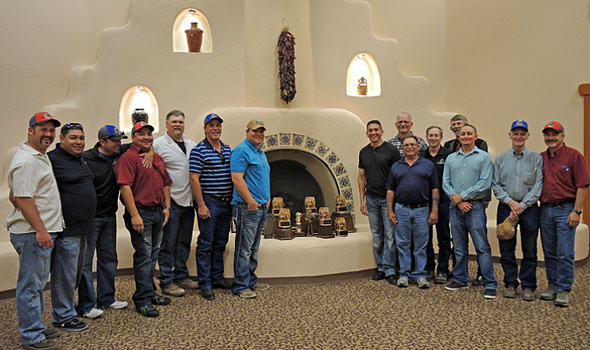
Trophies won by the WIPP mine rescue teams at the 2013 Southwest Regional Mine Rescue Competition in Taos, N.M.
Last month, the Red Team competed in the 2013 Southeast Regional Mine Rescue Contest in Maysville, Ky. Earlier this year, they competed in the Nevada Mine Rescue Contest in Winnemucca, Nev., and the Blue Team participated in the Southern Regional Mine Rescue Contest in New Iberia, La. The Blue Team will travel to Rolla, Mo. in September for the Missouri Mine Rescue Contest. From July 30 to Aug. 1, both WIPP teams will take on the nation’s best teams at the National Mine Rescue Competition in Reno, Nev.
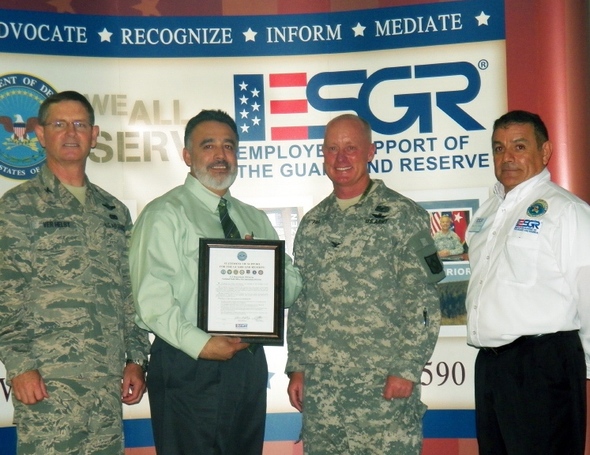
EM Carlsbad Field Office (CBFO) Manager Joe Franco receives the Employer Support of the Guard and Reserve (ESGR) Seven Seals Award in June at a ESGR recognition event in Carlsbad, N.M. From left: Assistant Adjutant General for Air and Commander of the New Mexico Air National Guard Colonel Steven J. VerHelst; Franco; New Mexico Army National Guard Chief of Staff Colonel Timothy Paul; and Eddy County, N.M., ESGR Chairman Tony Renteria. The National ESGR seeks to develop and promote a culture in which all American employers support and value the military service of their employees. The Seven Seals Award, which recognizes those who significantly advance the ESGR mission, was presented to Franco for his support of the Guard and Reserve. “As a veteran and a former member of the U.S. Navy, I recognize the nation’s need for — and the important support provided by — the Guard and Reserve,” Franco said.
The scorecards serve as an important benchmark to see where DOE has been successful in achieving sustainability goals, reducing emissions, cutting costs and identifying opportunities for improvement. They also help the Department track the best opportunities to lead by example in clean energy and hold DOE accountable for meeting annual energy, water, pollution and waste reduction targets.
In the past year, DOE achieved a number of important successes in its efforts to promote clean energy and reduce waste and greenhouse gas emissions. EM was highlighted for some of the largest contributions, including the biomass cogeneration facility at Savannah River Site. The project will produce up to 20 megawatts of clean energy, avoid more than 100,000 tons of greenhouse gas emissions each year (equivalent to emissions from 20,800 cars) and save $35 million in energy and operations and maintenance costs annually. The new facility is a major contributor to the Department's achievement of its energy intensity and renewable energy goals.
The highly-efficient, biomass-fired cogeneration facility at the Savannah River Site replaced a 1950s-era coal-fired plant and will result in significantly reduced pollutant emissions, including a reduction of 100,000 metric tons per year of carbon dioxide emissions.
Although EM's petroleum use climbed, due to an increased level of activity in recent years, DOE’s overall use dropped by 8 percent in fiscal year 2012 relative to the fiscal year 2005 baseline and represents a 3 percent improvement from fiscal year 2011. While this progress did not allow DOE to meet the target, the reduction is significant considering DOE's often energy intensive mission activities, such as EM’s waste vitrification at the Savannah River Site in South Carolina. As these activities wind down, EM and the Department as a whole should see a marked reduction in petroleum use.
There is progress in many areas as well as the need for improvements. EM will make significant progress in decommissioning and demolishing inefficient, excess facilities and strive to make its enduring building stock more energy efficient and sustainable.
Based on benchmarks in the fiscal year 2012 scorecard, EM and DOE will update their annual Sustainability Performance Plans to continue building on accomplishments and find additional ways to exceed clean energy goals.