Oak Ridge Finishes Largest Site Demolition to Date
OAK RIDGE, Tenn. – This month, the Oak Ridge Environmental Management (EM) program finished the final phase of the Building K-33 demolition project.
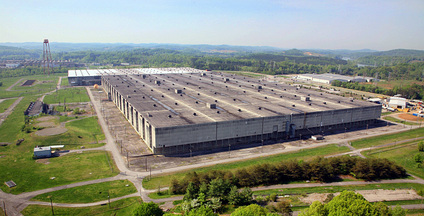
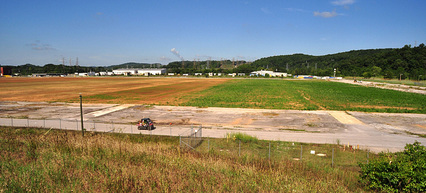
Workers with LATA-Sharp Remediation Services, the prime contractor for the project, removed areas of contaminated soil, backfilled the area with topsoil and seeded the land with grass. In April, they removed a 32-acre concrete slab that served as the foundation for the former 1.4 million-square-foot former gaseous diffusion plant in the East Tennessee Technology Park (ETTP). Constructed in 1954, the K-33 facility enriched uranium until 1985.
BEFORE: An aerial photo shows Building K-33 before demolition.
AFTER: This photo shows the site of Building K-33 following completion of the demolition project.
The facility's demolition is the latest effort to convert ETTP into a private industrial park. To date, Oak Ridge’s EM program has eliminated significant legacy wastes and almost 250 hazardous or unneeded facilities at ETTP.
“The completion of this project brings us considerably closer to our goal of transitioning the East Tennessee Technology Park into a private industrial park,” Environmental Management Oak Ridge Site Office Acting Manager Sue Cange said.
A majority of the building’s decontamination and decommissioning was performed in 1997, but the latest project removed siding, demolished the building, removed the slab and packaged and transported all associated debris to Oak Ridge’s Environmental Management Waste Management Facility (EMWMF).
K-33’s demolition was finished five months ahead of schedule in April 2011, and debris removal was completed in September, three months ahead of schedule. During the nine-month project, 164,000 tons of steel and concrete were transported in 13,000 shipments to the EMWMF for disposal. The slab removal resulted in more than 3,600 shipments of concrete totaling 61,300 tons and 125 cubic yards of disposed contaminated soil.
EM Wins Awards for Taking Big Steps to Reduce DOE’s Electronics Footprint
WASHINGTON, D.C. – EM is talking big steps to reduce its electronics footprint with exceptional results. EM sites won the majority of awards given to DOE for their outstanding performance in the 2012 Federal Electronics Challenge (FEC). This Environmental Protection Agency initiative encourages federal facilities to buy greener electronics, lessen their impact during use and discard outdated equipment in an environmentally safe way.
EM’s accomplishments in sustainable electronics have made DOE a leader among federal agencies in sustainable electronics. If EM was a freestanding agency, it would rank second in total number of FEC awards received within the entire federal government. EM big winners include:
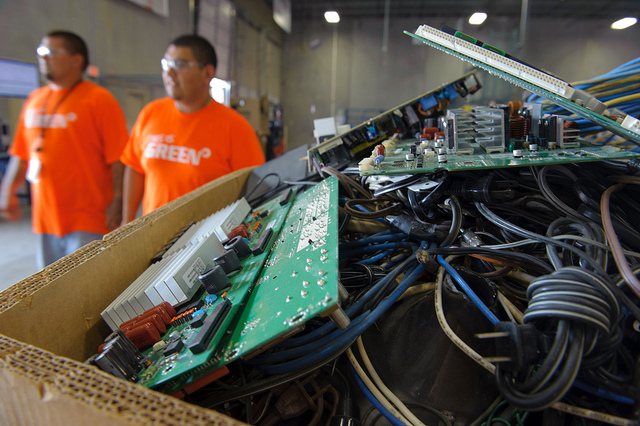
Every year, Americans generate almost 2.5 million tons of used electronics, which are made from valuable resources such as precious metals and rare earth materials, as well as plastic and glass. Photo: U.S Environmental Protection Agency
Sometimes doing little things can make big difference. In order to win the FEC awards, sites made sure electronics were recycled properly, implemented energy-saving policies for computers and used electronic systems to track waste shipments and reduce paper usage. Furthermore, lessening the Department’s electronics footprint can save taxpayers money by reducing power consumption and pollution.
EM to Proceed with Demolition Following Completion of Cascade Cleanout Operations
PIKETON, Ohio – EM and Ohio Environmental Protection Agency are reviewing decontamination and decommission (D&D) approaches for three buildings that housed the equipment for uranium enrichment that was shut down this spring after operating for 57 years.
Decisions on D&D of the facilities could be made within the next year, following a public comment period. Workers have completed pre-D&D work in one of the buildings that included moving about 50 converters to a staging area in preparation for the eventual D&D of the processing equipment, and ultimately, the building itself. In all, more than 400 buildings and systems are expected to be part of the D&D project.
The buildings, called the X-326, X-330 and X-333 process buildings, housed the uranium enrichment cascade, which took up nearly 100 acres of space. The last of the equipment that had been operating as part of the cascade was powered off May 30, 2012.
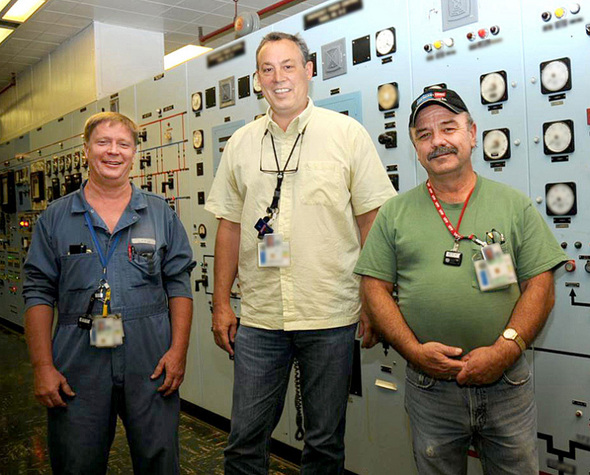
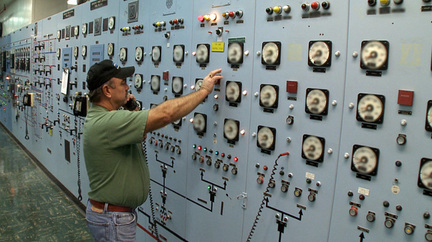
X-326 Facility Manager Jack Tully, left to right, DOE Site Lead Joel Bradburne and Operator Russ Nickell stand in the local control room after the last processing equipment that had been operating in the uranium enrichment cascade at the Portsmouth site in Piketon was shut down.
“This cascade and all of its supportive systems are a tremendous legacy of the engineering prowess and ingenuity of our communities and our nation,” DOE Site Lead Joel Bradburne said at the time of the shutdown. “More than half of a century of successes and achievements will never be duplicated.”
The cascade at the former gaseous diffusion plant at the Portsmouth site was a network of converters that processed a supply of uranium hexafluoride (UF6). The uranium was enriched at the atomic level to make it useable fuel for nuclear reactors. The converters were machines connected by an elaborate path of piping through which the UF6 was fed in a heated gaseous state. Converters and related equipment were arranged in groups called cells.
Preparations for the shutdown began in January after completion of a cleanup and treatment program for the equipment. The last cell was one of the high-speed cells used to separate uranium from the lighter gasses.
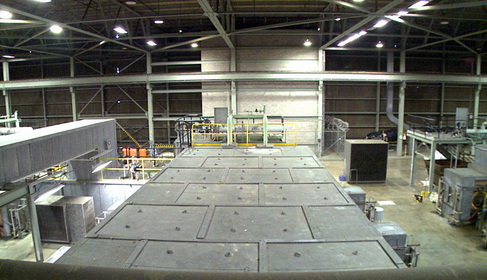
The last equipment that had been operating in the uranium enrichment cascade at the Portsmouth site in Piketon was powered off May 30 after more than 57 years of operation. Pictured here is the facility where that equipment is located.
The enriched uranium was originally used by the Department of Defense. Later operations produced fuel for the U.S. Navy and civilian power plants. The first cells of the cascade were brought online in 1954.
Over the cascade’s lifetime, more than 1 billion pounds of uranium were processed, filling nearly 40,000, 14-ton cylinders.
The cascade was placed in cold standby status in 2001 in the wake of newer technologies and changes in market demand for enriched uranium. The plant was placed in cold shutdown in 2005 as DOE began planning decontamination, decommissioning and site cleanup. Fluor-B&W Portsmouth assumed cleanup contractor duties in March 2011.
Facility Shift Supervisor John Hutchison said the shutdown was significant to the employees, many of whom had worked together for more than a decade.
The switch to the last operating cell at the uranium enrichment facility was manned by Operator Russ Nickell during the shutdown at midday May 30, 2012 in the X-326 Process Building at the Portsmouth site in Piketon.
“There are a lot of mixed emotions among the operators. They’re sad to see the X-326 being shut down,” Hutchison said at the time of the shutdown. “There’s a lot of activity to support operations.”
When it was time to shut the cell down, Operator Russ Nickell verified personnel were in place on the cell floor and in the local control center. Watching the instrument panel, a small crowd waited for needles on the gauges to reach zero before Nickell pushed the “Motor Stop” button and the motors on the cell floor came to a halt.
“That’s it. Lights are out. We’re done,” Nickell said.
Carlsbad Field Office Technical Assistance Contractor Shares In Top Honor
CARLSBAD, N.M. – The Carlsbad Field Office Technical Assistance Contractor’s (CTAC) parent company, Portage, Inc., and its 400 employees nationwide recently achieved a significant milestone by exceeding one million hours worked over 560 days without a lost-time injury or illness.
CTAC is a small group responsible for technical and quality assurance resources for the DOE Carlsbad Field Office (CBFO), which provides oversight for the Waste Isolation Pilot Plant (WIPP) and the National Transuranic (TRU) Program. In 2010, DOE awarded Portage a three-year contract with two, one-year options. WIPP and its operations are not new to Portage. The company previously held the technical assistance contract in Carlsbad from 2000 to 2005.
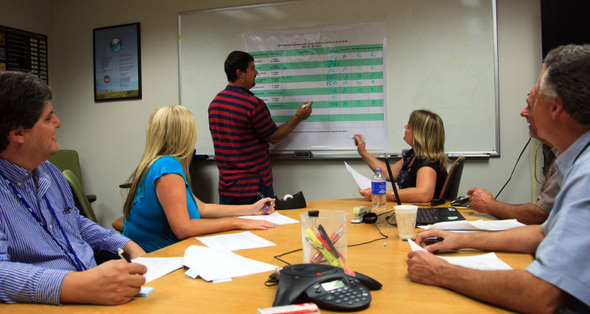
Members of the Carlsbad Technical Assistance Contractor discuss audit criteria for quality assurance implementation.
Joe Harvill has 28 years experience with WIPP and became the CTAC program manager in spring 2012. “Though I have been with Portage and CTAC for only four months, I’ve been impressed with Portage’s dedication to employee health and safety,” said Harvill.
CTAC’s workforce totals 25 people. They perform a variety of technical services that include quality assurance for TRU waste certification, assistance to the National TRU Program, support to the international repository science program, and comprehensive audits to assure project compliance to environmental and safety requirements.
Portage, which provides engineering and environmental remediation services, is based in Idaho Falls, Idaho, with satellite offices across the nation, including Carlsbad.
DOE Headquarters Review Focuses on Improved LATA Kentucky Worker Safety
PADUCAH, Ky. – DOE Office of Health, Safety and Security headquarters representatives recently spent three days at the Paducah site helping EM cleanup contractor LATA Kentucky better identify and correct issues before they result in worker illness or injury.
“It supports our mutual bottom line of ensuring that workers go home in the same condition they arrive in that day,” said Kevin Dressman, director of the Office of Worker Safety and Health Enforcement, a branch of the Office of Enforcement and Oversight. “LATA Kentucky saw the benefits of building relationships with our office and increasing our awareness of the programs the company has in place.”
Dressman and two other team members visited Paducah in mid-June for a DOE headquarters regulatory assistance review providing LATA Kentucky feedback on identifying, evaluating, tracking, reporting and correcting noncompliances with DOE worker safety and health regulations. The first morning was set aside for training, and the rest of the review largely involved interviews and discussions — individually and in small groups — with people involved in the process.
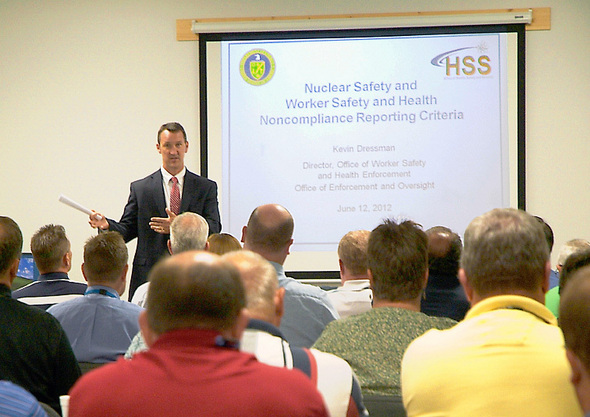
Kevin Dressman, director of the DOE Office of Worker Safety and Health Enforcement, addresses LATA Kentucky employees during a training session. The June regulatory assistance review was aimed at ensuring worker safety.
“We’re here at LATA Kentucky’s request; this is not an enforcement investigation,” Dressman said at the start of the visit. “We offer this service to all DOE contractors who are interested in getting this kind of feedback.”
The informal, proactive exchange with LATA Kentucky managers and safety and health professionals led to a summary briefing following the review describing positive observations and potential areas for improvements.
Over the previous 12 months, LATA Kentucky invested significant resources improving internal processes and oversight activities. Dressman’s team provided the unique opportunity of an objective review and feedback regarding those improvements and their implementation, said Michelle Dudley, LATA Kentucky quality manager.
“The positive feedback from the assist team during the out brief supported LATA Kentucky's internal judgment that the improvements were appropriate and served to increase rigor in the programs overall,” Dudley said. “The assist team also provided valuable input to strengthen areas within the current programs based on lessons learned from other sites.”
LATA Kentucky is reviewing the shared insight for incorporation into existing programs as future process improvements, Dudley said.
Safety is a core value of LATA Kentucky and not just a priority, said Eddie Magness, manager of Environment, Safety, and Health.
“We are proud of the fact we have achieved 1.5 million safe work hours without a lost-time injury and more than 900,000 hours without a recordable injury. Our workers are going home safe,” Magness said.
LATA Kentucky is a learning organization committed to continuous improvement, Magness said. Partnering with the Office of Enforcement and Oversight in a regulatory assistance review is an opportunity to confirm that the company’s safety processes conform to established requirements and sound management practices.
“Our workforce and our project will benefit from this interaction and the collective experience of the team,” Magness said.
Dressman said his office typically does three or four regulatory assistance reviews each year. The most recent at Paducah was for the classified information programs for DOE infrastructure contractor Swift & Staley in May 2011.
Team member Valerie Steele is a former Paducahan who attended Paducah Tilghman High School and Murray State University in Kentucky. David Zwolak is team lead.
DOE Hosts Festival to Collect Items for Food Banks
WASHINGTON, D.C. – Deputy Secretary of Energy Daniel Poneman and a representative of the Capital Area Food Bank are among the guest speakers at an event this Tuesday, July 31, to collect food items for the DOE Feeds Families drive.
The DOE Feeds Families Fest and Hunger Awareness Event are from 11 a.m. to 2 p.m. at the Forrestal West Plaza in Washington, D.C. The fest features an outdoor barbecue, live music and dunk tank. Participants who bring at least five nonperishable food items pay a discounted price for the barbeque meal and drink and receive a free turn at the dunk tank. Educational materials on hunger in the local area also will be on hand.
In addition to Poneman, who chairs DOE Feeds Families, the other speakers are Capital Area Food Bank Food Resources Coordinator Molly McGlinchy and Feds Feed Families Campaign Program Manager Duane Williams.
For more information on Tuesday’s event contact Steve Domotor at stephen.domotor@hq.doe.gov or Hans Yee at han.yee@hq.doe.gov.
The DOE Feeds Families Fest and Hunger Awareness Event are from 11 a.m. to 2 p.m. at the Forrestal West Plaza in Washington, D.C.
Organizers are midway through their campaign to stock area food banks. The campaign runs June through August.
The campaign hopes to alleviate the severe shortage food banks in the Washington, D.C. region and U.S. face during the summer months. DOE hopes to collect at least 230,000 pounds of food this summer. So far, EM employees at headquarters and field sites have collected more than 11,300 pounds of food.
Designated collection boxes for nonperishable goods are located throughout federal workplaces. Most-needed items include canned fruits and vegetables, multigrain cereals, grains, soups, 100 percent juice drinks, condiments, snacks and baking goods.
Additional information on this year’s campaign is available here.