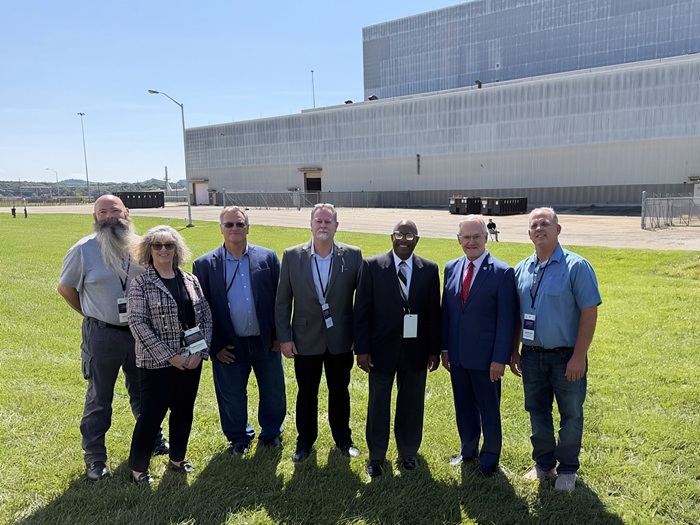
 Southern Ohio Diversification Initiative (SODI) staff and board members participate in a celebration at the Centrus facility, shown in background, on the Portsmouth Site. Centrus recently announced an expansion to support uranium enrichment. From left, SODI Board Member Tom Woltz, Administrative Assistant Donna Carson, Board Chair Herman Potter, Board Member Ryan Clemmons, Board Member Carlton Cave, Ohio Lt. Gov. Jim Trussel and Board Member Jody Crabtree.
PIKETON, Ohio — The U.S. Department of Energy’s (DOE) community reuse organization at the Portsmouth Site is seeing decades of efforts to redevelop the former gaseous diffusion plant pay off.
Over 350 acres have been transferred to the Southern Ohio Diversification Initiative (SODI) from the Portsmouth Site, almost 10% of the original site footprint. Companies are making plans to unleash American energy, support national security and enable U.S. innovation and jobs.
Central to reuse of the site’s land is an American Energy Hub taking shape with a $33 billion investment that has changed the region’s trajectory. Earlier this year, SoftBank and AEP Ohio announced a unique public-private partnership to redevelop DOE land, modernize energy infrastructure and develop advanced computing in southern Ohio.
“The location of the Portsmouth Site was originally chosen for its secluded, rural nature and proximity to resources and infrastructure needed for industry,” Portsmouth Paducah Project Office Strategic Planner Greg Simonton said. “These same features are an asset in reindustrialization as the site still contains infrastructure beneficial to industry. SODI has been key in recognizing and promoting the site to industry partners and creating interest in reindustrialization.”
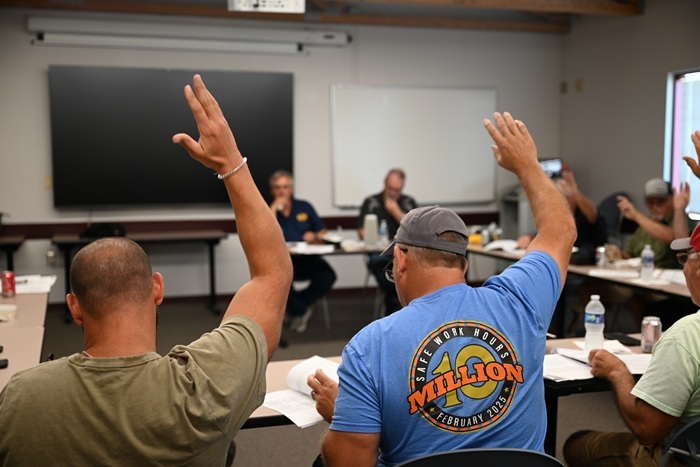 Southern Ohio Diversification Initiative board members vote at a recent board meeting. They meet monthly to discuss potential projects.
As a nonprofit maintained by a staff of only three, SODI has served as an important voice since forming in 1998. With assistance from Ohio University and its PORTSFuture program, the organization was able to plan and recruit future industry based on community feedback.
“We have known since the site ended uranium enrichment that the desire of the community is for the site to be cleaned up and made available for new industry,” SODI Legal Counsel Kevin Shoemaker said. “There were years of reaching out to developers to tell them about the benefits of building at the Portsmouth Site both for its valuable infrastructure and its capable workforce before it all started to come together. Now people are reaching out to us because the value of the site is well known.”
SODI keeps the community front of mind. Its board comprises 15 local leaders who meet monthly to discuss community needs and potential projects.
“SODI has already invested millions in the counties surrounding the Portsmouth Site,” SODI Executive Director Steve Shepherd said. “We have developed industrial parks, a GIS system, workforce training programs, a business incubator, and an entrepreneur loan fund to improve the quality of life for Jackson, Pike, Ross and Scioto counties through economic diversification, development of underutilized land and facilities on the Portsmouth Site, and continued support of local industry.”
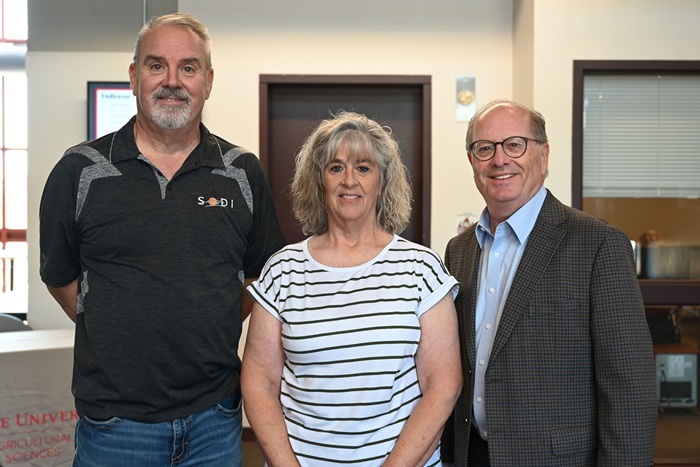 Southern Ohio Diversification Initiative has a staff of three members. From left, Executive Director Steve Shepherd, Administrative Assistant Donna Carson and In-House Counsel Kevin Shoemaker.
Funding for SODI projects becomes available in two ways:
- Asset recovery, in which excess material from the site is reviewed for use by other departments and DOE sites. If not needed, the material goes to SODI to donate to the local community, resell or recycle.
- Building and property transfers from federal ownership. After evaluation and board approval, land is sold to industry to reindustrialize the Portsmouth Site.
“With the help of SODI, the Portsmouth Site is transforming to create space for a new American Energy Hub, new jobs for generations to come and economic vitality in the local community,” Simonton said.
-Contributor: Melissa Green
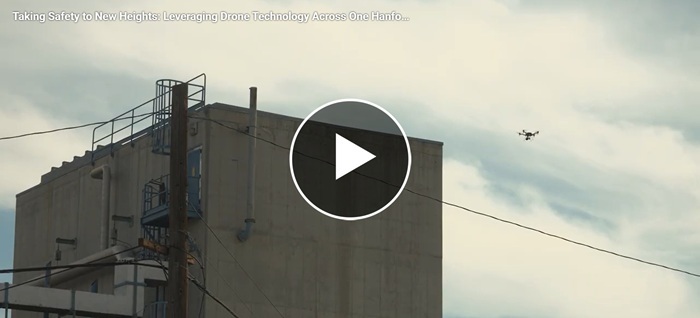 EMTV: Watch a video of the Hanford Site drone collaboration.
RICHLAND, Wash. — The Hanford Site’s complex operational landscape requires continuous innovation to ensure safe, compliant and efficient management of aging nuclear facilities.
A recent drone roof inspection highlights the growing role of remote technology and the importance of proactive cross-contractor integration in advancing the One Hanford mission.
Initiated by Hanford Tank Waste Operations & Closure (H2C), it was the contractor’s first time using a drone as part of its facility condition inspection.
“Using drones gives Hanford a safer, smarter way to inspect aging facilities while reducing risk to workers,” said Vanessa Turner, assistant manager for mission support at the Hanford Field Office. “It replaces conventional manned inspections that historically exposed personnel to fall hazards. This approach supports the U.S. Department of Energy’s (DOE) mission by helping teams make faster, better decisions that protect people.”
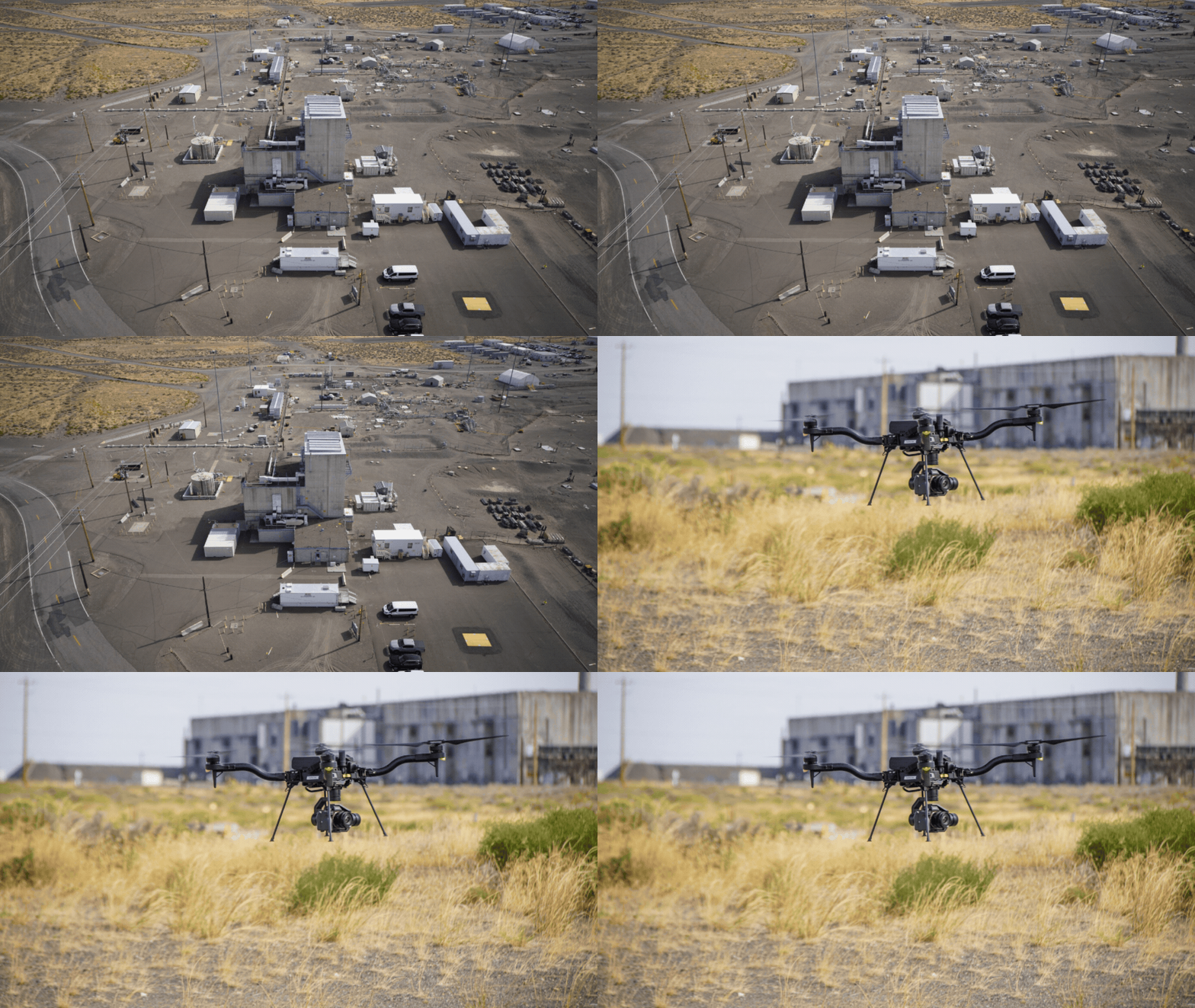 A drone captures images of the Hanford Site’s inactive 242-S Evaporator during a roof inspection.
H2C requested the inspection as part of a routine effort to check inactive facility conditions that don’t require a hands-on approach to fulfill maintenance requirements. Instead of deploying workers at elevated height to check the roofs of inactive facilities, H2C used the opportunity to work with Hanford Mission Integration Solutions (HMIS), which manages the site’s drone program, for the inspection.
H2C’s Engineering & Innovation team guided drone operators during the flight, ensuring that imagery captured roof surfaces, vents, stacks and potential leak pathways that could impact nuclear material protection. This collaborative effort reflects Hanford’s broader operational model, where contractors pool specialized expertise to solve complex technical challenges efficiently.
“It’s another way to use technology to improve processes and keep people safe,” said Rob Voeks, H2C Nuclear Maintenance Program manager. “Cross-contractor teamwork is essential because each contractor holds different pieces of scope and we want to continue to find ways to expand the use of drones at Hanford.”
 |
|
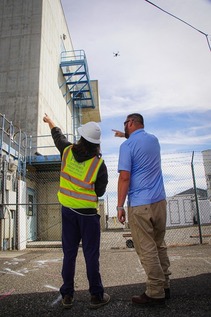
Matthew Williams, right, a Hanford Tank Waste Operations & Closure engineer, guides drone footage in real time with Danner Breault, a certified drone pilot with Altitude Agri Services, a Hanford Mission Integration Solutions subcontractor. |
Hanford’s drone program began in 2022 and is available for use by DOE and Hanford contractors.
In addition to taking photos and video, drones can help teams build detailed 3D images and maps.
HMIS routinely produces photogrammetric 3D models, often between 2,000 and 5,000 images, enabling precise dimensional measurements and structural assessments. Photogrammetry is the science and technology of capturing such 3D models from 2D photographs or digital imagery.
Additional capabilities include lidar mapping, which is used to characterize terrain and structural boundaries without requiring field personnel to enter unmonitored areas. Short for light detection and ranging, lidar is a sensing method that uses pulses of laser light to determine the presence, shape and distance of objects, often in great detail.
“We push safety — keeping people out of hazardous areas for as long as possible,” said John-Paul LeCompte, HMIS Aviation Program manager. “HMIS continually looks for areas where we can integrate this technology and assist contractors.”
-Contributor: Jamie St. Martin
Assistant Secretary for Environmental Management (EM) Tim Walsh will take part in a virtual meeting of the EM Site-Specific Advisory Board (SSAB) Chairs on Nov. 10, maintaining the U.S. Department of Energy's commitment to listen to and engage with communities around cleanup sites.
“Everything starts with the local community on up,” said Walsh, who will provide a program update at the meeting. “We want to work with and partner with the communities home to EM sites.”
Chairs and vice chairs from the eight local chapters of the EM SSAB will discuss cross-cutting topics, receive briefings from EM senior leadership and present their top high-priority topics.
A public comment period will be held during the meeting, set for 12:45 to 3:30 p.m. Eastern Time via Microsoft Teams.
Click here to register and for more information.
The chairs’ meetings occur twice a year — one in person and the other virtually. The previous meeting was held in April at the Hanford Site in Washington state. The April 2027 meeting is set to take place at the Savannah River Site in South Carolina.
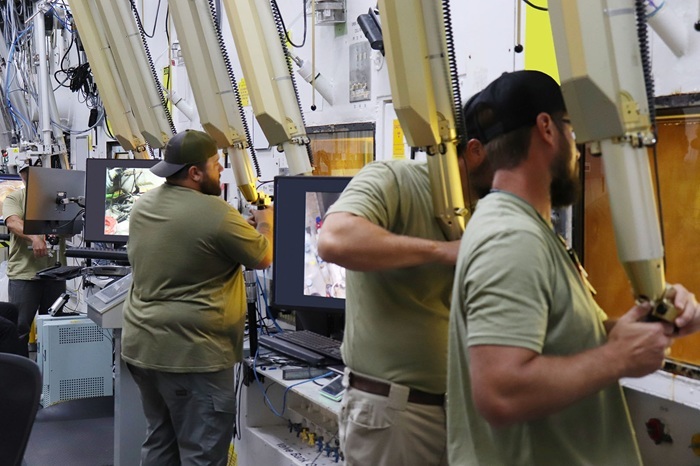 Workers process uranium-233 material in heavily shielded rooms called hot cells.
OAK RIDGE, Tenn. — The Oak Ridge Office of Environmental Management (OREM) processed 62 canisters of uranium-233 for safe transportation and disposal during the fiscal year that recently ended, surpassing its 50-canister goal as crews advance the highest priority cleanup project at Oak Ridge National Laboratory (ORNL).
“Despite the technical challenges that are part of processing this special nuclear material, the Isotek team consistently finds solutions, efficiencies and workarounds to be able to deliver significant progress annually on the overall mission,” said Sarah Schaefer, project manager for contractor Isotek.
Isotek is working to eliminate the nation’s inventory of uranium-233, which has remained in storage at ORNL for decades. The material was created in the 1950s and 1960s for potential use in nuclear reactors but proved unviable.
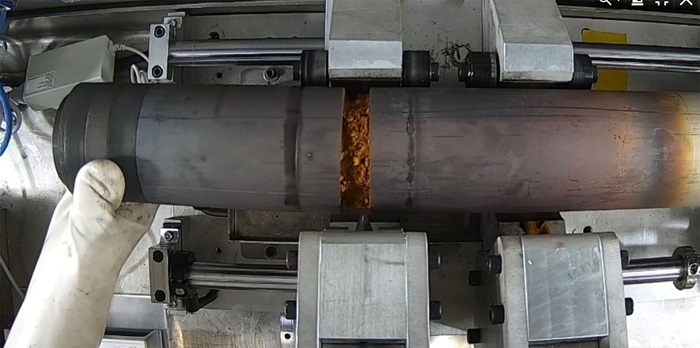 Crews segment a canister containing uranium-233 in a glovebox before transferring it for processing. A glovebox protects personnel from hazards.
As processing has progressed, it has presented more challenges. A portion of the remaining inventory exceeds limits allowed in the processing facility. Isotek designed an innovative solution to segment the canisters in the storage facility before moving them for processing, saving the project $175 million and preventing delays.
Additionally, some of the material is higher in transuranic activity — meaning it has radioactive isotopes heavier than uranium on the periodic table — requiring additional downblending before it can be shipped for disposal.
“We’ve adapted our approach to transuranic material by incorporating additional sampling and detailed technical reviews to better understand the waste stream, support processing decisions and maintain compliance with waste acceptance criteria,” Isotek Process Manager Shanna Veilleux said. “The goal is to make informed, defensible decisions without compromising safety or operational reliability.”
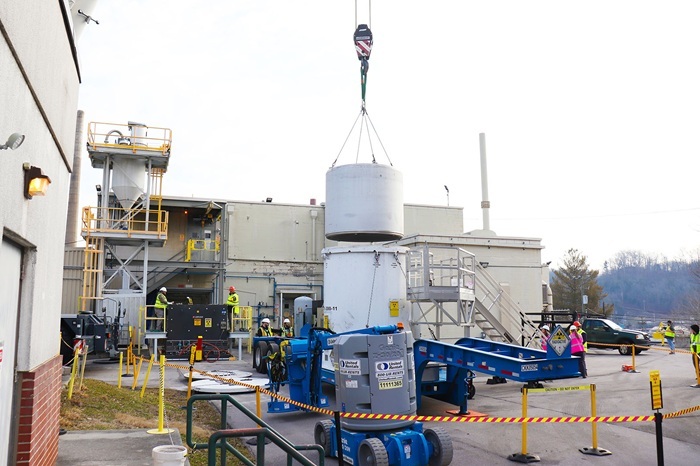 Crews move a tank of solidified, downblended uranium-233 into a shipping cask so it can be relocated for disposal.
To date, Isotek has processed and disposed of over 78% of the original uranium-233 inventory stored at ORNL. Workers have transported over 700,000 pounds of processed solidified waste for disposal.
Isotek is also extracting an extremely rare medical isotope, thorium-229, from the material. The isotope is being used to develop targeted cancer treatments currently in clinical trials. Crews have extracted over 24 grams of thorium-229, boosting the world’s supply by more than 2,000%.
OREM and Isotek recently installed a new analytical laboratory that will accelerate uranium-233 waste disposition and increase thorium-229 isotope deliveries.
-Contributor: John Gray
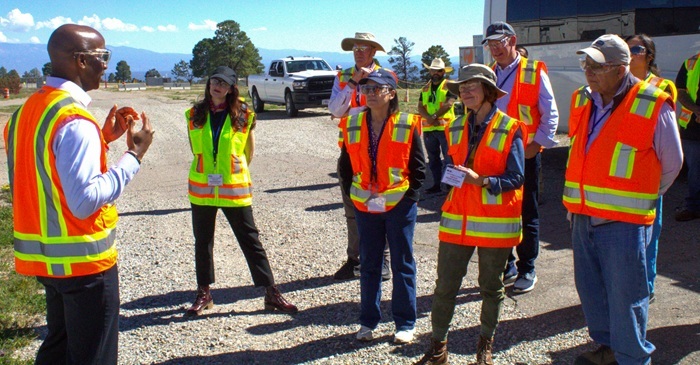 During Los Alamos County’s annual infrastructure and policies tour, Environmental Management Los Alamos Field Office (EM-LA) Acting Manager Stanley Pyram discusses EM-LA’s role in the legacy cleanup at Technical Area 21 (TA-21), a National Nuclear Security Administration site at Los Alamos National Laboratory. Pyram explains the detailed analysis required at TA-21 to safely address the remaining waste at the site.
LOS ALAMOS, N.M. — The U.S. Department of Energy’s Environmental Management Los Alamos Field Office (EM-LA) recently participated in Los Alamos County’s annual infrastructure and policies tour, which included discussions about the county’s cleanup priorities.
EM-LA and legacy cleanup contractor Newport News Nuclear BWXT-Los Alamos LLC (N3B) showed the tour group Technical Area 21 (TA-21) near the Los Alamos townsite, and interim measures to reduce or prevent migration of the hexavalent chromium plume in Mortandad Canyon at Los Alamos National Laboratory.
Attendees included county elected officials, leadership and staff; New Mexico state Sen. Roberto Gonzales; New Mexico state Rep. Christine Chandler; Eric Chavez, field representative for U.S. Sen. Ben Ray Luján’s office; the county’s federal lobbyists; and legislative consultants.
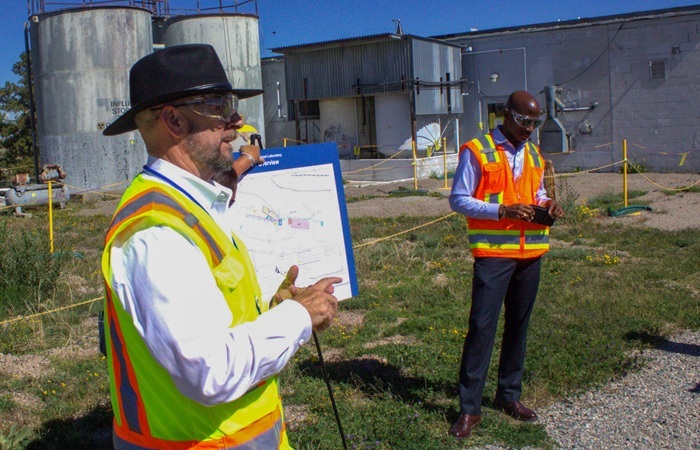 Brad Smith, left, president and general manager for legacy cleanup contractor Newport News Nuclear BWXT-Los Alamos LLC (N3B), talks with tour attendees about the Resource Conservation and Recovery Act corrective action process the Environmental Management Los Alamos Field Office and N3B follow under a consent order between the U.S. Department of Energy and the New Mexico Environment Department. Building 21-257, pictured in background right, is the former Radiological Liquid Waste Facility at Technical Area 21, which will be removed as part of the legacy cleanup.
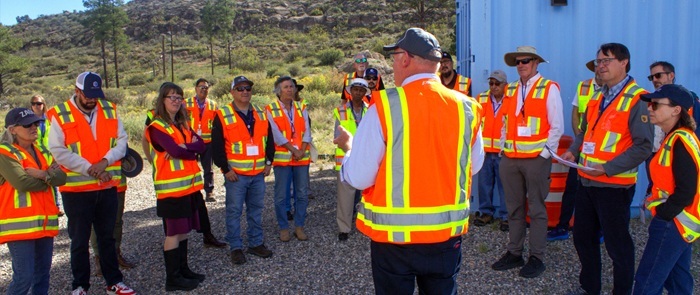 Philo Shelton, center, manager for Los Alamos County Department of Public Utilities, addresses the tour group during a visit to Mortandad Canyon to see the interim measures for the hexavalent chromium plume at Los Alamos National Laboratory.
TA-21 is a former Manhattan Project and Cold War era complex of 125 buildings that housed plutonium processing facilities and groundbreaking energy, environment and weapons research. Currently, EM-LA and N3B conduct soil, groundwater and vapor sampling and monitoring to protect the public and environment.
In November 2025, the New Mexico Environment Department (NMED) directed EM-LA to immediately cease all injection operations associated with the chromium interim measures, which necessitated shutdown of the measures. EM-LA continues to engage with NMED, Los Alamos County, the New Mexico Office of the State Engineer and Pueblo de San Ildefonso to collaborate on a path forward for the interim measures.
Decades ago, workers at a nonnuclear power plant at LANL periodically flushed chromium-contaminated water from the plant’s cooling towers into Sandia Canyon. At the time, potassium dichromate, with active ingredient hexavalent chromium, was commonly used as a corrosion inhibitor. It has not been used at LANL since the 1970s.
-Contributor: Stephanie Gallagher
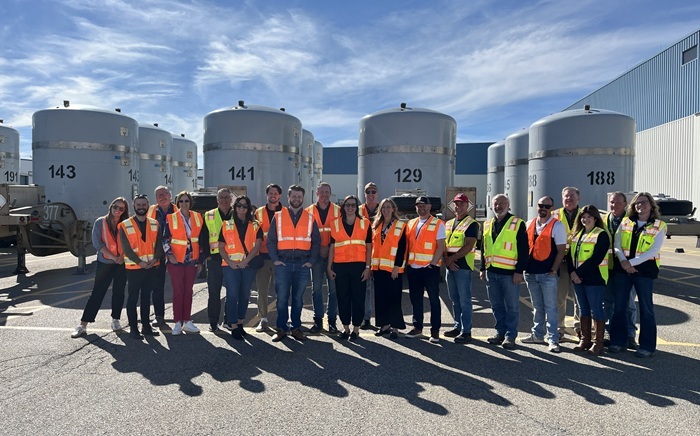 Community leaders from eastern Idaho stand in front of transuranic waste shipping packages at the Radioactive Waste Management Complex at the Idaho National Laboratory Site, where crews package, certify and ship transuranic waste to the Waste Isolation Pilot Plant in New Mexico for permanent disposal.
IDAHO FALLS, Idaho — State legislators recently joined local and regional public officials from eastern Idaho for an Idaho Cleanup Project (ICP) tour, where they learned how the cleanup ensures protection of people and the environment while meeting commitments in the 1995 Idaho Settlement Agreement.
The officials saw firsthand how crews have reduced risk to the underlying Snake River Plain Aquifer by exhuming targeted buried legacy waste from a Cold War-era landfill. Crews are packaging, certifying and shipping this waste to the Waste Isolation Pilot Plant in New Mexico for permanent disposal.
The group also visited the Idaho Nuclear Technology and Engineering Center, where workers demonstrated how used nuclear fuel from historic fuel recycling efforts is safely held in indoor and outdoor storage areas. In recent years, crews achieved a milestone under the agreement with the state by transferring used nuclear fuel from wet storage to safer dry storage to prepare for its final disposition when an offsite repository becomes available. Completing such milestones supports critical research at the Idaho National Laboratory Site.
“Tours like this give us the opportunity to demonstrate firsthand the success of cleanup activities in Idaho and show how the Energy Department has been a good steward of its responsibilities,” ICP Manager Nick Balsmeier said. “We appreciate the community’s continued support as we move this important work forward.”
-Contributor: Carter Harrison
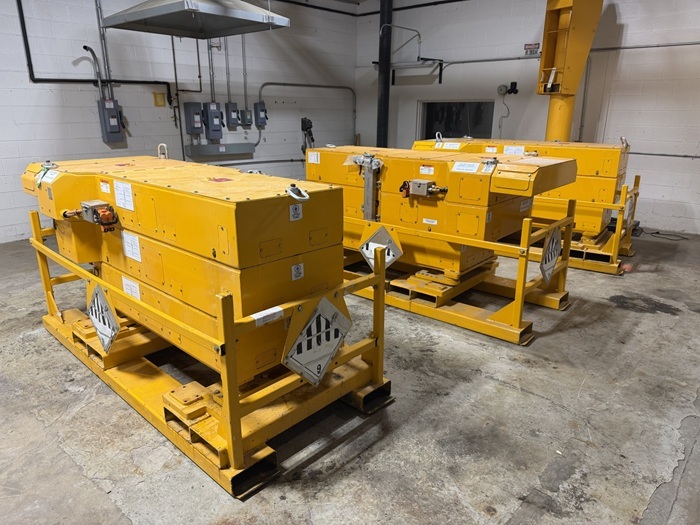 The large lithium-ion batteries transferred from the Waste Isolation Pilot Plant in New Mexico are shown in storage at the National Institute of Occupational Safety and Health Pittsburgh Mine Research Division in Bethel, Pennsylvania, for future testing.
DOE and National Institute for Occupational Safety and Heath collaborate to advance battery safety research
CARLSBAD, N.M. — Through an interagency agreement, the U.S. Department of Energy’s Carlsbad Field Office has transferred three large-platform lithium-ion batteries from its Waste Isolation Pilot Plant (WIPP) in New Mexico to the National Institute of Occupational Safety and Health Pittsburgh Mine Research Division for a first-of-a-kind study to develop real world knowledge of the nature and risks of large-scale battery fires.
Previous research has been limited to testing medium-sized battery packs, with results used to estimate the performance and fire risk of larger batteries. While that research provided valuable information, the true nature of large-scale battery fires remains difficult to predict and understand.
The landmark research is vital to advancing the safety of underground facilities such as mines, tunnels, repositories and research facilities, including those under DOE jurisdiction where heavy-duty battery-electric vehicles are becoming more common. Among them is WIPP, the nation’s only deep geologic repository for the permanent disposal of defense-related transuranic waste.
The research findings could support development of targeted emergency evacuation, response protocols and occupational safety and health related to underground spaces.
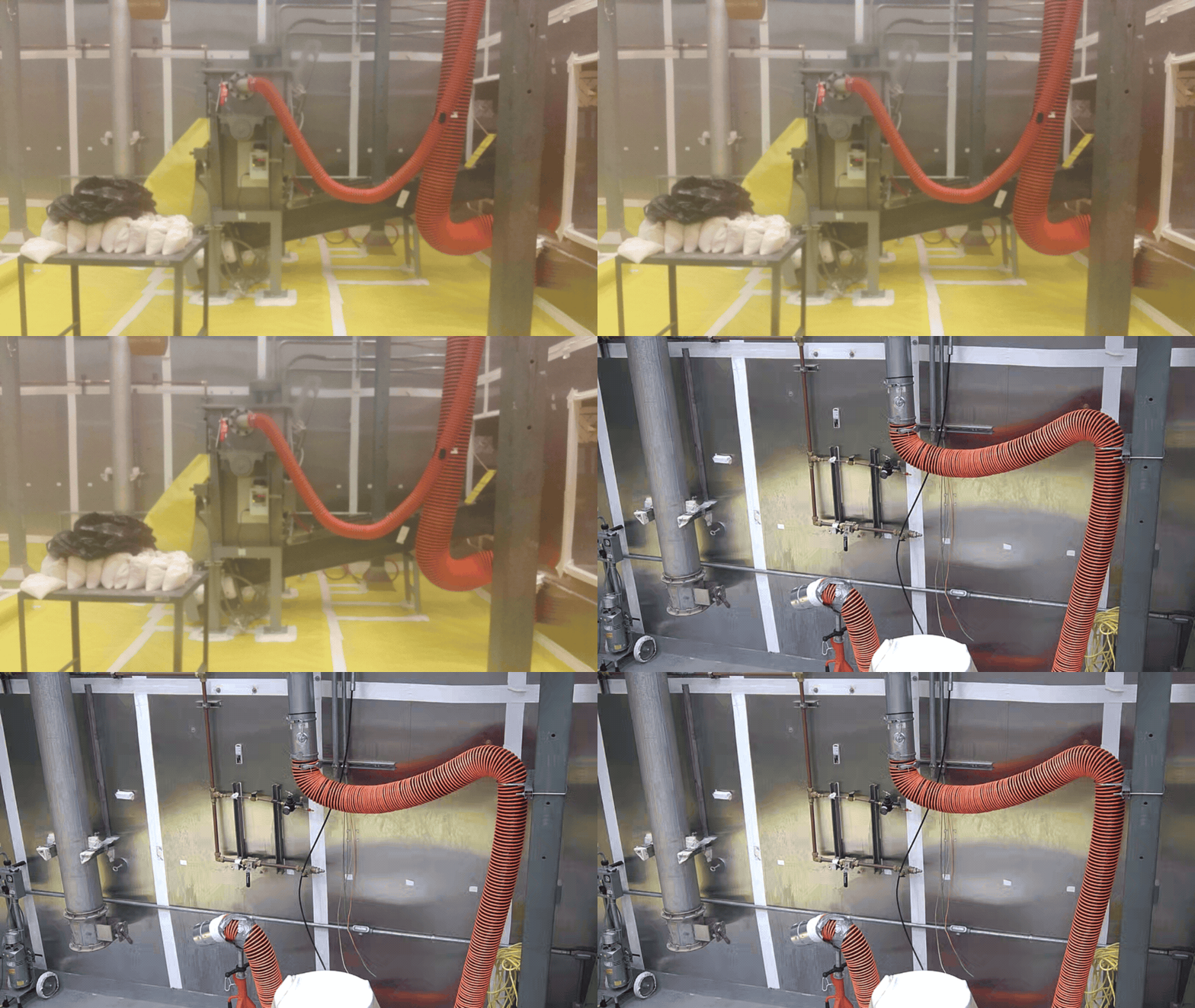 Before and after upgrades: The first frame shows the cask processing enclosure area prior to removal of outdated equipment, including a conveyer, soil mixer and ventilation system. The second frame shows the addition of a ventilation line to support more waste processing activities.
OAK RIDGE, Tenn. — The Oak Ridge Office of Environmental Management (OREM) and contractor United Cleanup Oak Ridge (UCOR) are improving the Transuranic Waste Processing Center (TWPC) to broaden waste processing capabilities.
TWPC is one of only two facilities in the U.S. Department of Energy’s complex capable of processing legacy transuranic waste. Its 38,000-square-foot processing building has four waste treatment areas: contact-handled glovebox, box breakdown area, hot cell and the cask processing enclosure (CPE). Such equipment protects personnel from radiological and chemical hazards when handling hazardous or radioactive materials.
“TWPC has unique capabilities to process and prepare transuranic waste for final offsite disposal,” Federal Project Director Michael Griswold said. “Investing in the site and making the necessary upgrades supports the department’s important mission.”
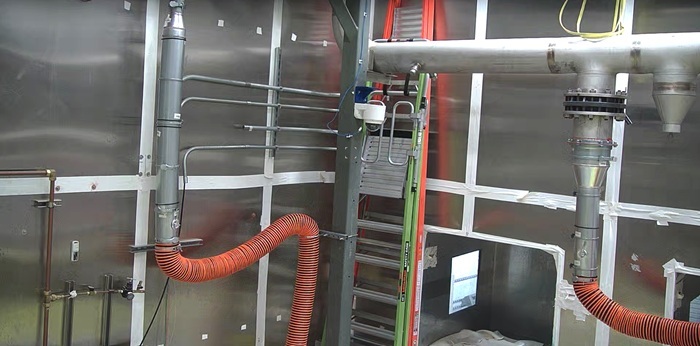 Workers installed new, higher quality cameras and monitoring software.
The CPE was originally designed to process waste from buried casks. After that work was completed, it was redesigned to support treating contaminated soil from remediation of a buried legacy tank at Oak Ridge National Laboratory (ORNL). With that work done, the space is available to support new activities, prompting additional upgrades to the CPE.
The remodeled CPE area allows TWPC to process large waste boxes from deactivation and demolition work at ORNL and the Y-12 National Security Complex.
Earlier this year, UCOR crews began removing outdated equipment and electrical controls from the CPE. Workers modified the ventilation system and installed new cameras, monitoring software and a drum crusher. They previously cut drums with a reciprocating saw, but with the addition of the new machine, they will operate safer and more efficiently.
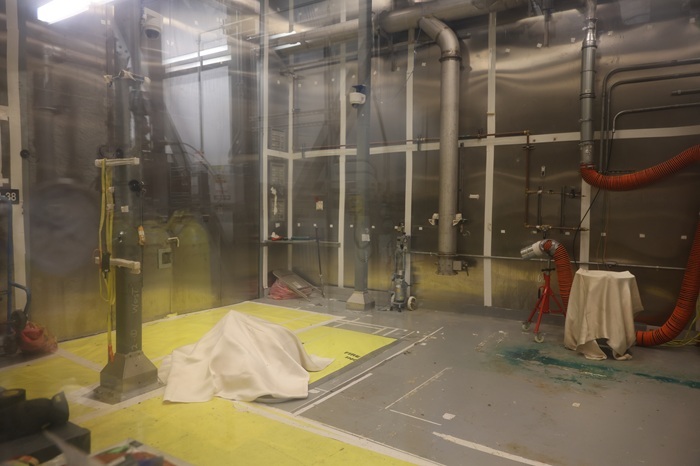 The updated cask processing enclosure area provides space to handle large waste boxes from deactivation and demolition activities.
“We have a relatively small footprint, so repurposing nonfunctional space and providing more tools to our skilled workforce is essential to accelerating legacy waste cleanup on the Oak Ridge Reservation,” TWPC Facility Operations Manager Adam Fraser said.
-Contributor: Ella Stewart
|