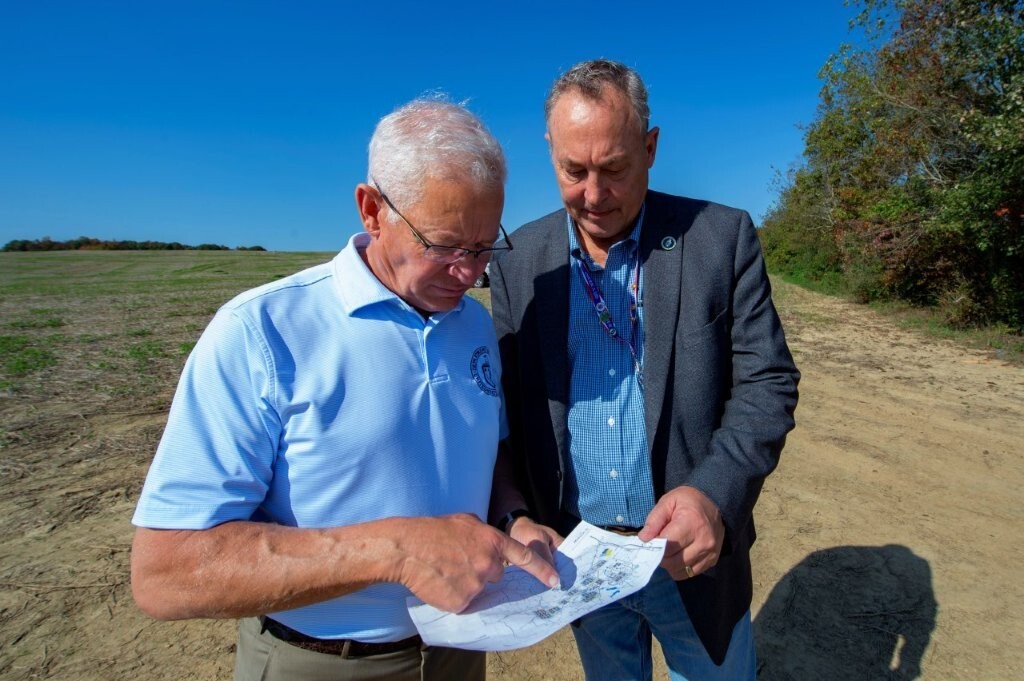
 Assistant Secretary for the Office of Environmental Management Tim Walsh (left) and Principal Deputy Assistant Secretary Joel Bradburne consult a map of energy projects planned for the area surrounding the Portsmouth Site.
PIKETON, Ohio — Leadership from the U.S. Department of Energy’s Office of Environmental Management (EM) recently visited the Portsmouth Site to observe firsthand the accelerating pace of cleanup work actively clearing the path for future reuse and energy development.
Led by Assistant Secretary for Environmental Management Tim Walsh, the visit highlighted how safely addressing Cold War-era legacy facilities serves as the vital foundation for transforming the 3,400-acre site into an energy and industrial hub for southern Ohio. By safely dismantling former uranium enrichment facilities and remediating legacy soil and groundwater, EM is enabling new opportunities for the future.
“We met with building trades and United Steelworkers to talk about how we can continue to accelerate our cleanup mission here to make space for new economic opportunities built and operated by American union labor,” Walsh said. “More than $33 billion of investment is coming to this site to create the Portsmouth American Energy Hub. Both the local community and the building trades are excited about what is coming here and the tremendous possibilities for the future.”
 |
|
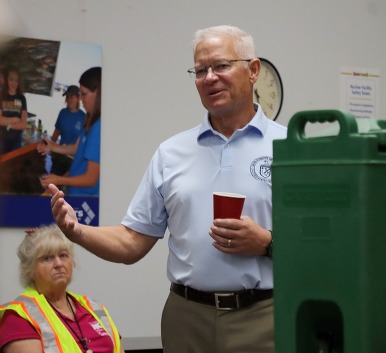
Assistant Secretary for the Office of Environmental Management Tim Walsh speaks with union members at the Portsmouth Site. |
A central highlight of the multi-day itinerary was direct engagement with the local workforce and community. Leadership met with frontline personnel, craft workers and union representatives to discuss project milestones, operational safety and the future transition of the site as new life changing jobs are created.
“A cleanup of this scale only works when the community, the trades and leadership are on the same page,” Tri-State Building and Construction Trades Portsmouth Site Representative Jody Crabtree said. “We put in the work early to listen to our community's concerns and show that this site had a future. Seeing new energy and industrial projects taking root today proves that when you earn that local trust, big things can happen for our families and our region.”
During the Portsmouth visit, EM leadership also toured the Centrus Energy Corp. American Centrifuge Plant, emphasizing that reviving U.S.-owned, domestic uranium enrichment preserves the region’s deep-rooted nuclear expertise while creating enduring, high-paying technical careers for the southern Ohio workforce.
“Our workforce has generations of hands-on experience, and Centrus is showing that companies want that talent here,” United Steelworkers Local 689 President Andria Tipton said. “It keeps good, high-paying jobs right here at home for our families as the site transitions from cleanup to new energy projects.”
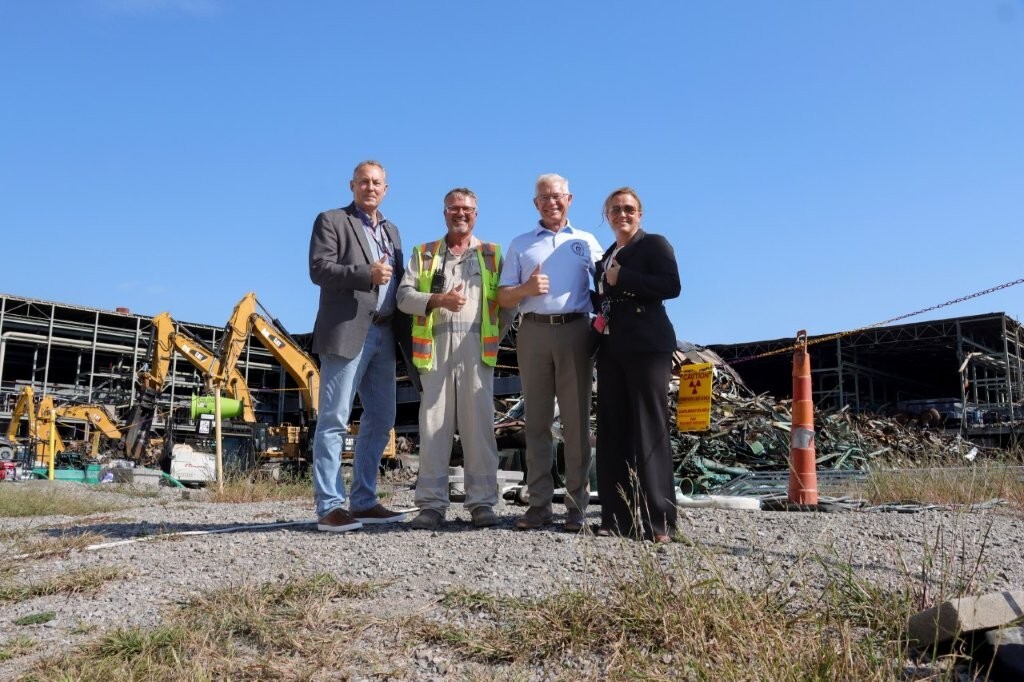 From left, Principal Deputy Assistant Secretary Joel Bradburne, Southern Ohio Cleanup Company Demolition and Operations Manager Bob Chancy, Assistant Secretary Tim Walsh and Acting Portsmouth Site Lead Christy Brown give a thumbs up to the progress on the demolition of the X-333 Process Building.
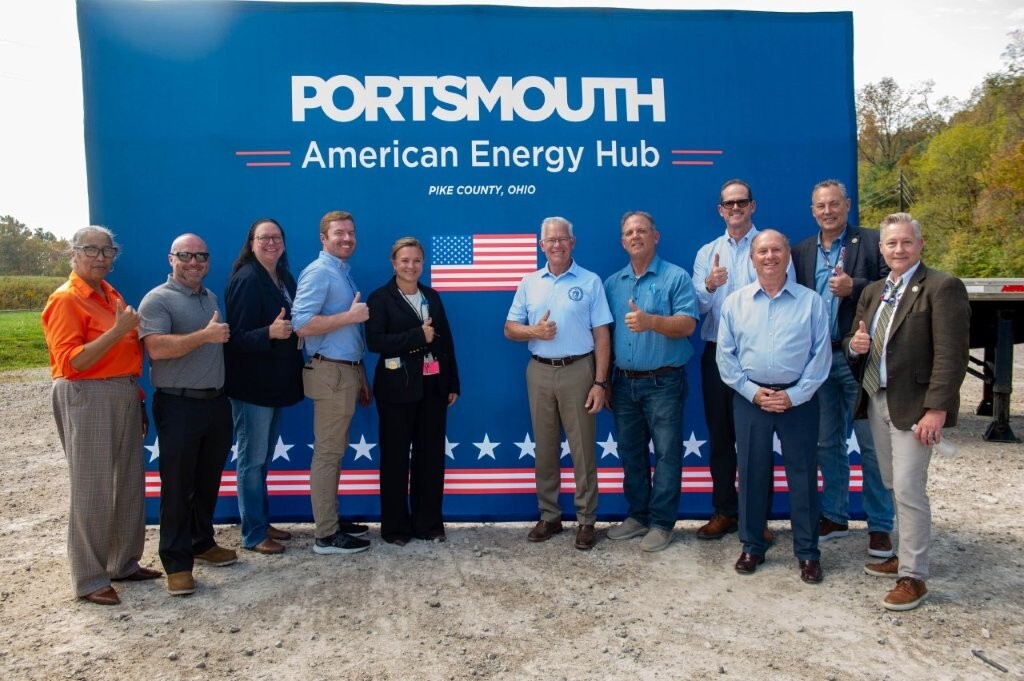 EM leadership, along with local leaders, address the local press about the progress of Portsmouth Site cleanup paving the way for reuse of the site for an American Energy Hub.
EM leadership expanded their regional outreach with several key stops across the area, including the Portsmouth Paducah Project Office in Lexington, Kentucky, the Office of Legacy Management Fernald Preserve in southwestern Ohio, and the EM Consolidated Business Center headquarters in Cincinnati, Ohio.
The comprehensive tour underscored EM’s ongoing commitment to executing high-hazard cleanup missions safely while maintaining strong alignment with local communities, workforce partners and stakeholders across the region.
-Contributor: Melissa Green
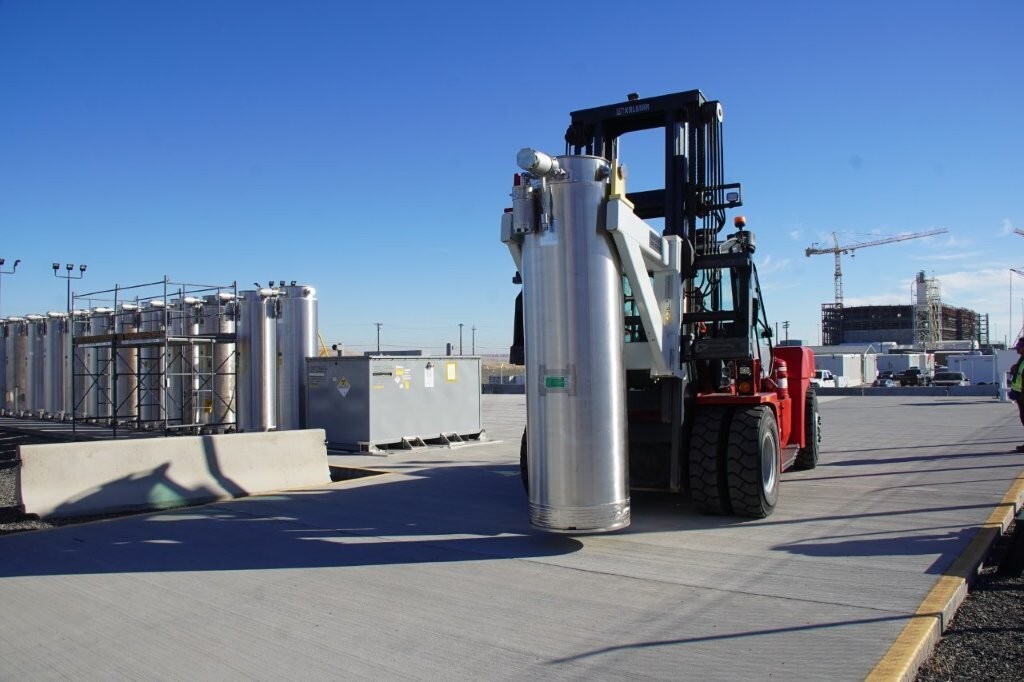 Workers move a used ion exchange column from the Hanford Site’s Tank-Side Cesium Removal System to a storage pad. The columns are replaced after they become full during waste pretreatment operations.
RICHLAND, Wash. — The Hanford Site’s tank-side pretreatment system set a new record, processing more than 222,000 gallons of radioactive tank waste in September during its latest run — the largest batch processed since the Tank-Side Cesium Removal (TSCR) System began operating in 2022.
The system removes 99.9% of the radioactivity from the waste before it is stored in Tank AP-106. From there it is sent to the Waste Treatment and Immobilization Plant (WTP), where it is mixed with glass-forming materials and heated to 2,100 degrees Fahrenheit. This process, called vitrification, transforms the waste into a stable glass form for safe disposal.
“This record-setting run reflects the skill, persistence and professionalism of the TSCR team,” said Mat Irwin, assistant manager for tank waste operations. “Crews worked through challenges, stayed focused on safety and kept this important cleanup mission moving forward.”
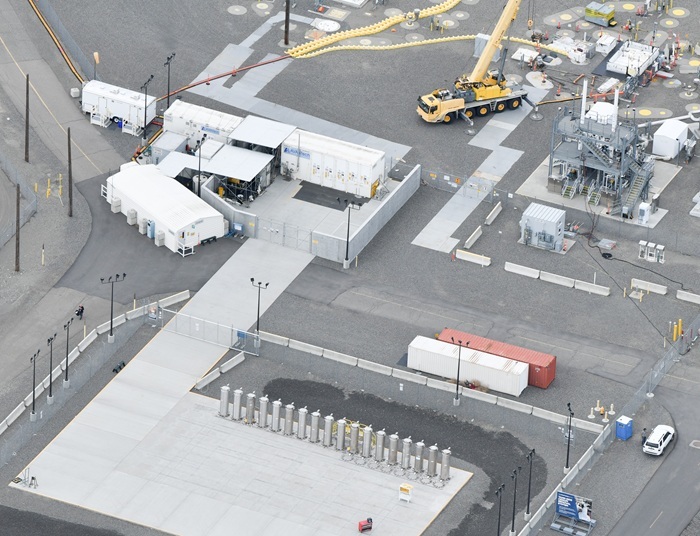 An aerial view shows the Hanford Site’s Tank-Side Cesium Removal System and the ion exchange column storage pad outside AP Farm in the 200 East Area.
After TSCR processing ended, crews with contractor Hanford Tank Waste Operations & Closure (H2C) moved to a planned maintenance outage. Workers removed the full ion exchange columns used to remove cesium from the waste, installed new ones, completed leak checks and finished the turnaround in about two weeks, preparing the system for the next processing run.
“This was a demanding run, but our Operations, Maintenance and Engineering teams kept working through the issues and safely delivered the largest amount of pretreated waste TSCR has processed in one batch so far,” said Ken Langdon, H2C president and program manager. “They also completed the outage on schedule and positioned the system to run again as soon as space is available.”
TSCR is now ready to restart, but operations must wait until the WTP takes enough pretreated waste from AP-106 to create room for more.
The delay underscores why Hanford is advancing the U.S. Department of Energy Office of Environmental Management’s dual glass-plus-grout strategy for appropriate waste streams. Workers are retrieving and pretreating waste faster than it can be immobilized through vitrification alone. The strategy pairs vitrification and grout as complementary waste treatment pathways, providing opportunities to accelerate tank waste cleanup and supporting continued progress in cleaning up the legacy of Hanford’s Manhattan Project and Cold War era defense programs.
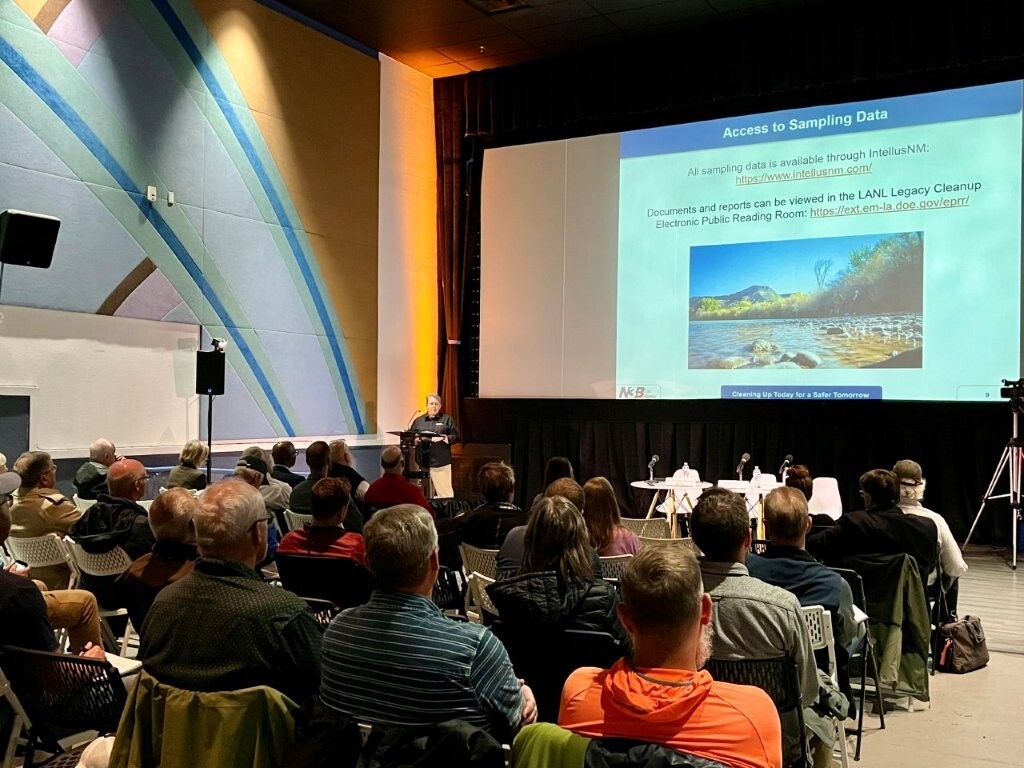 Participants at the Environmental Management Cleanup Forum listen to a presentation on the sampling and monitoring program for the legacy cleanup at Los Alamos National Laboratory.
LOS ALAMOS, N.M. — As part of its regular engagement with stakeholders, the U.S. Department of Energy’s Environmental Management Los Alamos Field Office (EM-LA) recently hosted a public Environmental Management Cleanup Forum (EMCF). EM-LA conducted the EMCF with legacy cleanup contractor Newport News Nuclear BWXT-Los Alamos LLC (N3B) to inform community members, local elected officials and New Mexico congressional staff on the legacy cleanup at Los Alamos National Laboratory (LANL).
EM-LA Acting Manager Stanley Pyram provided an update on cleanup priorities, emphasizing collaboration between EM-LA, N3B, state regulators, stakeholders and pueblos.
Pyram highlighted a standout year for legacy transuranic waste shipments to the Waste Isolation Pilot Plant (WIPP), noting a significant increase over the previous year.
“We dramatically increased waste shipments to WIPP,” Pyram said, highlighting 89 shipments completed in fiscal year 2026 – a 107% increase over 43 shipments in fiscal year 2025. Pyram also emphasized that N3B’s “excellent safety record in getting the mission done” remains a foundation for the program’s success.
Pyram also addressed ongoing work for the Hexavalent Chromium Campaign. In November 2025, the New Mexico Environment Department (NMED) directed EM-LA to immediately cease all injection operations associated with the interim measures (IM), which necessitated IM shutdown. EM-LA and N3B have continued to drill new groundwater monitoring wells, update the conceptual site model and transition to the MODFLOW groundwater modeling software.
“Is the IM a perfect system? No, but it supports us getting to a remediation solution for the hexavalent chromium plume,” Pyram said. Pyram added that the data demonstrates the IM works.
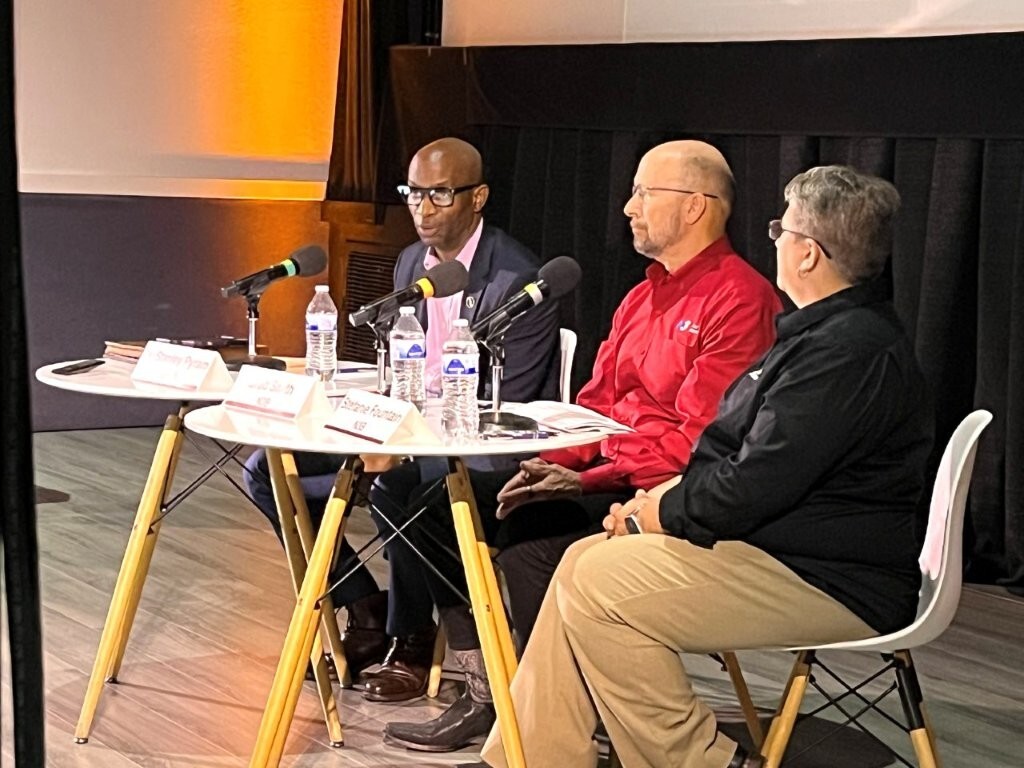 The Environmental Management Los Alamos Field Office (EM-LA) and Newport News Nuclear BWXT-Los Alamos LLC (N3B) respond to questions during public Q&A at the Environmental Management Cleanup Forum. Pictured left to right: EM-LA Acting Manager Stanley Pyram, N3B President and General Manager Brad Smith and N3B Water Program Director Stefanie Fountain.
During the EMCF, N3B Water Program Director Stefanie Fountain discussed how environmental data informs LANL legacy cleanup activities. Fountain’s presentation explained how sampling detects contamination, guides field decisions and verifies that protective actions work.
The N3B sampling and monitoring team collects about 7,000 environmental samples annually, including groundwater, surface water, stormwater, sediment, soil and vapor.
“By collecting and analyzing data, we are able to track contaminant pathways closely and confidently determine whether we should maintain our current approach, adjust our field controls or implement additional corrective actions,” Fountain said.
For example, in Chaquehui Canyon, adding biodegradable logs and rock to stormwater controls helped lower copper and polychlorinated biphenyls (PCB) levels below the regulatory limits. In Ancho Canyon, N3B continues testing additional controls as they monitor and adjust operations.
"The success we are seeing in places like Chaquehui and Ancho Canyons proves this methodology works," Fountain added. "When our monitoring detects a threshold exceedance, it closes the loop by triggering a targeted mitigation effort. We don't stop adjusting our field controls until the data confirms we are meeting our compliance and environmental protection goals."
The EMCF included time for public comment and questions from in-person and virtual participants. A portion of the meeting was dedicated to an interactive session for in-person attendees to speak directly with N3B subject matter experts.
Environmental data is publicly accessible through the Intellus New Mexico database. Reports and deliverables submitted to NMED are available in the LANL Electronic Public Reading Room.
-Contributor: Donavan Mager
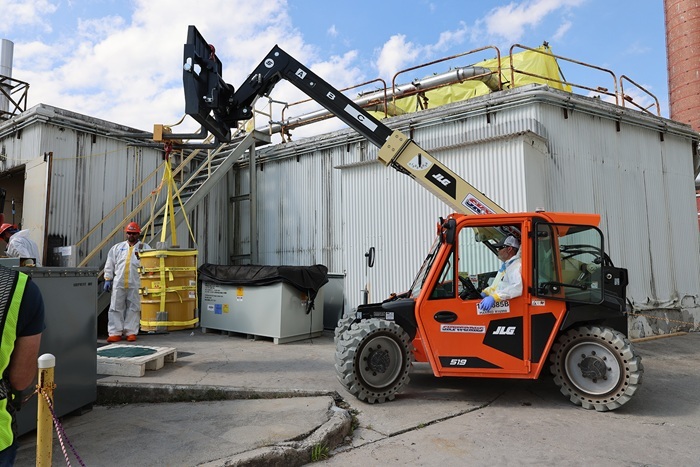 Oak Ridge National Laboratory deactivation and demolition crews push forward to remove the 16th of 18 highly radioactive materials from the legacy Building 3029 hot cells.
OAK RIDGE, Tenn. — Innovative mechanical problem-solving led the U.S. Department of Energy’s Oak Ridge Office of Environmental Management (OREM) and cleanup contractor United Cleanup Oak Ridge (UCOR) to achieve significant cost savings and dodge a monthslong project delay at Oak Ridge National Laboratory (ORNL).
By developing an in-house engineering solution to repair a specialized remote manipulator arm inside the legacy Building 3029 hot cells, crews avoided delay-related expenses while preventing up to six months of project downtime.
Building 3029 previously housed radioisotope production for medical, industrial and national defense applications dating back to the late 1940s. While preparing the 3,406-square-foot facility for demolition, crews discovered highly radioactive sources coming from the building’s hot cells — concrete-shielded rooms that allowed scientists to handle radioactive materials safely.
"Removing these high-dose materials is critical to completing demolition of the facility, and this team found a safe, practical solution that kept that work moving forward," Acting ORNL Portfolio Federal Project Director Michael Griswold said. "Their ingenuity avoided months of potential schedule impacts while continuing to reduce risk at one of ORNL’s most challenging legacy facilities."
 |
|
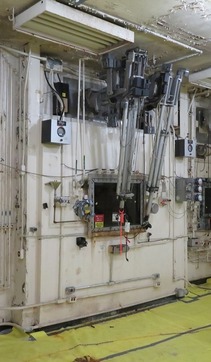
The repaired manipulator arm at Building 3029 is shown after crews used the mechanical drive on the left arm to successfully restore the right arm. |
After extensive characterization and multidisciplined efforts, including using remote radiation-resistant cameras to identify the radiation origin, crews discovered 18 legacy high-dose radiological sources requiring removal from the hot cells before structural teardown could proceed.
Building 3029 is equipped with manipulator arms that allow workers to handle those materials inside its hot cells. Recently during removal operations, the facility's sole functioning right-hand manipulator arm suffered a critical failure when its hand dislodged. With procurement and installation of replacement arms estimated at six months, the demolition timeline faced significant setbacks.
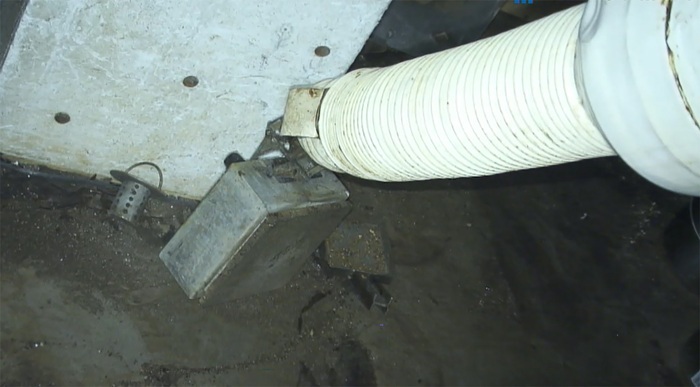 Manipulator arms are remote-controlled equipment that limit exposure inside highly contaminated facilities by grabbing contaminants remotely without crews entering the facility. Here, a manipulator arm grabs a hot plate.
Rather than pausing cleanup, field teams pursued an inventive, resource-efficient workaround. Crews manually re-engaged the mechanical drive of an inactive left-hand manipulator arm and used it to repair the damaged right arm. The innovative approach restored the broken arm without purchasing new hardware.
"This is a prime example of our workforce maximizing taxpayer value by using existing resources and expertise to overcome technical hurdles," UCOR ORNL Area Project Manager Chad York said.
By identifying an alternative to waiting months for replacement equipment, the team continued advancing OREM’s cleanup mission, which will enable ORNL to continue critical science and research missions in the heart of its central campus.
-Contributor: Ryan Getsi
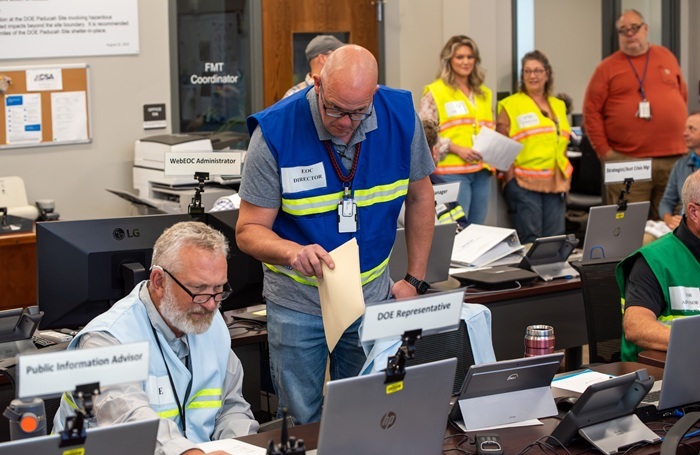 Facility Representative Max Woods, left, and Emergency Operations Center (EOC) Director Robby Purcell track incident data at the Paducah C-105 EOC during a graded emergency management exercise.
PADUCAH, Ky. — Emergency preparedness teams recently participated in an annual graded exercise at the U.S. Department of Energy’s (DOE) Paducah Site but staying ready is something they practice all year long.
“Annual exercises put our preparedness to the test, as challenging scenarios are developed. The exercises test our skills and capabilities, and our emergency response organization answers the call for help every day, night, weekend and holiday,” Portsmouth Paducah Project Office (PPPO) Safety System Oversight Brad Pont said. “Thanks to the dedicated emergency planners and responders for being prepared for the day we all hope never happens.”
Emergency preparedness is based on an approach to all hazards, addressing potential fires, hazardous-material incidents, severe weather, earthquakes and radiological emergencies.
“Emergency preparedness is measured not only by how we respond when something goes wrong, but by the work performed every day to ensure we are ready when it matters most,” Mission Conversion Services Alliance (MCSA) Safeguards and Security Director Shawn Ramage said. “The dedication, professionalism and teamwork of the Paducah Site emergency services organization instill confidence that the site workforce, our DOE customer and our community are protected.”
MCSA is the operations and site mission support contractor for PPPO, and a portion of its scope is emergency services.
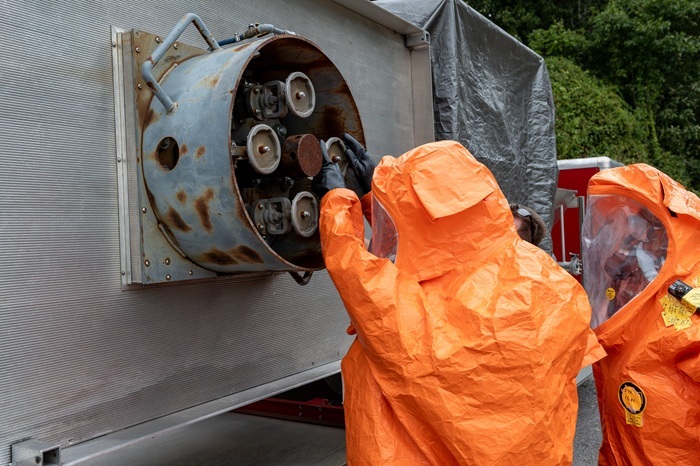 Decontamination specialists respond to a simulated vehicle rollover to secure a leaking tanker valve during a Paducah Site graded emergency management exercise.
Each operating shift at the Paducah Site includes a fire commander, eight firefighter/emergency medical technicians, a paramedic, plant shift superintendent and shift coordinator. They maintain Kentucky certifications and specialized training in hazardous-material response, technical rescue, incident command and emergency medical care.
The plant shift superintendent monitors site alarms and dispatches emergency resources from the Central Control Facility. There, the shift coordinator manages emergency communications, dispatches the emergency response organization as directed, requests mutual aid or other offsite assistance when needed and makes emergency announcements over the site’s public address system.
The site also maintains agreements with local and regional agencies, including fire, emergency management, law enforcement, ground and air ambulance and hospital partners. The agreements provide additional resources in the unlikely event an incident requires offsite assistance.
An onsite medical facility provides support and is staffed by a nurse practitioner, physician’s assistant and/or medical physician and two registered nurses.
Keeping track of the weather is also part of emergency preparedness. Severe weather preparedness includes monitoring an onsite weather station and lightning detection system. When such weather is expected, the plant shift superintendent and site emergency management participate in briefings with the National Weather Service in Paducah and recommend potential site closures or delayed worker arrivals.
“Emergency preparedness is a continuous practice, not a one-time effort,” MCSA Emergency Management Director Wes Hodges said. “Preparedness is both a mindset and a set of actions that we as DOE site contractors take to heart to protect lives, property and the environment.”
-Contributor: Katherine Mueller-White
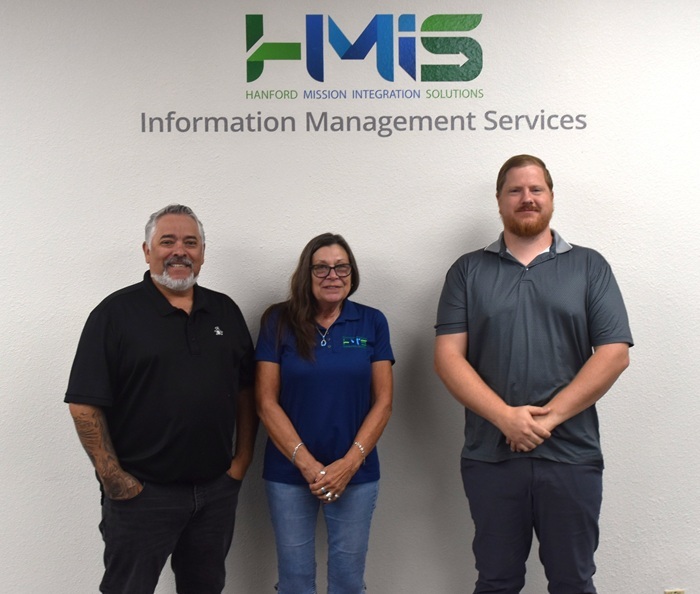 The Major Incident Management process starts with notifications to the Hanford Site Mission Service Desk. From left: Hanford Mission Integration Solutions (HMIS) Help Desk and End User Services Manager Cesar Gutierrez, and HMIS Field Work Supervisors Karen Ward and Ricky Rada-Burns. Their teams play a key role in supporting incident response and service restoration.
RICHLAND, Wash. — With nearly 13,000 employees across the Hanford Site relying on a functioning information technology (IT) infrastructure, quick response time to a system outage is critical to the cleanup mission.
To strengthen response times and coordination, Hanford Field Office essential services contractor Hanford Mission Integration Solutions (HMIS) developed the Major Incident Management (MIM) initiative, a structured approach for responding to high-impact IT service disruptions.
HMIS implemented the MIM model earlier this year, and early pilot rollouts have already shown meaningful positive outcomes, demonstrating the model’s effectiveness in real world use.
MIM is designed for incidents affecting more than five users, an entire building, a network or another critical system or application. Instead of teams working independently, MIM creates a centralized response model that brings the right teams together early in the process to assess the issue, coordinate communications and restore service as efficiently as possible.
“Strong mission support depends on strong teamwork,” said Mike Eddy, Hanford Field Office IT specialist. “This initiative shows how coordinated response and clear communication can make a meaningful difference when critical systems are affected.”
Before a MIM is initiated, Hanford’s Mission Service Desk and the Network Operations Center (NOC) work together to confirm the issue and assess its potential impact. Through this joint validation, the teams determine whether the situation meets major incident criteria. If it does, it’s elevated to the NOC, where the MIM process is activated. The NOC then coordinates with the support teams and updates leadership as restoration efforts continue.
“This initiative is about more than incident response — it’s about creating a shared structure for communication, decision-making and restoration during the moments that matter most,” said Cesar Gutierrez, HMIS help desk and end user services manager. “Thanks to this process, we can cut response times down significantly, sometimes from days to hours.”
|